Showing posts with label 1948 London Olympics. Show all posts

42. Marked for Gold: ALBERT VON EINSIEDEL: Olympic Marksman, Asian Games Medalist

One of the top marksmen of the country from the late 1930s to the 1950s was the sharp-shooting ALBERT  VON EINSIEDEL who had the distinction of competing for the Philippines in  shooting sports at both the world Olympics and the continental Asian Games.

 Born on 14 May 1917 to German Albert H. von Einsiedel and Filipina Lucia Salamanca, the young Albert developed an early interest in shooting, which he mastered as a student of the University of the Philippines. In 1936, U.P. shooting standout, Martin Gison, became the first and lone representative of the country in shooting at the 1936 Berlin Olympics, where he nearly medalled, placing 4th in the small-bore rifle event.

 This spurred more Physical Education students to sign up for the school’s shooting program. So, while  Einsiedel was learning folk dancing steps, he was also becoming adept in both rifle and pistol shooting where he trained religiously at the U.P. range,  until he became a deadeye in both disciplines.

After 1936,  Einsiedel showed that he, too, was capable of becoming a world-class shooter.  The U.P. Shooting Team then held regular competitions against members of the National Rifle and Pistol Association of the Philippines, which counts ace shooters from the military, as well as sports hunters and shooting hobbysts. In one such meet on 31 Oct. 1937, Einsidiel placed 4th among the state shooters in the Rifle .22 caliber, helping U.P. win over the N.R,P.A, shooters. In the Pistol .22 caliber, he placed 3rd , resulting in a tie with the more seasoned N.R.P.A. team.

 The next year, on the 27th of February, the versatile all-around U.P. athlete earned a pistol championship title, by winning the Philippine Exposition .22 caliber pistol championship, sponsored by the N.R.P.A. held at the Pureza shooting grounds, with a score of 493 x 600. Highly-regarded Felix Cortes shot a score of 484 x 600 to garner second place, nosing out Ramon Villamor, who took third with 483 x 600. The course fired was 60 shots at 80 meters on the 50 meter target.

 But as every country, including the Philippine Commonwealth, was gearing up for the 1940 Olympics, the war intervened, cancelling not only the games scheduled in Japan, but also the 1944 edition in London. When the war ended, there was a slow return to normalcy, as rebuilding began. The government resumed its operations, the economy was restarted,  and schools reopened. Sports training went back into full swing and our nation’s athletes began to look forward to competing at the 1948 London Olympics.

The 1948 National Shooting Championships, held in February and March, were the first to be held since the outbreak of the war, and served as try-outs for the Olympics. Ten individual matches were held to determine the members of the shooting team. Einsiedel had already installed himself as one of the favorites of the meet, and he lived up to expectations.

 In the first event, Einsiedel had no trouble in beating a large field of free pistol experts by scoring a creditable 521 out of a possible 600 points. In Event no. 2, Einsiedel snuck into the winners’ circle, placing third in the 3-Position small-bore rifle with a score of 508, behind winner Higinio Pacaña, and ahead of 4th placer Gison. Next, he landed 5th in the small bore rifle 60 Shots Prone at 50 m., and 7th in the 45 cal. National Match Course. In the Center Fire National Match Course, he placed 5th, but came back in the next 2 events placing 1st in both the Olympic Free Rifle (3 positions) and the Navy Cup Match -20 Shots Military offhand.

Only 3 shooters would end up being part of the Philippine Olympic shooting team: Martin Gison ( 25 m. pistol, 50 m. pistol); Cesar Jayme (50 m. rifle), and Albert von Einsiedel (50 m. pistol, 50 m. rifle). Einsiedel was chosen to captain the lean, but mean shooting team in London.

In the Free Pistol, 50 metres event, Einsiedel ended up in 26th place among 50 shooters, trailing Martin Gison who was ranked 25th. The two were the highest placed Asians, with the Lebanese entry, Khalil Hilmi, in last place. The winners were  Edwin Vasquez (Gold, Peru),  Rudolf Snyder (Silver, Switzerland) and Torsten Ullman (Bronze, Sweden).            

 Einsiedel fared better in the Small-Bore Rifle, Prone, 50 m., placing 22nd ,with a score of 591, among 71 athletes. His teammate Cesar Jayme also did very well, landing among the top 20 finishers, in 17th place with 593 points. Gison could only pace 43rd, with 585 points. Americans went 1-2 with Arthur Edwin Cook and Walter Tomsen winning Gold and Silver with identical 599 points, new world records.  Jonas Jonsson of Sweden won the Bronze with 597 score.

After the Olympics Einsiedel finished his university schooling and became a Physical Education instructor at the American School (the future International School) in Manila. He was still active in shooting until that time, and when Manila was chosen as the site of the 2nd Asian Games in May 1954, an issue arose as to the amateur status of active athletes employed as teachers. As it turned out, it was clarified that teachers were not considered pros at all. The ruling was announced rather late, leaving  Einsiedel only 4 months to train for the Asian Games.

 His first event was the Free Pistol, where he lost by a whisker to  Japanese Choji Hosaka, settling for the Silver Medal. But it was a different story in the 50 m. Rifle Prone, which he topped—followed by team mates Cesar Jayme and Martin Gison for an all-Filipino sweep of the shooting event. The Philippines amassed 4 Golds, 4 Silvers and 4 Bronzes from the Manila Asiad, the best-performing country in shooting sports.

Albert von Einsiedel was married to the former Luz Alabastro with whom he had 2 sons, Nathaniel and Albert Jr., He passed away in August 1999 at age 82.

SOURCES:

Maj. Carlos Quirino, 1948 National Shooting Championships, The Filipino Athlete, Vol. IX, No. 3, may 1948, p. 8-12.

 “Einsiedel Captures Pistol Championship”, The Tribune, 1 Mar. 1938, p. 10

 “U. P. Rifle Shots Win Over N.R.P.A”, The Tribune, 3 Nov. 1937. P. 9

 London 1948 Shooting 50m rifle prone 60 shots men Results, https://www.olympics.com/en/olympic-games/london-1948/results/shooting/50m-rifle-prone-60-shots-men

 London 1948 Shooting 50m rifle prone 60 shots men Results, https://www.olympics.com/en/olympic-games/london-1948/results/shooting/50m-rifle-prone-60-shots-men

 Shooting at the 1954 Asian Games, https://en.wikipedia.org/wiki/Shooting_at_the_1954_Asian_Games

 The Marksman, August 1939 issue, https://repository.mainlib.upd.edu.ph/omekas/files/original/28d401e3ff35f8f38f8315c0ae88c4a722ca0e4a.pdf

 Albert von Einsiedel, geni.com

39. Swimmer RENÉ AMABUYOK, 1948 Olympian, Asian Games Medalist, Swim Coach

One of the country’s finest post-war swimmers to emerge from the far South was RENÉ  TALITI AMABUYOK, born 10 July 1923, of Japanese-Filipino lineage, in Zamboanga City, Zamboanga. At the age of 10, he took up swimming, and became so proficient that he progressed to competitive swimming in his high school years at Zamboanga High School.

After his graduation, the young Rene moved to Manila and enrolled at Mapua Institute in 1939 to take up Physical Education. There, he honed his swimming skills as a member of the Mapua Swimming Team, helping win championship trophies for his school in many inter-collegiate meets.

When the Japanese-led global war reached the Pacific in 1941, Rene dropped out of Mapua and transferred to the National College of Physical Education (N.C.P.E.), a school founded in 1932 by the Philippine Amateur Athletic Federation (P.A.A.F.). There, he secured his certificate in Physical Education.

During all these years, Rene and his family kept a low profile being partly Japanese. When the defeat of Japan became imminent, the family Filipinized their surname of Koyubama, reversing the spelling to ‘Amabuyok’, to avert any possible ill feelings towards their Japanese link, even if they considered themselves as true and loyal Filipinos.

Sure enough, when the war came to a close and a sense normalcy began to settle in the country as re-building began in earnest, Rene Koyubama, now known as Rene Amabuyok, resumed his swimming career determined to represent the Philippines and raise its flag abroad. By this time, he was turning in incredible times in national meets, especially in the breaststroke, backstroke and the new butterfly events.

Though Amabuyok never dreamed he would someday be a great swimmer, his qualification to the lean 26-man Philippine Olympic team gave him an opportunity to prove his worth and stretch his potential. Amabuyok was just one of 3 swimmers sent to compete in London held at the end of July in 1948. UST’s Jacinto Cayco and Letran’s Sambiao Basanung completed the swim team.

Amabuyok was entered in only one event—the 200 meter breaststroke the same event at the 1928 Olympics where Teofilo Yldefonso made history by claiming Bronze, the 1st Filipino Olympic medalist. To get to the finals, he had to hurdle the First Round of Heats that would determine the Semifinalists.

The First Round consisted of 5 Heats; the first 2 finishers of each heat—plus the 6 fastest losers get to advance to the Semifinals. Amabuyok swam in Heat 1 and landed 4th with a time of 2: 52.6 minutes. When the Semifinalists’ names were called, Amabuyok was one of them.

The Semifinals Round saw Amabuyok grouped again with U.S. Robert Sohl, who had swum with him and who had topped the First Round Heat 1. Amabuyok bettered his time to 2: 51.8 mins,, placing 6th among 8 swimmers.

In the Semifinals, the first 3 fastest, plus the 2 fastest losers will fight it out for the Finals. When all the times of the 2 semifinal heat swimmers were tallied, Amabuyok found himself in 11th place, and was thus eliminated. Still, his 11th place finish among 32 swimmers was a creditable accomplishment.  In the end, the 200 m. breaststroke finals became an all-American finish, with Joseph Verdure (1st), Keith Carter (2nd) and Robert Sohl (3rd) as winners,

London would be his first and last Olympics. His next competition was at the Manila-Hongkong Interport Meet of 1949 which the Philippines topped. Then the inaugural 1st  Asian Games opened in New Delhi, India in 1951. There, Amabuyok was entered in his favorite 200 m. breaststroke event and won a Silver Medal in 2:54.8 minutes behind his team mate Jacinto Cayco, who won Gold in 2:54.4, a new games record.  

In his sterling swimming career, Amabuyok also mastered the new butterfly stroke, which only became an independent event beginning in 1956 at the Melbourne Olympics. He held the 100 m. butterfly record (1:14.8 mins.)  for 7 years (1950-1956), until his student, , teen sensation Freddie Elizalde broke it at a 1956 High School Boys swim league with a time of 1:12.6 mins.

After his retirement, Amabuyok became a coach of the Indians Swim Teams of the American School in Manila, handling both the girls and boys varsity teams. He led the teams to several significant wins in meets like those mounted by the Manila Athletic Association for Secondary Schools.

At the 1958 National Intersecondary School Meet, the American School, paced by the aforementioned Freddie Elizalde, captured the Boys Division  championship title to put an end to FEU’s domination of the tournament.

In inter-department school presentation, Coach Amabuyok, with his fine singing voice (he moonlit as a professional singer), would join the swimming team in musical productions. Off-season would find him either swimming at the Rizal Memorial pool or taking care of his wife and 7 children, 5 girls and 2 boys. It is interesting to note that one of her daughters, Arene Cecilia “Pinky” Anas Amabuyok became the Philippine beauty delegate to the 1968 Miss World Contest in London. She placed 5th , the first time a Filipino reached the finals of the oldest beauty pageant in the world.

Asked about the pronouncement of her daughter’s supposed wish to become a nun—news that generated buzz around the world—coach Amabuyok said he knew nothing about his daughter becoming a nun. “She’s just like any other girl,” he said.

Amabuyok remained as a much-loved coach of the American School—now known as International School based in Makati—until his retirement. From the 70s onwards, there has been no news, nor any details of his passing—but swimmer, coach and Olympian Rene Amabuyok will always be known as a multi-faceted athlete whose love for mentoring young swimmers knows no bounds.

 SOURCES:

1948 London Olympics Official Report, LA84 Digital Library, https://digital.la84.org/digital/collection/p17103coll8/id/5717/

Rene Amabuyok, Olympedia

Photo Credits: Pinky A. Santos FB Page : (Coach Amabuyok, with Indian Swim Team of American School/ Amabuyok with Trophy)/ Rodante Sacdalan FB Page: (Rep Men’s Swimming Team 1st Asian Games, New Delhi, India/ American School articles: “R. Amabuyok, Swim Coach”; “Swimming Season Starts”/ Nostalgia Manila, “ Amabuyok,Baker Rizal Swim Meet 1952”

31. Ageless Shooting Star: MARTIN M. GISON, The Only 5-Time Filipino Olympian


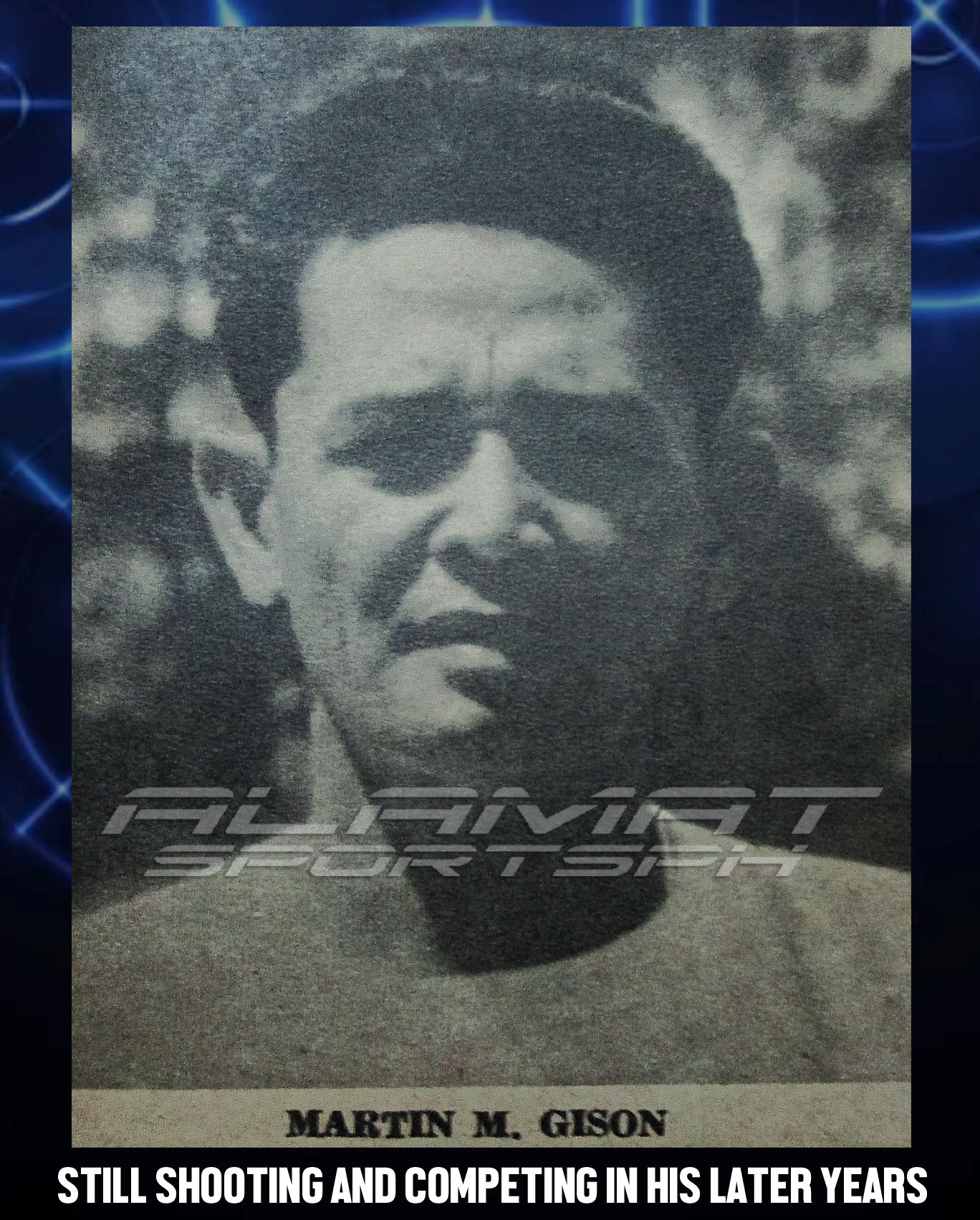
One of our greatest shooting sports legends was the marksman MARTIN MAURICIO GISON. (b.14 March 1914) who had a long, sterling shooting career that began in his college days at the University of the Philippines, to 5 Olympic stagings and 3 Asian Games editions.

Growing up in his home province in Iloilo, the young Martin loved playing with his “tirador”, aiming and slinging his shot at any target he could find-- a fruit hanging from a tree, an empty can, or even pesky, stray animals. He earned a reputation as a sure shot, foreshadowing his future as a world-class shooter.

As a University of the Philippines R.O.T.C. cadet in the mid 1930s, Gison  joined the U.P. Shooting Team, and quickly built a reputation as an elite marksman in rifle and pistol events. The team was often fielded in inter-ROTC Rifle competitions and in events organized by the National Rifle and Pistol Association  of the Philippines under Judge Delfin Jaranilla.

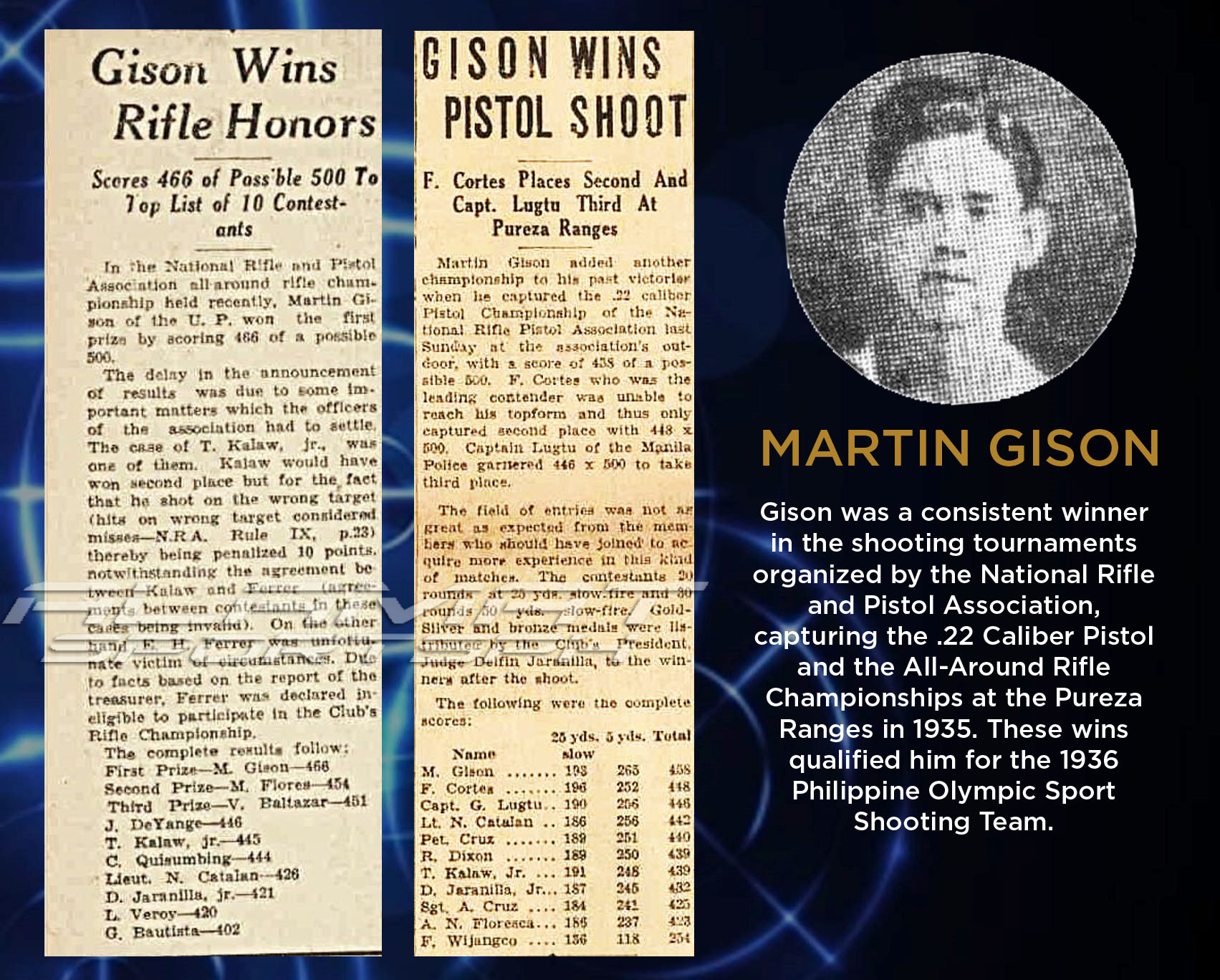
In June 1935 alone, he won 2 titles, claiming the All-Around Rifle Championship in the first week of the month, by scoring 466 out of 500. Three weeks later, on June 23, Gison added another outdoor championship title in the .22 Pistol category (20 rounds at 25 yards slow-fire and 25 rounds 50 yards slow-fire), with a score of 458 out of 500, edging favorites Felix Cortes and Capt. G. Lugtu.

These victories paved the way for Gison’s inclusion in the 1936 Philippine Olympic Team that went to Berlin in August. Against the world’s sharpest marksmen, he started strong in 5-way tie for 2nd place  in the Small-bore .22 Rimfire Rifle, Prone event. After the countback that decided the winner, he dropped to 4th , edged for the Bronze by the Polish Wladislaw Karas, who had an identical score of 297. Still, it was the closest podium finish ever by a Filipino shooter. However, Gison was not able to hold his form in the target pistol and revolver events, where he was also entered. 

His U.P. team mate, Otoniel Gonzaga, failed to advance in his events. Nevertheless, the Olympics proved to be an enriching experience to the young sport shooter and his modest accomplishment, so close to winning a medal in Berlin,  was reported in major newspapers back home.

At the 1937 U.P. Athletic Commencement and Physical Education Day, the U.P. varsity athlete and Olympian received his major letters for his rifle and pistol achievements, along with his certificate and sweater, at the Rizal Tennis Stadium.

In 1938, Gison became the coach of the Colegio de San Juan de Letran Shooting Team. He was also selected by the P.A.A.F affiliated National Rifle and Pistol Association to be one of the country’s representatives to an international shooting tilt in July 3, against Saigon sharpshooters from the Federation Cochinchinois de Tir et Preparation Militaire.

Gison joined the USAFFE (Unites States Armed Forces in the Far East) and was stationed in Camp Murphy (later Camp Aguinaldo). One of his last tournaments before the war was the 1940 Philippine Army-Philippine Constabulary Meet at the Pureza ranges of N.R.P.A. using .45 caliber service pistols or revolvers, which his team won.

At the height of the war, Lt.  Gison was among those captured in 1942 by the Japanese imperial forces. He survived the infamous Bataan Death March, and on 25 Dec. 1942, he, along with 238 former USAFFE servicemen, took their oath of loyalty before the Director General to support the New Philippines under the Japanese empire. When the country was liberated, Gison started anew by going back to sport shooting.

In 1948, he qualified for the much-delayed Olympics in London that were supposed to have been hosted by Japan in 1940.  He came in 25th in the Free Pistol, 50 m.; 40th in the Rapid-Fire Pistol, 25 m. , and 43rd in his pet event, the Small-Bore Rifle, Prone, 50 m. 

 Gison had mixed results at the 1952 Helsinki Olympics, improving his standing to 32nd place in the Free Pistol, 50m., but skidded down to 36th place in the Rapid-Fire Pistol, 25 m.. He placed a creditable 13th in the Small-Bore Rifle, Prone, 50 m.

The 1950s saw Gison at his peak, as in-between Olympics, he participated in the Asian Games that were first instituted in India in 1951. At the 2nd Asian Games in Manila held in 1954, he bagged a complete set of medals of every color:  Gold for the Rapid Fire Pistol, 25m.; a pair of Silvers for the Free Rifle, 3 positions, 300 m., and the Free Rifle, 3 positions, 50 m.. and Bronze for the Rapid-Fire Pistol, 25 m.

The Melbourne Olympics followed in 1956, where Gison qualified in 2 events. He placed 13th in a new event, Free Rifle, 3 Positions, 300 m., and 22nd in the Rapid-Fire Pistol, 25 m. Two years after, the 3rd Asian Games in Tokyo saw him winning a Bronze in the Rifle, Prone, 50 m.

Defying age, Gison, at 50 years old, qualified for his 5th Olympics at the 1964 Tokyo Games, along with 8 other Filipino marksmen. In his swan song, he finished in 48th place in the Small-Bore, 3 Positions, 50 m.

 Martin Mauricio Guison may not have medalled in his shooting events but he holds an extraordinary record that has never been matched—for making the most number of appearances at the Olympics—5 times—from 1936 to 1964, spanning 28 years. No other Filipino athlete has ever come close to this feat, a lesson on achieving greatness, through perseverance, endurance, and the will to win.

SOURCES:

The Tribune, various issues: 5 June, 25 June, 5 Sep. (1935), 27 April, 11 Aug. (1936); 27 Feb.(1937); 19 July (1938); 20 Jul. (1940); 25 Dec. (1942).

Photo of M. Gison with Letran Shooting Team, Colegio de Letran College Yearbook, 1938

Main Photo: Olympedia

Records, Martin Gison, Wikipedia.com


13. World and Olympic Weightlifting Record Setter: RODRIGO DEL ROSARIO

RODRIGO DEL ROSARIO  (b. 11 Jun. 1917) was a 3-time Olympian from Cabangan, Zambales. Standing only 5’4”, he never won an Olympic medal but he broke Olympic and world records in his long career.

Physical culture and weightlifting were already established sports by the mid 1930s, and interest peaked when menfolk were required to do military training as a looming war approached. Del Rosario discovered weightlifting in Manila, and he came under the training of the Ben Gallegos Club which had a gym in Sta. Mesa, Manila. The Club also held regular weightlifting tournaments and fielded qualified members to the National Weightlifting Championships. It was in these championships that Del Rosario began making his mark.

At the nationals held in Cebu on 21 Mar. 1948, Del Rosario, competing in the featherweight division, managed a total of 712. 2 lbs. in 3 lifts. He also made a lift of 236.2 lbs. in the military press. These broke the world records established by American lifter Bob Higgins at the Philadelphia Championship in Sep. 1947, where he lifted 231.5 lbs. in military press, and a 3-lift total of 638.5 lbs.

His peak was at the 1952 Helsinki Olympics, he came closest to winning a weightlifting medal when 110 lbs. Del Rosario placed fourth in his featherweight division. He pressed 105 lbs . in the (231 ¼ ) lbs. which was declared an Olympic Mark, surpassing the previous record of Jafar Salmasi of Iran . This also equaled that year’s world mark. His combined lifts, adding his 92.5 kilos in the snatch (203 ¾ lbs.), and 120 kilos in the jerk (264 ½ lbs), totaled 317.5 kilos  (699 ½ lbs), trailing the Bronze medalist R. Wilkes of Trinidad, by just 5 pounds.

Del Rosario may have lost the Bronze by a whisker, but the record he set for the press lift remains the first and only Olympic record set by a Filipino, which caught the attention of international lifters. He reset this world record in the press lift to 108.75 kg. (or  239.75 lbs.) at the 1954 Asiad in Manila. The record, though, lasted just for 6 days, surpassed thrice by international lifters.

Like all carry-over athletes from the thirties, he continued to join competitions past his peak, finishing second in his class in the 1955 National Champioships. Del Rosario has always found the 2-hand snatch an enigma and he was unable to lift over 200 pounds, that thwarted his 1955 title hopes.

Pushing 40, Del Rosario made it to his 3rd Olympics in Melbourne in 1956, along with fellow lifter Pedro Landero. He failed to lift his clean and jerk portion, so he was not ranked for his incomplete lifts.

Del Rosario became a trainer of young weightlifters and coached the 1968 Philippine Weightlifting Team to the Mexico Olympics.  His last competition was in the World Weightlifting Championships  in Columbus, Ohio in 1970. By dint of good luck, he was awarded 1st place in the flyweight division after the Top 3 lifters were disqualified for drug use.

After his competitive years were over, Del Rosario took on a job as a security officer at the Rizal Memorial Stadium, where retired athletes would congregate at the P.A.A.F. office. He continued mentoring young weightlifters including his nephew Salvador del Rosario who would win a world title, paving the way for a stint at the Olympics in 1968 and 1976. His son Arturo, followed suit, becoming an Olympian in 1972 and 1976.

Rodrigo del Rosario, our finest Olympic strongman, died on 10 October 2009, at the venerable age of 92.

SOURCES:

Olympedia, https://www.olympedia.org/athletes/56487

Progress 1955, Report on Postwar Sports

Abesamis, M. E. 13 Oct. 1968, The Sunday Times Magazine, “All the Weights for Gold” 13 Oct. 1968. p. 30

1952 Official Olympic Report, LA 1984 Digital Collection

Alex R. Castro, FilipiKnow. 13 Sports Legends Who Proved Filipinos Are Kickass Athletes, https://filipiknow.net/legendary-filipino-athletes-in-sports-history/

62. Hurdler Supreme of the 1950s: FRANCISCA SAÑOPAL

The best and most successful Filipina hurdler of the 50s decade , was without a doubt, the Ilongga all-around athlete FRANCISCA SAÑOPAL . ...