Showing posts with label Philippines. Show all posts

30. STAN CARBUNGCO: Our Mr. Philippines Who Rocked the Universe!

It’s not just our Philippine queens who are ruling pageants, this Pinoy muscleman made waves in a world bodybuilding tilt!

The icon of Philippine bodybuilding, Estanislao “Stan” Carbungco was born on 13 Nov. 1931, the youngest of 7 children to Don Ambrosio Ocampo Carbungco with roots in Porac, and Doña Angelina Cuenco. His father, a former chef of Casino Español for 8 years, was a successful restaurateur, founder of the popular Carbungco Restaurant, a renown catering and dining place in pre-war Manila, with a branch in Antipolo.

Though the young Stan Carbungco was raised in a comfortable household, he learned from his father the value of hard work, who had no qualms washing dishes and doing menial jobs in his own restaurant.

He spent his school years at the Far Eastern University, where he finished high school. He would later finish his Commerce degree at the same university.

Sickly growing up, Stan Carbungco was plagued with all sorts of illnesses like typhoid and pneumonia. At age 20, the weakling weighed only 89 pounds. He began doing weight training in a gym that his neighbor owned. Carbungco became so good at it that he was soon immersing himself deeply in physical culture. His parents did not exactly approve of his interest in bodybuilding, which was not a common sport at that time.

The only visible musclemen in the 50s was Jesus Ramos, Mr. Philippines of 1951, who became a certified star after appearing in a series of jungle movies, and dubbed as the Philippine Tarzan. His contemporary, Arlen Quindoy Aguilar. did good as well, using bodybuilding as a stepping stone to showbiz. The former Mr. Luzon assumed the screen name Cesar Ramirez and starred in the big budget 1951 film, “Bernardo Carpio” opposite Alicia Vergel, who would become his wife. Then there was Olympian Rodrigo del Rosario, who, en route to  placing fourth in the 1952 Helsinki Olympics,  set a world and Olympic record in the military press portion of his event.

Hoping to join competitions, Carbungco continued to train in secret. In 1954, he qualified for the Mr. Philippines bodybuilding contest, and to his surprise, won his first of second Mr. Philippine titles. He would duplicate that achievement by winning the Mr. Philippines title yet again in 1959, pipping Manuel Hernandez in the finals with the slimmest of margins—225 to 224 points. 1959 would prove to be his most successful year.


It was an exciting time for a 28 year old to fly to Montreal, Canada as the first ever country representative to the 1959 Mr. Universe bodybuilding contest. This premiere event was organized by the International Federation of Body Building and Fitness. He travelled alone to Canada braving the winter cold, without a retinue to assist him, but that did not seem to faze him. He not only made bodybuilding friends from around the world—but also history for Asian sports.

At the exciting finals held on 25 January 1959, Carbungco placed 1st as the Most Muscular in the Medium class division, and earned runner-up honors to Mr. Universe Medium class. In the overall class, the unheralded athlete was named second Most Muscular after Eddie Silvestre of the U.S., who went on to become Mr. Universe. With his placement, Carbungco became the first Filipino and only Asian to break into the winning circle, a feat unprecedented at that time.

From Montreal, the Filipino muscleman went to New York where event sponsor Getz Bros., distributor of Borden Milk, feted all the winners at the Waldorf Astoria. Upon his return, Carbungco made a major shift by concentrating on weightlifting rather than bodybuilding.

It was an opportune time as the 1960 Rome Olympics were coming up, and he was hoping to follow the footsteps of the prodigious Rodrigo del Rosario who, 8 years before, pressed 231 ¼ lbs. , a new Olympic Mark in his featherweight division. He began powerlifting, and at one point, he was lifting weights that would have been good for Olympic bronze or silver.

Indeed, Carbungco was being touted as a sure Olympic bet and medalist in weightlifting, but his Olympic dreams were dashed when, after appearing in a print ad for boat motors, he lost his amateur status for being paid as an endorser.

Carbungco was sadly frustrated over this disqualification, but never looked back. Instead, he stepped up his efforts to promote the sports of bodybuilding like never before.  After his competitive days were over,  he put up a weight and fitness center, ‘Stan Carbungco’s  Gym”, in Quezon City where he personally trained and mentored many young physical culturists.  

To meet the growing needs for gym equipment, Carbungco pioneered the local manufacture of weight-training equipment and gear in the Philippines.  The well-patronized gym had a loyal following, and the hallowed institution for bodybuilding has been in operation for over 50 years now.

All his life, Carbungco devoted his time and effort to the fitness sport he loved. For many years he headed the Philippine Federation of Body Builders, an official affiliate of IFBB which fields Filipino bodybuilders to various competitions abroad. He co-founded the Powerlifting Association of the Philippines (PAP) in 1982. He never forgot the sports that made him famous too. At the remarkable age of 60, he could still snatch a 110 pound barbell with relative ease.

Fifty years after his victory in Canada, he would return to his place of victory where some of his children were settled. There, he would try to locate his fellow bodybuilders whom he competed against, way back in 1959. He was saddened to find that all have gone before him, leaving him as the lone survivor from that golden age of competitive bodybuilding.

The legendary bodybuilder, “Mang  Stan” as he was fondly called in his later years, passed away at age 81 on 10 March 2012. He left behind his wife, Edna Oquendo-Carbungco and their children, and a legacy of health and fitness that he passionately pursued, and which continue to inspire Philippine sports to this day.


SOURCES: 

Sibug, Edgardo. “PORAC: A Rancheria at Batiauwan 1594-2004”, © 2003. p. 280

FB Interview with Mr. Tiny Carbungco, son of Stan Carbungco

Tiny Carbungco FB Page

Jeffrey dePadua Panela

Lolo Stan Carbungco Tribute: https://www.youtube.com/watch?v=Ef9a9q9g3f4

Uploaded by Grace Carbungco, published April 3, 2012.

Stan Carbungco tribute: https://www.youtube.com/watch?v=n7hqbaut5UI

Uploaded by Beng Gonzales, published 22 March 20102, accessed 2 Nov, 2018.

https://en.wikipedia.org/wiki/Bodybuilding_in_the_Philippines

http://www.philippinewatchclub.org/forum/viewtopic.php?f=39&t=13717

Iron Pinoy : https://issuu.com/ironpinoy/docs/ipmag2011may-june/29

https://issuu.com/ironpinoy/docs/ipmag2011may-june/29

https://www.ironpinoy.com/a-short-history-of-philippine-powerlifting/

19.Boxer FRISCO CONCEPCION, The Man Who Beat Pancho Villa

Pancho Villa was our first boxing world champion, and he would remain the only Filipino to hold a world title (achieved in 1923,  flyweight class), until 1960. But not many people know that Villa’s record was marred by one defeat—in the hands of fellow Filipino, FRISCO CONCEPCION (b. 21 Aug. 1901/d. ?), one-time flyweight champion of the Orient.

Born in San Felipe, Zambales to Lorenzo Concepcion and Enana Labrador, Frisco was a 16 year-old farm boy when American businessman Ed Gallaher took him under his wings and trained him in boxing, Before long, Frisco developed a knock-out punch that floored established boxers like Kid Jamito, Joe Suzara (from whom he wrested the Oriental flyweight crown in a 20-round fight)  and Pete Sarmiento, who went on to fight in the U.S.

In April 1921, the 20 year-old Frisco squared off with Pancho Villa in an 8-round contest in Olongapo, Zambales. Villa was then the reigning flyweight champion of Manila. Pancho’s manager, Paquito Villa, was against the fight as he felt there were more worthy contenders for his ward. Pancho Villa went on to fight Frisco without his manager’s knowledge, where he received a trouncing that he would rather forget.

Starting with Round 1, Frisco went for the attack immediately which took Pancho by surprise. The slugging continued in Round 2 , but Frisco’s effective counter-punching caused Pancho to miss his shots. Pancho recovered his bearing in Round 3, as he focused running his blows on Frisco’s body which visibly hurt him. In Round 4, Pancho shifted his assault on Frisco’s face, and managed to duck and avoid Frisco’s counter attacks. Pancho was relentless in Round 5, but Frisco fought back with sure counter-punches that threw his opponent off-balance.

It was the same story for Round 6:  lagging on points, Pancho unleashed blows on Frisco, who neutralized these with more effective counterpunches. The desperate Pancho tried to go for the kill with a knockout punch but his face and body was met with heavy punches from Frisco. The referee stepped in between the fighters to remind them of the last round.

The fighters shook hands and began Round 8 with Pancho attacking with body blows that were returned with head blows by Frisco. Pancho shifted his style to imitate Frisco, but by then it, was too late as the latter pummeled him with rapid jabs and punches to the face. When the bell sounded, it was clear who the winner was—Frisco Concepcion, with a score of 6 rounds to 2.

An eyewitness to that match was Gregorio Torres, a boxing trainer who observed Frisco’s fighting style: “Frisco’s punches were rapid and his deliveries were level. He was a terrific and aggressive counterpuncher. Frisco’s target was always the jaw of his opponent”.

Frisco, however, had to take a week’s rest to recover from the heavy body punches that he received from his opponent. As for Villa, he never fought Frisco again.

After Frisco retired from boxing, he became a photographer. His manager, Gallaher, had operated a portrait studio on the side, which influenced Frisco to make a career shift when his fighting days were over. Frisco Concepcion made photography his lifetime career until his retirement; however, without a doubt, his lifetime achievement will always be the day he conquered a world champion.

SOURCE:

“The Conqueror of Pancho Villa”, by Felix M. Caliwag, Sunday Times Magazine, 19 June 1960, pp. 18-19.

14. THE FIRST MR. PHILIPPINES 1926: JOSE MARIA BARREDO

In the 1926 edition of the Manila Carnival, it was announced that aside from the regular search for the Manila Carnival Queen, another beauty will be chosen with the first ever title of “Miss Philippines”. To complement the crowning of the first Miss Philippines won by Anita Noble of Batangas, a contest was  held by Carnival authorities to look for “the most perfect Filipino”, that is, “Mr. Philippines”, via a Physical Development Contest.

“The Most Perfect Filipino”.

An unprecedented number of contestants came forward—all 45 of them, and in the end, a 19-year old engineering student of the University of the Philippines was elected as the 1st Mr. Philippines—JOSE MARIA BARREDO of Manila. Jose’s  muscled and toned body impressed the judges, for he was largely self-taught, learning from physical culture magazines, reading barbell instruction manuals, and engaging in all kinds of sports.

The son of Don Fausto Alonso Barredo of Manila and Carmen Seoane Fargas of Zamboanga, Jose Maria Barredo (b. ca. 1907) was to wealth and privilege born. His father was a successful business magnate who operated Malate Garage and Auto Repair Shop, the largest institution of its kind in the Philippines, and owned a taxi and car rental company that serviced the Manila insular government. It was said that Mr. Barredo owned half of Malate, with his real estate property consisting of 25 buildings in that district alone. These allowed the Barredo siblings, Manuel, Eduardo, Jose Maria and Carmen, to enroll in the country’s best schools.

A Sports Jock Rocks the School!

The young Jose had always loved sports and the great outdoors. His first love was Tennis,  but in La Salle College, he took up football in his intermediate grades. When he transferred to the University High School in 1920, he became a member of the prize-winning basketball team.

At age 17, he started reading about he lives and works of great athletes like the late Eugene Sandow, Liederman and Strongfort. This inspired him to study physical culture, by following the regimen shared by these strong men  and even reading the manuals of the Milo Barbells company.

In 6 months, his bodybuilding yielded great results merely from barbell exercises. He could lift and jerk 120 pounds overhead with one hand and snatch 85 with one hand-- more that the average Filipino can do.

At the University, Barredo developed his all-around athletic prowess even more. In 1921, Barredo became the Junior Singles National Champion in tennis, which he held for 3 straight years. He joined UP’s Unit One swimming squad that emerged as intramural champions.  While there, he dabbled in wrestling and boxing. He also joined the football, basketball, and the university’s gymnastic team, these, while pursuing bodybuilding—which had become his more regular interest.

In his case, Barredo avers that he finds it more healthful to exercise early in the morning before breakfast. Except when he has burnt the midnight oil on account of a quiz the following morning, he exercised every day.

Beefcakes at the Carnival

Known to friends as a bashful young man not given to boasting, it was a surprise that Barredo agreed to participate in the Physical Development Contest at the 1926 Manila Carnival. The physique contest required him to show off his well-sculpted body, along with other muscled beefcakes from every part of the archipelago. In the final judging, it was Barredo who stood out and named Mr. Philippines, and the tale of the tape told it all.

Tipping the scales at 140 pounds, Barredo was all muscles—from his pecs and chest that could expand out to a girth of 41 ½ inches, biceps of almost 15 inches, rock-hard abdominals, 22 inch thighs, a waist of just 27 ½ inches, all packed in his 5’5 ½ feet frame.

It also helped that Barredo, with his mestizo features, was an audience favorite. Within the last few days of his proclamation as “Mr. Philippines”, he received hundreds of congratulatory letters, many coming from young ladies, known and unknown to the “famous strong man”. Although not altogether displeased, Barredo said “he was not that strong for that kind of stuff”. But he added:  “Of course, every great undertaking is inspired by an outside force”.

Beauty and Brawn, Muscle and Music

Barredo earned a Civil Engineering degree from the U.P. and became a contractor. One of his first projects was the Jesuit novitiate in Novaliches. He was also named Assistant Manager of his father’s many enterprises.

At another Carnival edition, he met Isabel delos Reyes, daughter of Isabelo delos Reyes, nationalist, politician, writer, and labor activist. She had been a princess (“dama de honor”) in the court of the 1929 Carnival Queen, Pacita delos Reyes, but resigned her title over the objections of St. Therese's College nuns.   The two would eventually get married on 7 June 1930. They made  their home on Dakota St., in Malate, with their 2 sons.

Barredo forayed into classical music in his mid 20s, drawn to musical theater and the operas. With his fine yet forceful tenor voice, he was cast as the captain of the guards in Giuseppe Verdi’s opus , “Aida”, that was locally staged  in 1933 at the Manila Grand Opera House, and presented by the Manila Chamber Music Society. The opera was a big hit and would be restaged in 1938 with the same cast.

The Manila Musical Guild, of which he was a founding member, often hosted monthly concerts at the Barredo home. Up until the coming of the war, Barredo sang in charity events, radio shows and performed in operas like “Cavalleria Rusticana” (1935) and “Il Trovatore” (1939).

Barredo resided much of his life in Malate and became an active member of the Rotary Club in the 1970s, where he would lead sing-alongs with the the members and the community.  His niece, Carmen Johnson Barredo, popularly known as Baby Barredo, is the co-founder of Repertory Philippines, producer of stage luminaries like Monique Wilson and Lea Salonga.

SOURCES:

Jose P. Bautista, “Introducing Mr. Philippines”, The  Sunday Tribune, 14 Feb. 1926, p. 7

“Malate Garage, Taxicab Company, Keeps Pace with Times” The Tribune, 9 Feb. 1933, p. 9

“Aida” 1933 Playbill and Program, by the Manila Music Chamber Music Society,

Familysearch.org

2. LET THE GAMES BEGIN!

Brief histories of major international sporting competitions with Philippine participation.

·       THE MODERN OLYMPIC GAMES (1896)

Based on the ancient Olympic Games held in Olympia, Greece every 4 years, from at least 776 B.C. until they were banned by Emperor Theodosius in 393 A.D. Inspired by the original, Baron Pierre de Coubertin of France conceived the modern Olympic Games. Thus, the first modern Olympiad unfolded with much success in its original birth country, Greece—the 1896 Athens Olympics. Fourteen nations and 241 athletes (all males) took part in 9 sporting disciplines (Athletics, Cycling, Fencing, Gymnastics, Shooting, Swimming, Tennis, Weightlifting, Wrestling. 

In 1918, the Philippines was accepted by the International Olympic Committee in 1918. But it was only in 1924--the 8th staging of the Games--that the Philippines sent a lone athlete accompanied by his coach. That honor belongs to Bicolano David Nepomuceno, a sprinter who raced in the 100 meter and 200 meter events. The first-ever Filipino to medal at the Olympics was the swimmer Teofilo Yldefonso who took home a Bronze medal at the 1928 games in Amsterdam. Filipino athletes have appeared in every edition of the Summer Olympic Games from 1924 onwards, except for Moscow 1980 when the nation was part of the American-led boycott.

·       THE FAR EASTERN CHAMPIONSHIP GAMES (1913-1938)

Also known as the Far Eastern Olympic Games, Far Eastern Championships, Far Eastern Games, and the Oriental Olympics,  this was the first  Asian multi-sport event considered to be the predecessor of the Asian Games.

In 1913, Elwood Brown, president of the Philippine Amateur Athletic Association, proposed the creation of the "Far Eastern Olympic Games" to China and Japan. The Far Eastern Olympic Assocation (FEOA) was thus formed to organize the  first edition that was held on the Manila Carnival grounds (the future Rizal Memorial Sports Complex) from 1-9 February 1913.  Japan sent 12 delegates, China 40, and the host Philippines a whopping 103 athletes.  Gov. Gen. Wiliam Cameron Forbes welcomed the athletes who contested medals in 5 sports: Athletics, Swimming, Soccer, Basketball, and Volleyball. The Games were a huge success. As the Philippine Free Press reported: "the Far Eastern Olympiad is quite the most significant event that has touched Oriental peoples in united action. They have never met before for united action on any basis other than athletics". Brown reported its success  to Olympic founder Pierre de Coubertin, who approved of the  games but suggested to drop the term "Olympiad"  as it was already in use by the Olympic Games. hence, in 1915, it was called the Far Eastern Championship Games.  The Games would come to include China, Empire of Japan, British East Indies (Malaysia), Thailand and British crown colony Hong Kong.  The Far Eastern Games ran every 2 years from 1913 to 1935, but the 1937 edition slated in Osaka, Japan was cancelled with the brewing second world war.

·       THE ASIAN GAMES (1951)

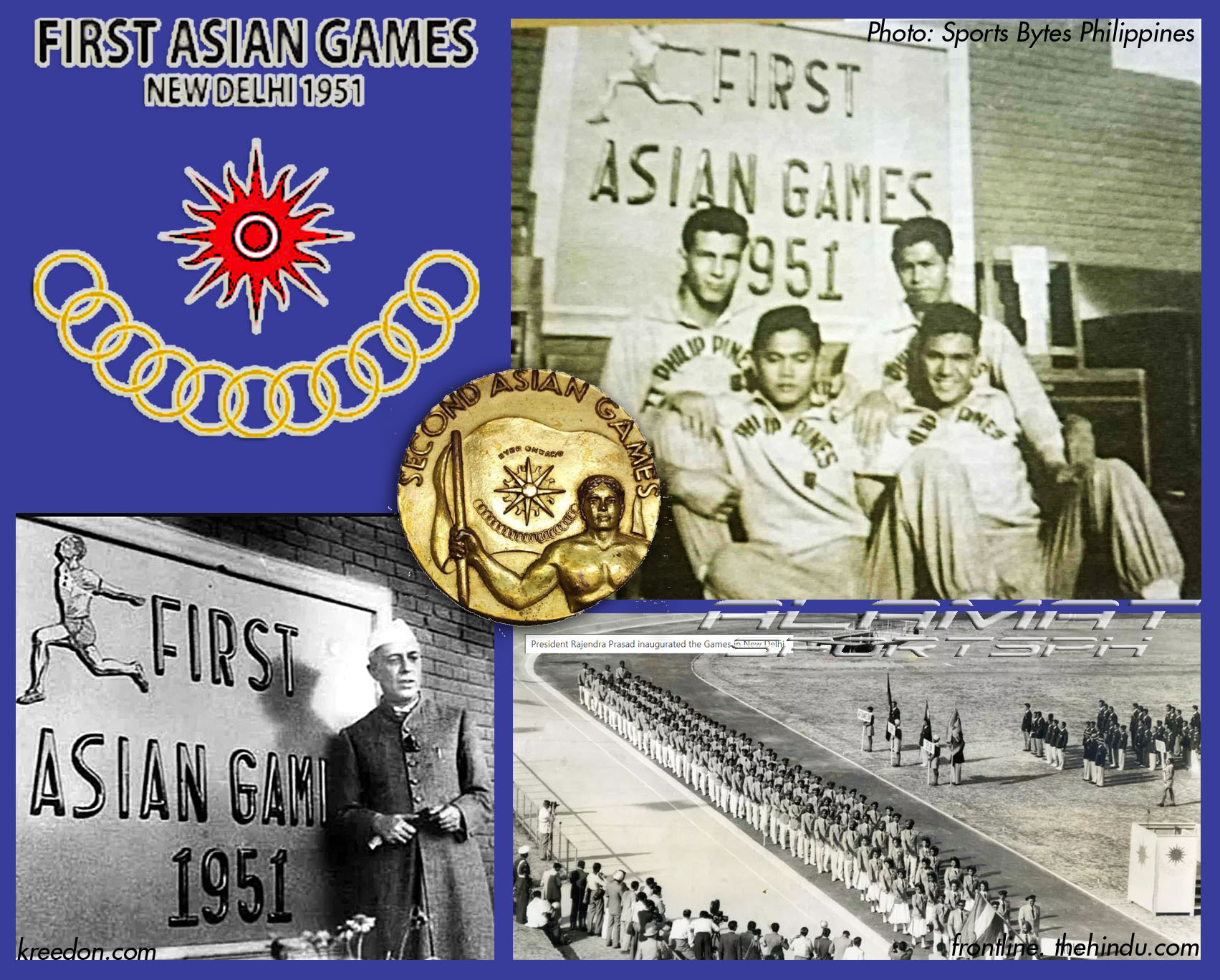
The Asian Games or the Asiad, is considered second-largest multi-sport event in the world after the Olympics. India took the lead in recommending a more inclusive competition to include more than just Far Eastern countries in 1949. The 1st Asian Games were held in New Delhi from 4-11 March 1951. A total of 489 athletes from 11 National Olympic Committees competed in 12 sports. Japan was allowed to compete in the inaugural Asiad, after being banned at the 1948 London Olympics. The Philippines placed a creditable 5th  (5 Golds, 6 Silvers, 8 Bronzes)   in the medal tally, and 3rd in the actual number of medals won.

Since the 1982 Games, the quadrennial events have been organized by the Olympic Council of Asia (OCA). The Games are recognized by the International Olympic Committee (IOC).

·       THE SOUTH EAST ASIAN GAMES (1959)

The SEA Games is a biennial multi-sport event involving participants from the current 11 countries of Southeast Asia. It is one of the five subregional Games of the Olympic Council of Asia (OCA).  First launched as the South East Asian Peninsular Games or SEAP Games (abbreviated as SEAPG), the event was an offshoot of a post-Asian Games in Japan in 1958.

Founding member countries Burma (Myanmar), Cambodia, Laos, Malaya (Malaysia), Thailand and Vietnam, agreed to hold a sports event to promote relations among countries of the region. The 1st SEAP Games was held in Bangkok from 12 to 17 December 1959, with the addition of Singapore. In 1977, the admission of the Philippines, Brunei and Indonesia to the games, prompted a name change to Southeast Asian Games Federation (SEAGF). In its debut appearance at the 1977 games, the Philippines placed 3rd overall, with 31 Golds, 30 Silvers and 30 Bronzes.


INTERNATIONAL SPORTS FEDERATIONS

Today, Olympic sports are represented by their own international sports federations and are an essential part of the Olympic movement. Some of these governing bodies include: World Athletics, FIBA (Fédération Internationale de Basketball) for basketball, FIFA (Fédération Internationale de Football Association) for football and soccer, FIG (Fédération Internationale de Gymnastique) for gymnastics, ISSF (International Shooting Sport Federation) for shooting, ITF (International Tennis Federation), and World Aquatics, for swimming, diving, water polo, artistic swimming.

There are 30 members of the Association of Summer Olympic International Federations which are recognized by the International Olympic Committee. The International Boxing Association (IBA) was dropped from this roster in June 2023 due to managerial, finance, refereeing and ethical issues

These federations mount a series of world cup or world championship tournaments that serve as Olympic qualification events as well. Filipino athletes like gymnast Carlos Yulo, hurdler Eric Cray, pole vaulter Ernest Obiena, swimmer Jessie lacuna, and the Philippine Basketball Team have represented the country in these international championship events.

SOURCES/ CREDITS:

Olympics: https://en.wikipedia.org/wiki/Olympic_Games

David Wallechinsky, “A Brief History of the Modern Olympics”, xxi-xxiii. The Complete Book of the Olympics, Penguin Books, 1988, p.

Far Eastern Games: Frederick O. England, History of the Far Eastern Athletic Association, from the  OFFICIAL BULLETIN of the INTERNATIONAL OLYMPIC COMMITTEE, p. 18.

Asian Games, Wikipedia: https://en.wikipedia.org/wiki/Asian_Games

Southeast Asian Games: https://en.wikipedia.org/wiki/SEA_Games

Logos of international federations, via google.

1. ALL THE WORLD'S A SPORTS STAGE

WELCOME TO PHILIPPINE SPORTS ALL-STARS! This blog recalls the greatest moments in Philippine sports and the glorious athletes of yesteryears, both celebrated and unsung, who animated the sports arenas, here and around the world, with their show of strength, endurance, resilience and national pride.

Ever since the age of organized sports, Filipinos have been competing for God, country and personal glory with varying degrees of success. Before that, the only competitive game known in the country was the noncontact sport of  “sipa”- where a small bamboo ball kicked back and forth between 2 lines of players. Another leisure game popular in rural areas was ‘sabong’ or cockfighting.

It was during the American Regime that sports came into full flower, deeming it essential to keep the people of their new territory physically and morally fit. An American soldier introduced baseball in 1899, gaining such wide popularity—until basketball took over. Taught through the school system, basketball was an instant hit.

Filipinos took to these sports not only for leisure, but also to assert their nationalism, as they competed against their taller, heavier opponents.

By 1913, sports was making rapid advancements in the country. “In no other part of the world has physical education and recreation made such remarkable progress in so brief a time as in the Philippines”. Manila YMCA director Elwood S. Brown observed. The Bureau of Education reported that 400,000 Filipino children are engaged in some form of activity. There were “hundreds of baseball teams, leagues in many kinds of sports, frequent track and field meets, …and an Amateur Athletic Federation that promoted competitive athletics in the community..”

Americans organized athletic meets of all sorts, beginning in schools and in national events like the annual Manila Carnival that began in 1908. The 2-week fair held sports competitions for participating schools and government bureaus, that included disciplines like athletics and swimming events.

There were regular Army Athletic meets known as McKinley Games that had a mix of American and Filipino participants, who competed in separate divisions. The major meet, held at Fort McKinley, included Aquatics (swimming), Track and Field (sprint and long distance running, pole vault),  Ball Games (baseball, basketball), and Boxing. The annual meet that began in the 1920s, is credited with developing athletics in the country.

The performance standards of Filipino athletes leveled up as they began pitting their skills against their counterparts from other countries. From regional athletic meets, they found their way representing the Philippines in the earliest international sports competitions that would of course, come to include the premier and most celebrated sporting events in the world--the Olympics.

SOURCES/ CREDITS:

Elwood S. Brown, Athletics in the Philippines Islands and the Far Eastern Olympic Games

McKinley Games, The Tribune, Sports Page, 19 Dec. 1931.

66. Post-War Belles of the Breaststroke: NORMA GUERRERO & LOLITA RAMIREZ, National Record Holders

The Philippine Women’s University was one of the first schools to have a competition-size pool—the Belen Perez Swimming Pool -- as part of ...