Showing posts with label Olympics. Show all posts

37. THE 1972 PHILIPPINE BASKETBALL TEAM TO THE MUNICH OLYMPICS

At the 20th Olympiad held in Munich, Germany, the Philippine Basketball Team proved that it was still the best in Asia when it placed 13th overall after the controversy-tainted finals between the U.S. and U.S.S.R. The Soviet Union snapped the gold medal streak of U.S.A. when it won by a point (51-50) , relegating the Americans to 2nd place, with Cuba placing 3rd. 

The Philippines team suffered defeats against Poland (90-75), Puerto Rico (92-72), West Germany (93-74), Yugoslavia (117-76), Soviet Union (111-80), and Italy (101-81). Undettered despite overwhelming odds, the Philippines won its games against Senegal (78-71), Egypt (2-0, by default) and perennial foe Japan (82-73).

Members of the 1972 Philippine Olympic Basketball Team.

WILLIAM "Bogs" ADORNADO. (b. 26 May 1951). UST college basketball player. Joined Crispa Redmanizers as rookie, achieving star status at the Manila Industrial and Commercial Athletic Association (MICAA) All-Filipino Tournament. 3-time Philippine Basketball Association Most Valuable Player (1975, 1976, and 1981). Named among the PBA Greatest Players. Inducted in the 2005 PBA Hall of Fame.

NARCISO C. BERNARDO. (b. 27 Jul. 1937 / d. 23 Dec. 2008). Played in the MICAA for Ysmael Steel, Crispa and Mariwasa. Coached the Crispa 400s in the MICAA and later the Crispa Redmanizers in the Philippine Basketball Association, leading the team to the 1984 PBA First All-Filipino Conference championship. Served as councilor in Mandaluyong City, but failed to finish term due to his death.

RICARDO "Joy" CLEOFAS. (b. 9 Feb. 1951). Played college basketball for Ateneo which became NCAA champions in 1969 with team mates Marte Samson, Chito Afable, Jun Ross and Francis Arnaiz. Played for YCO Painters at the MICAA after graduation. Known for his accurate distance shooting and passing. Member of the first Youth team in 1970 that won the first ABC Youth Tournament. Post-Olympics, plated at the 1973 Asian Basketball Confederation and the 1974 World Basketball Confederation in Puerto Rico. Entered the PBA pro league playing for Tanduay.


DANNY Z. FLORENCIO: (b. 5 Sep. 1947/d. 25 Feb. 2018). Nicknamed "Daredevil Danny", original "Skywalker". Played with UST Glowing Goldies (1965–1967). Member, PH Team, which beat South Korea 83-10 for the 1967 ABC Championships won through his last minute 4-points scoring thus earning his 1st Olympic slot in Mexico. Placed 2nd  in 1971 ABC Championships, qualifier to the 1972 Munich Olympics.  Played with YCO Painters and Crispa at the MICAA. Turned pro in PBA with the U/Tex Wranglers, the Toyota Super Corollas, 7-Up, and the Galerie Dominique Artistas (1975-83) . Ranked 11th in the all-time scoring plateau with 5,791 points, 8TH in scoring average, and 13th all-time in steals. Named PBA's Greatest Players (2000).  PBA Hall of fame inductee (2007). Retired and settled in San Francisco, California, until his death from a stroke in 2018.

JAIME "Jimmy" MARIANO. (b. 19 Apr. 1941). Known as “Mr. Cool”, the 6'3 1/2" Malabon native first played for the UE Red Warriors team under Coach Baby Dalupan. Later played in the MICAA for Ysmael Steel, Meralco and Concepcion Industries.  2-Time Olympian: 1968 Mexico, and 1972 Munich where he was the country’s flag bearer. Team captain of the national basketball team in the 1974 FIBA World Cup. Began his coaching career in 1981 as coach of  Presto Tivolis and  Red Bull in the Philippine Basketball League. Led Presto to the 1990 All-Filipino championship. Also had coaching stints with University of the East Red Warriors ( 2 UAAP Championship titles).

ROSALIO "Yoyong" MARTIREZ. (b. 9 Sep.1946/ d. 18 June 2024). “Sultan of Swipe. Originally from Samar, moved to Cebu where he played for Southwestern University before being recruited by the San Miguel Beermen. 2-time PBA champion, Guard of PH Team in  the 1972 Munich Games, a World Basketball Championship player in San Juan, Puerto Rico, and a Gold Medalist in the 1973 ABC and 1970 Asian Youth tournaments. Saw action in MICAA from 1972-1982. In late 70s, forayed into acting, appearing on TV shows like “Iskul Bukol”, “John en Marsha”, “Pepito Manaloto”, among others. Debuted in the 1985 film “Ma'am May We Go Out? With Tito, Vic & Joey. Served as councilor and later vice mayor of Pasig.


ROGELIO "Tembong" MELENCIO. (b. 27 Sep. 27, 1939/ d. 1995).Tondo-born Melencio played for the Yutivo Opels and for Concepcion Industries in the MICAA. PH Team player at the ABC Championships in Seoul (1967)  and Manila (1973) where the Philippines won Gold. This Munich Olympians was also a key member of the Pesta Sukan Basketball Team. Tragically stabbed and killed in a bar room brawl in 1995.

 EDGARDO "Ed" OCAMPO. (b. 5 Oct. 1938/d. 19 Jul. 1992). Captain of the 1972 PH Olympic basketball team. Son of renown architect Fernando H. Ocampo and Lourdes Luciano. Initially played football for Ateneo, his first interest. Played in Korea and Spain as PH national team member and was named “Mr. Football” at age 17 in 1956. After a football injury, joined the Ateneo basketball team, leading to 2 back-to-back wins at the NCAA in 1957-58. Joined the YCO Painters in the MICAA and became part of its championship teams. Member, PH Basketball team (1959-1972). Placed 8th at the 1959 FIBA World Championship;  Member of 3 PH teams that won 3 ABC championships (1960, 1963, 1967). 3-time Olympian: 1960, 1968, and 1972. Had a long coaching career from 1975-1990. Honors: Ateneo Sports Hall of Fame (1982), National Basketball Hall of Fame (1999), PBA Hall of Fame (2013).

MANUEL “Manny” PANER. (b. 17 May 1949).A Cebuano, 6’ 2”, this Commerce student of University of Visayas, was renown for his strong defense and hook shots. Played in the MICAA for the San Miguel Braves. 1970 Most Outstanding Rebounder of MICAA. Named in the first Mythical Team of the 1975 PBA inaugural season. Left Royal Tru-Orange in 1978 for  Great Taste, after bagging a contract that paid him Php 8,000 a month, an unheard of sum at that time. Played briefly for CDCP Road Builders, but returned to San Miguel in 1982, until 1986. Named a member of the PBA's 25 Greatest Players (2000).  PBA Hall of Fame inductee (2007). Manny is married to actress Daisy Romualdez, father to 2 adopted daughters, Kristina and Danita.


ADRIAN “Jun” R. PAPA Jr. Played in the UAAP for the NU Bulldogs, and in the MICAA for Ysmael Steel Admirals and the Crispa-Floro Redmanizers . Joined Mariwasa in 1975  that played in the PBA, leading his team to 2nd place in 1977 at the 1977 All-Filipino Conference championships. Named to PBA’s Mythical Five. His stint at the PBA spanned 6 seasons (1975–80).

 MARTE SAMSON. (b. 22 July 1951). Ateneo Blue Eagles ball player; 1969 NCAA champion. Gold medal, 1970 ABC Junior Championship (Now Called FIBA Asia U18 Championship), 1971 PH Team to the ABC tournament.  At age 21, the 6-footer Samson played first  for the Elizalde & Co. team at the MICAA. Had a 5-year stint at PBA  where he suited up as a member of the Painters,  Tanduay Distillery and Royal Tru Orangemen.

 FREDDIE WEBB. (b. 24 Nov. 1942). Schooled in San Beda, and Letran College (A.B. English) where he was a star player of the Letran Knights (1960–64). Played in the MICAA with the YCO Painters (1965–1975) and in the PBA with the Tanduay Rhum Makers (1976–78). Retired in 1978, and became PBA coach for YCO-Tanduay (1981–83) and Shell (1985). Also coached his alma mater Letran team in 1975. Joined politics as Pasay City councilor, 1971-78. Elected as congressman of Parañaque in 1987; Awarded one of the Ten Outstanding Congressman of the Year Award. Elected Senator in 1992. Became a Radio and TV personality as sportscaster, TV host and actor, appearing in the popular “Chicks to Chicks” opposite Nova Villa.

 *************

HEAD COACH IGNACIO RAMOS. Coach Ignacio "Ning" R. Ramos (b/?/ d. 22 Jun. 2012) played for the Ateneo Blue Eagles in the NCAA from 1949 -1950. Member of the Gold Medal winning  Philippine national basketball team at the 1951 Asian Games in New Delhi, India. Coached the San Miguel Corporation teams in the Manila Industrial and Commercial Athletic Association (MICAA) and the Philippine Basketball Association (PBA).

TEAM MANAGER DOMINGO YULO ITCHON. (1924–2004). MICAA president (1971-74), 2nd president of the Philippine Basketball Association (PBA), Asia's first professional basketball league. Cum laude business administration graduate of the University of the East, CPA board topnotcher and Harvard University graduate. Controller of the Elizalde Group of Companies. Appointed team manager of the Elizalde-owned YCO Painters in the Manila Industrial and Commercial Athletic Association (MICAA), serving for over 20 years. Itchon was also MICAA president from 1971-1974. Itchon also became team manager of four Philippines men's national basketball teams. Posthumously inducted into the PBA Hall of Fame on 8 Apr. 2007.

SOURCES:

THE FILIPINO ATHLETE, Vol. XXV, Sep-Oct 1972 issue.

Wallechinsky, David. The Complete Boof of the Olympics, Penguin Books, 1988. "Basketbal", pp. 178 

34. RP’s New Ring Hero, ANTHONY VILLANUEVA, HE VOWED TO BREAK HIS FATHER’S RECORD

by Felix Caliwag, The Sunday Times Magazine, 8 November 1964, pp. 18-21

When 19-year-old ANTHONY VILLANUEVA capped the only silver medal won by his country since the Philippines participated in the Olympics in 1924, no man was more proud than his father, Jose “Cely” Villanueva. In fact, he was so proud, he cried.

But not many people know that Cely started off his son with elercises when he was a baby, At the age of 4, Anthony was already in the ring, mixing it up with another tot in an exhibition bout.

 Jose “Cely” Villanueva was in tears when he showed The Sunday Times Magazine a telegram which was sent to him by Anthony after he had won the silver medal, in the recently concluded Tokyo Olympics. The wire read, “Sorry, Itay, I already broke your record.”

To father and son, this simple communication has a lot of meaning. Cely recounted that in 1952, during a PAAF award night, he showed “Boy” (that’s how father calls son Anthony), who was barely 7 years old then, a plaque which was given to him as a world’s Olympic bronze medalist. “I distinctly remember this is what I told Boy, in Tagalog: “This record has not been broken in the Philippines.”

According to Cely, Boy readily answered: “Itay, I’ll break that record.”

“Just imagine,” Cely continued, “my own son breaking my Olympic record. Is this not a remarkable father-and-son-affair? I must confess that when I heard the news that Boy had won the silver medal, I was so overwhelmed I could hardly eat for three days.

“But, do you know that fate seems to have a pattern for Boy and me. I was born on March 19. And Boy was born a day ahead, March 18. I won a bronze medal in the bantamweight division and Boy won a silver medal in the featherweight division which is a rung higher.”

Because of Anthony’s victory, Cely said he has proven that his son’s boxing method is superior. Cely was reminded, however, that so far, no one disputed the fact that he is the dean of Filipino boxing trainers and that he has proven it through Elorde’s successful bouts and the many pugilists he has trained to become champions.

 “So many of our so-called boxing experts got for the slugger type. Not since my time has any of these sluggers won any medal in an Olympics. They were all defeated, They say I am a stylist. Well, Boy is a stylist, too. Sugar Ray Robinson, whose record in the annals of boxing has yet to be broken, is another super-stylist. At least we have proven something.”

What particular style has Boy adopted?

“Boy is an all-around performer, He can box, slug, counter punch, and defend. Boys is also adept at combination punches with both mitts. He is a body puncher but he himself is durable. In short, he is the ideal boxer who can give and take punches.”

At what age did Boy actually start boxing?

“I think he was a little over 3 years when he first dinned his boxing gloves. I was then instructor at the Manila Police Department. A certain sports goods store donated uniforms and fighting shoes. Instead of these donations, I convinced the donor to give me boxing gloves for kids. When I reached hme to present a pair of boxing gloves to Boy, he was so overjoyed that he kissed me several times and kept on jumping.

Since then, according to Cely, Boy showed a very special interest in boxing. He kept his boxing gloves in a box and he saw to it that they were always clean.

"In 1948, a fire broke out in our neighborhoods in Felix Huertas and naturally we were all rushing to take our belongings out of the house. But, do you known that Boy’s first impulse was to save only his boxing gloves?

“I realized then that even at that early age, Boy already demonstrated his deep concern for boxing. In the years that followed, I tried to convince Boy to discontinue his interest in boxing as I explained to him that is a thankless and rough sport. But Boy was simply adamant. He has will power, you know.”

The Olympic bronze medalist said his son is the calm type. “While it is true he is not temperamental, it is, however fair warning that he should not be provoked.”

Cely related an incident in which Boy boxed a playmate almost twice his age. “Boy, who was barely 4 years, was drawing something on the cement. After he finished his drawing, a boy, who was twice his age, erased his drawing. Anthony warned him twice and when the playmate refused to heed his warning the third time, Anthony hit him straight on the jaw. The playmate cried and complained to his father. But when the father saw it was only Anthony who was half his son’s age, he laughed aloud.”

This sort of thing, Cely said, was repeated on several occasions when Anthony was provoked. But as a rule, “Boy is very forgiving. He loves his plamates and he always treats them to a blow-out. They call him the little Santa Claus.”

Who is Anthony’s favorite boxer?

“Boy has great admiration for Elorde but he idolizes Cely Villanueva,” was Cely’s laconic answer.

The greatest Filipino Olympian to date received this special advice from his father: “Son, always be humble in victory or defeat.”

“It must be told,” Cely says, “there would not be an Anthony Villanueva without my friend Tom Ortega, our dean of physical culture.

“I am always grateful to Tom who saved me from certain death. It was Tom who sacrificed time and effort to help me recover from my failing health. That was before Boy was even born. I was desperate and bed-ridden. Tom gave me his personal attention. He supervised my training until I was pronounced fit to work. Inagaw ni Tom ang buhay ko sa tiyak na kamatayan at ito ay niloob ng Diyos marahil upang ibigay sa atin si Anthony.

“A few weeks after Boy was born, Tom also showed special interest in him.. He gave him baby exercises. It’s quite amazing but in nine months time, Boy was able to walk already to the Systomor gym at Dasmariñas, A foreigner who happened to take his photo was surprised to learn that Boy was only nine months old.”

Does Cely have a special diet for Anthony?

“Boy takes a very light breakfast. He takes tea or coffee and two soft-boiled eggs. But he takes his lunch at exactly 11 a.m. His lunch consists of hot fish and green vegetable salads. His supper when he has to eat well consists of steak.”

Cely pointed out that during the Olympic qualifying tournament, it was he who trained Anthony. “They tried to turn him into a slugger but I told Boy to sick to what I had taught him. Boy is very obedient. If he hears my whistle at night, he immediately goes to bed.

“Boy is also deeply religious. He collects religious objects. In his wallet, he has many estampitas. I also told him that “man propose, God disposes!”

That was Cely Villanueva speaking, about a son who may one day become a world champion.

SOURCE:

The Sunday Times Magazine, 8 November 1964, pp.18-21

Photos by Marcelino Roxas

5. First Filipina Olympians: THE FAB FOUR OF THE 1956 MELBOURNE OLYMPICS

Over half a century ago, four Filipina athletes distinguished themselves by becoming the first women from our country to compete in the quadrennial Olympics. It had taken them 32 years to get to Melbourne, the site of the 16th Olympiad. 

In the 6 Olympics since 1924—when the first Filipino—sprinter David Nepomuceno, made his historic appearance in Paris, all the delegates sent to subsequent editions have been male athletes—swimmers, tracksters, shooters, weightlifters. The last Olympics before Melbourne had an all-male Philippine cast of 25 athletes. That changed when 4 nationally-ranked Filipina athletes were welcomed to join the games for the first time.

Let’s meet these pioneering Filipina athletes who were the first to flex their Pinay Power, long before the golden triumph of Hidylin Diaz in the game of all games that is the Olympics.

FIRST FOUR. The first ever Filipina Olympians--Francisca Sanopal, Manolita Cinco,Getrudes Lozada and Jocelyn von Giese, march proudly into the Melbourne Olympic Stadium, with M. Shea, an official.

**********

FRANCISCA SANOPAL, Athletics (80m hurdles)

The Philippines’ top female low hurdler of the 1950s, Francisca Sanopal (b. 1931) was unbeatable in her specialty—the 80 meter hurdles. The national champion was sent to Melbourne to compete in her favorite event plus the century dash. But it was decided to scratch out of the 100 and concentrate on the hurdles where she had better chances. She ran in the qualifying Heat 5, clocking in at 11.8 secs. (hand-timed) or 12.15 (automatic time), good enough for 5th place. Francisca bettered her time in 1957, with an 11.4 clocking.  In 1958, she made her presence felt at the Asian Games in Tokyo, winning two Silvers (80 m. hurdles, behind Japan’s Michiko Iwamoto in 4x 100 meter relay, with Inocencia Solis, Rogelia Ferrer, and Irene Penuela.


MANOLITA CINCO, Athletics, (80m hurdles)

Manolita Cinco (born 1932), like Francisca, was a topnotch low hurdler at 80 meters, but she was also a champion sprinter. In Melbourne, she was supposed to compete in the 100 m. dash as well, but she scratched out, in favor of the low hurdles where teammate Francisca Sanopal was already entered. She ran in Heat 3, and registered a hand-time clocking of 12.1 seconds (12.20, automatic time), placing 7th and last. This experience served her well, as Manolita was won the Bronze two years later at the 1958 Asian Games in Tokyo, behind Francisca, who secured the Silver. A cancer survivor later in life, Manolita is married to Alejano Dopeno. Of the athletes of her generation, she says: “Disiplinado  kami noon at  masunurin  sa  coach. Walang  incentives  na  pera pero serious kami  lahat" (Back then, we were disciplined and we obeyed our coach. We didn’t receive any incentive,  but we were all serious).


GERTRUDES LOZADA, Swimming (100m, 400m freestyle)

Gertrudes  “Tuding” Lozada, born in 1943, came from the famous swimming Lozada Family which originated swim schools in the country. Two other sisters, Corazon and Tessie would become world-class swimmers like her. But it was Tuding who was first to display her skill in the pool, winning races early in various age meets in the country. Soon, she was beating adults at sprints and middle-distance swimming races. Tuding surprised everyone when she was named as member--and flag bearer-- of the Philippine swimming team for the 1956 Melbourne Olympiad—she was just 13.

When the Philippine Team landed in Melbourne, Tuding became a media sensation. Newsmen covering the world’s premiere sporting event called the young teener, “Baby of the Olympics”.  She was widely photographed and even athletes from other countries sought out the Filipina swimming prodigy to make her acquaintance. Tuding competed in two events—the 100 meter freestyle where she placed last in her heat, and in the 400 meter free, where she placed 6th.

Tuding would have a long career—winning Gold and Silver at the 1958 Asian Games  (400 meter free, 4x100 m. freestyle); she was just 15. She would win more medals at the 1962 Asian Games (Silver, Bronze for 4x100 free, 4x100 individual medley). Tuding , the youngest Philippine Olympian in history (Akiko Thompson was almost 14 when she competed in her first Olympics in Seoul), retired from competitive swimming shortly in the 1970s, and today, she runs a swimming school bearing her name.


JOCELYN VON GIESE, Swimming (100m backstroke)

Jocelyn vin Giese (b. 1936) belongs to the sensational swimming von Giese sisters of the Philippines. Sisters Sonia, Sandra (b. 15 Nov. 1939), and Sylvia all made the national team that competed abroad, with the 2 elder girls making it to the Olympics. Of German-Filipino parentage, the four were nieces of famous actress Paraluman (Sigrid Von Giese,  in real life) which was played up in media every time they competed.

 In 1956, Jocelyn qualified for the Olympics held in Melbourne, Australia and went on to compete in the 100 meter backstroke event. She swam in Heat 2 of the preliminary races, clocking in at 1:20.0, placing 7th and last. But it was a good experience for the 21-year old, as in the 1958 Tokyo Asian Games, Jocelyn, along with sister Sandra, Victoria Cagayat and Haydee Coloso won Gold with a time of  5:22.2 minutes after the disqualification of the Japanese team.Meanwhile, Sonia made it to the Rome Olympics in 1960. There have been many swimming siblings in Philippine swimming like the Lozadas, Kiunisalas, Borjas and Papas, but none as celebrated in their time as the beautiful sisters von Giese, led by Jocelyn von Giese.

SOURCES:

Manolita Cinco: http://manilastandard.net/mobile/article/151022

PROGRESS ’56, Sports in Post-War Philippines, p. 229, for photos of Manolita Cinco, Francisca Sanopal, von Giese

Photo of Gertrudes Lozada, Sunday Times Magazine, 1970.

www.sports-reference.com (Bio,Stats, Results), for Francisca, Sanopal, Manolita Cinco, Gertrudes Lozada, Jocelyn von Giese,

3. Making History: Sprinter DAVID NEPOMUCENO, The 1st Philippine Olympian

The honor of becoming the first Philippine athlete to participate in the World Olympics belongs to DAVID NEPOMUCENO, a trackster who was officially sent to the 8th Olympiad in Paris, France, held from 4 May to 27 July, 1924.

Though still under American rule, the Philippines was allowed to join the International Olympic Committee in 1918, on the basis of its established Philippine Amateur Athletic  Federation (PAAF) which became the governing body of Philippine sports in 1911. It was only in 1924 though, that a Filipino athlete was sent to compete officially under our flag, making the Philippines the first country from Southeast Asia to join the world’s premiere sporting event.

David Nepomuceno was born in Oas, Albay on 29 June 1900. Not much is known about him before 1924, except that he comes from a quiet, unassuming family who valued hard work and simple living. He grew up in his humble town and obviously benefitted from the American physical education programs that were introduced in local public schools. The smalltown youngster proved proficient in both athletics and baseball which led to his participation in many interscholastic and regional meets.

As he came of age, Nepomuceno joined the U.S. Army’s Philippine Scouts based in Fort McKinley, Manila. His athletic prowess came into good use at the Philippine Department Athletic Tournament that was regularly held at Fort W. McKinley. Also known as McKinley Games, the large sporting event was participated in by members of the Philippine Scouts of the U.S. Army, various infantry units and air corps who competed in athletics, swimming, boxing and ball games.

Many of the top athletes from these games saw action at the PAAF Championships that were timed with the holding of the 1924 Manila Carnival at Wallace Field in February. That same year, the Olympic body opened slots for the Philippines in athletics at the scheduled Paris Olympiad. Barely 3 months after the carnival games, PAAF had to mount a series qualifying events in May 5, at Wallace Field.

The formidable sprinter from Leyte, Fortunato Catalon, was heavily favored to make it to Paris. After all, he was the Far Eastern Champion Games winner  for 4 consecutive editions (1917, 1919, 1921), winning Gold for both 100 yard and 220 yard races. But it was the younger Nepomuceno who pulled a major surprise, by running 100 yards in a sensational 9.54 seconds. Though Catalon matched his time for the same distance, he was overshadowed by Nepomuceno, as it was he was chosen to run the 100 m and 200 m. at the games, with Catalon as a “non-partant” (non-runner) in the sprint doubles, as listed on the official program, along with Juan Taduran in Decathlon.

Nepomuceno lost no time in preparing for his trip to French capital where the games were scheduled for 3 months, starting May and ending in July. In fact, he applied for a passport on May 14—7 days after the opening of the Olympics. Hi passport forms give us a glimpse of David’s personal details. The brown-complexioned Filipino listed his occupation as a soldier, standing 5 feet 3 inches tall, with an oval face and round chin. His mouth and forehead were of medium size. His hair was black, his eyes dark brown, with a turned-up nose (retrousse).

Three days later, he left on board passenger and cargo ship Sui Sang, along with PAAF official Dr. Regino Ylanan, who doubled as his coach, being a Far East Games veteran himself. After over a month of sea travel, the Philippine delegation of 3 people (the 3rd was attache B. Minelle) arrived in time for the start of the athletic events. Nepomuceno barely had a month to get adjusted to the European weather, size up the competition and  train for the heats that were set on the first week of July.

Nepomuceno was grouped with 5 other runners in Heat 6, of 17 heats total. These include Antonin Svoboda  (Czechoslovakia), Henricus Adrianus “Harry” Broos (Holland), George Dustan (South Africa), Poul Schiang (Denmark), and José-María Larrabeiti (Spain). With his physical condition affected by the long trip, Nepomuceno had an unremarkable run, trailing all the runners, finishing sixth, and last.

The 100 meter dash finals was won by Harry Abrahams of Great Britain, whose victory was retold in the 1981 Oscar award-winning film, “Chariots of Fire”. Despite being branded as a true story, it has a few factual errors. For example, Abrahams did not look at the 100 meter race as a chance to redeem himself for his 200 meter loss, since the 100 m. preceded the 200 m. finals.

Our valiant Olympian fared better in the heats for the 200 meter-dash.  Lumped in Heat 15 with Maurice Degrelle (France) , Marinus van den Berge (Holland), Lawrence Betts (South Africa) and Henricus Cockuyt (Belgium), Nepomuceno placed third. Unfortunately, only the first 2 fastest could advance to the quarterfinals.

Still, Nepomuceno came home with head up high, as his Olympic experience only served to bolster his reputation as a major force to reckon with in Asian athletics. The next year, he proved just that in the 1925 Far Eastern Games in Manila, recording a personal best of 22.5 secs. in the 200 meter dash, defeating the strong Japanese contenders.

Then, in the 1927 staging of the Games in Shanghai, he won the Gold medal in the 100 meter dash, registering a record-breaking time of 10.6 secs., the first Filipino athlete to run the distance under 11 seconds, a clocking that stood for many years.

He continued to compete sporadically in the 1930s, and newspapers would still refer to him as “the 1st Filipino in the Olympics”, “former Olympic ace”, and “brilliant Olympic veteran” years after his Paris odyssey. In 1934, David was still good to be shortlisted for training by American coaches for possible inclusion in the next Philippine Olympic Team. Few years later, he opted to retire early from the Philippine Scouts and retreat to his quiet, domestic life. He was afflicted with a lingering lung disease which led to his hospitalization at the Sternberg General Hospital beginning in May 1939.

He never recovered from his disease and passed away 4 months later at age 39 on 7 September 1937. David Nepomuceno will go down in the history of Philippine sports as a pioneer athlete who made history by raising the flag of the Philippines for the very first time on the world’s biggest sports stage, for other great Filipino athletes to follow.

Source: wikimedia, David Nepomuceno

SOURCES/REFERENCES:

David Nepomuceno phot, https://catalog.archives.gov/id/143942829?objectPage=320

The Far East Games, https://www.rsssf.org/tablesf/fareastgames.html

“Two Filippinos did 100 Yards in 9.45 secs.”The Boston Globe, Mass. 5 May 1924 issue, p.13

“107 Athletes are on Tentative List”, Tribune (Philippines : 1932 - 1945), Saturday 17 February 1934, page 9

“Track Contest On Next Month, Entries Now Open at PAAF Office; Several Veteran Athletes Competing”, The Tribune, 9 Sep. 1933 issue, p. 7.

“Nepomuceno, Former Olympic Ace, Passes”, The Tribune, Thursday 28 Sept.  1939 issue, p. 11

Jojo de Jesus for Dateline Ibalon,”David Nepomuceno, Pioneer Filipino Olympian from Oas, Albay”,  3 Aug. 1924.

David Wallechinsky, The Complete Book of the Olympics, published by the Penguin Group, 1988.

Official Report of the 1924 Paris Olympic Games, LA84 Digital Library.

2. LET THE GAMES BEGIN!

Brief histories of major international sporting competitions with Philippine participation.

·       THE MODERN OLYMPIC GAMES (1896)

Based on the ancient Olympic Games held in Olympia, Greece every 4 years, from at least 776 B.C. until they were banned by Emperor Theodosius in 393 A.D. Inspired by the original, Baron Pierre de Coubertin of France conceived the modern Olympic Games. Thus, the first modern Olympiad unfolded with much success in its original birth country, Greece—the 1896 Athens Olympics. Fourteen nations and 241 athletes (all males) took part in 9 sporting disciplines (Athletics, Cycling, Fencing, Gymnastics, Shooting, Swimming, Tennis, Weightlifting, Wrestling. 

In 1918, the Philippines was accepted by the International Olympic Committee in 1918. But it was only in 1924--the 8th staging of the Games--that the Philippines sent a lone athlete accompanied by his coach. That honor belongs to Bicolano David Nepomuceno, a sprinter who raced in the 100 meter and 200 meter events. The first-ever Filipino to medal at the Olympics was the swimmer Teofilo Yldefonso who took home a Bronze medal at the 1928 games in Amsterdam. Filipino athletes have appeared in every edition of the Summer Olympic Games from 1924 onwards, except for Moscow 1980 when the nation was part of the American-led boycott.

·       THE FAR EASTERN CHAMPIONSHIP GAMES (1913-1938)

Also known as the Far Eastern Olympic Games, Far Eastern Championships, Far Eastern Games, and the Oriental Olympics,  this was the first  Asian multi-sport event considered to be the predecessor of the Asian Games.

In 1913, Elwood Brown, president of the Philippine Amateur Athletic Association, proposed the creation of the "Far Eastern Olympic Games" to China and Japan. The Far Eastern Olympic Assocation (FEOA) was thus formed to organize the  first edition that was held on the Manila Carnival grounds (the future Rizal Memorial Sports Complex) from 1-9 February 1913.  Japan sent 12 delegates, China 40, and the host Philippines a whopping 103 athletes.  Gov. Gen. Wiliam Cameron Forbes welcomed the athletes who contested medals in 5 sports: Athletics, Swimming, Soccer, Basketball, and Volleyball. The Games were a huge success. As the Philippine Free Press reported: "the Far Eastern Olympiad is quite the most significant event that has touched Oriental peoples in united action. They have never met before for united action on any basis other than athletics". Brown reported its success  to Olympic founder Pierre de Coubertin, who approved of the  games but suggested to drop the term "Olympiad"  as it was already in use by the Olympic Games. hence, in 1915, it was called the Far Eastern Championship Games.  The Games would come to include China, Empire of Japan, British East Indies (Malaysia), Thailand and British crown colony Hong Kong.  The Far Eastern Games ran every 2 years from 1913 to 1935, but the 1937 edition slated in Osaka, Japan was cancelled with the brewing second world war.

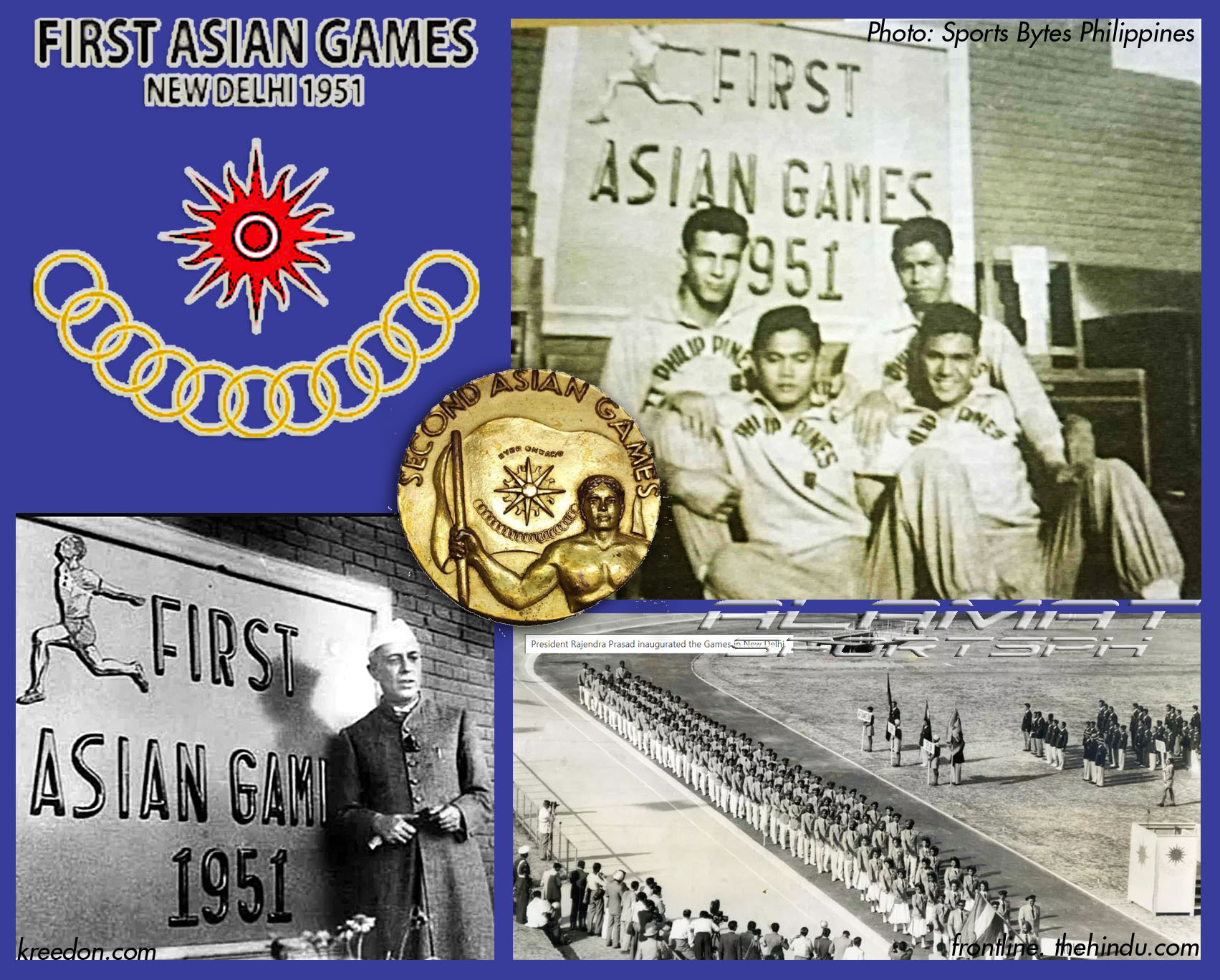
·       THE ASIAN GAMES (1951)

The Asian Games or the Asiad, is considered second-largest multi-sport event in the world after the Olympics. India took the lead in recommending a more inclusive competition to include more than just Far Eastern countries in 1949. The 1st Asian Games were held in New Delhi from 4-11 March 1951. A total of 489 athletes from 11 National Olympic Committees competed in 12 sports. Japan was allowed to compete in the inaugural Asiad, after being banned at the 1948 London Olympics. The Philippines placed a creditable 5th  (5 Golds, 6 Silvers, 8 Bronzes)   in the medal tally, and 3rd in the actual number of medals won.

Since the 1982 Games, the quadrennial events have been organized by the Olympic Council of Asia (OCA). The Games are recognized by the International Olympic Committee (IOC).

·       THE SOUTH EAST ASIAN GAMES (1959)

The SEA Games is a biennial multi-sport event involving participants from the current 11 countries of Southeast Asia. It is one of the five subregional Games of the Olympic Council of Asia (OCA).  First launched as the South East Asian Peninsular Games or SEAP Games (abbreviated as SEAPG), the event was an offshoot of a post-Asian Games in Japan in 1958.

Founding member countries Burma (Myanmar), Cambodia, Laos, Malaya (Malaysia), Thailand and Vietnam, agreed to hold a sports event to promote relations among countries of the region. The 1st SEAP Games was held in Bangkok from 12 to 17 December 1959, with the addition of Singapore. In 1977, the admission of the Philippines, Brunei and Indonesia to the games, prompted a name change to Southeast Asian Games Federation (SEAGF). In its debut appearance at the 1977 games, the Philippines placed 3rd overall, with 31 Golds, 30 Silvers and 30 Bronzes.


INTERNATIONAL SPORTS FEDERATIONS

Today, Olympic sports are represented by their own international sports federations and are an essential part of the Olympic movement. Some of these governing bodies include: World Athletics, FIBA (Fédération Internationale de Basketball) for basketball, FIFA (Fédération Internationale de Football Association) for football and soccer, FIG (Fédération Internationale de Gymnastique) for gymnastics, ISSF (International Shooting Sport Federation) for shooting, ITF (International Tennis Federation), and World Aquatics, for swimming, diving, water polo, artistic swimming.

There are 30 members of the Association of Summer Olympic International Federations which are recognized by the International Olympic Committee. The International Boxing Association (IBA) was dropped from this roster in June 2023 due to managerial, finance, refereeing and ethical issues

These federations mount a series of world cup or world championship tournaments that serve as Olympic qualification events as well. Filipino athletes like gymnast Carlos Yulo, hurdler Eric Cray, pole vaulter Ernest Obiena, swimmer Jessie lacuna, and the Philippine Basketball Team have represented the country in these international championship events.

SOURCES/ CREDITS:

Olympics: https://en.wikipedia.org/wiki/Olympic_Games

David Wallechinsky, “A Brief History of the Modern Olympics”, xxi-xxiii. The Complete Book of the Olympics, Penguin Books, 1988, p.

Far Eastern Games: Frederick O. England, History of the Far Eastern Athletic Association, from the  OFFICIAL BULLETIN of the INTERNATIONAL OLYMPIC COMMITTEE, p. 18.

Asian Games, Wikipedia: https://en.wikipedia.org/wiki/Asian_Games

Southeast Asian Games: https://en.wikipedia.org/wiki/SEA_Games

Logos of international federations, via google.

66. Post-War Belles of the Breaststroke: NORMA GUERRERO & LOLITA RAMIREZ, National Record Holders

The Philippine Women’s University was one of the first schools to have a competition-size pool—the Belen Perez Swimming Pool -- as part of ...