Showing posts with label 1964 Tokyo Olympics. Show all posts

50. Welterweight Boxer MANFREDO ALIPALA, Lone Gold at the 1962 Jakarta Asiad

The 1962 Asian Games in Jakarta were the first to be held in the new 1960s decade from Aug. 24 to Sep. 4, 1962. Even with Japan wresting the boxing championship from the Philippines  in the last 1958 Tokyo Games, hopes were fresh for the 6 young Filipino boxers to deliver more medals.

Leading the charge was a Far Eastern University standout student boxer, MANFREDO Panes ALIPALA (b.  25 Oct. 1938) of Murcia, Negros Occidental, son of Moises Alipala, the municipal chief of police, and Consuelo Panes, school principal of Murcia Elementary School.


“Noning”, as he was called, grew up in Bacolod, and attended the West Negros College. He then went to Manila to pursue his higher education at the Far Eastern University, to take up a Business Administration course. The university was known for its excellent amateur boxing program so the athletic freshman joined the team and proved to be an excellent student, amassing wins in major interscholastic meets.

This led to Manfredo being sent as the FEU entry to the national open boxing championship. The 5’8” student athlete ruled his welterweight class (67 kg.) , which gave him a slot in the Philippine boxing team that went to Indonesia for the 1962 Asiad.

The boxing matches were held at the the Senayan Tennis Stadium in the last weeks of August. Alipala breezed through the rounds of 16, then made it to the  quarterfinals, and all the way to the semifinals.

Now, the only boxer standing in the way of a Gold Medal was the formidable Japanese opponent, Kichijiro Hamada, 4 years his junior and inches taller. But the tough Alipala held his ground and, at the end of the 3 rounds, was announced as the winner. He had secured the one and only boxing Gold for the Philippines in the 1962 Jakarta Games—one of only 7 that year--with the Silver going to Hamadas, and the Bronze, shared by Korea’s Choi Song-keun with Singto Jamjitman of Thailand.

 Incidentally, three team mates, bantamweight Jose Ramirez, featherweight Egino Grafia and lightweight Catalino Arpon contributed 3 Bronze Medals to the Philippine harvest.

Two years later, Manfred Alipala was at the head of the Philippine Olympic delegation proudly bearing the  country’s flag during the 1964 Tokyo Olympics parade of nations at the opening ceremonies. Joining him in the boxing campaign were Dominador Calumarde (flyweight), Arnulfo Torrevillas (bantamweight), Anthony Villanueva (featherweight), Rodolfo Arpon (lightweight), and Felix Ocampo (light-middleweight), with their able coach, Celestino “Aling” Enriquez.

 When the boxing preliminary matches commenced, Alipala subdued Iraq’s Al-Kharki Khalid. In the round of 16, he suffered a surprise defeat in the hands of Kichijiro Hamada, the same boxer whom he had conquered in Jakarta 2 years earlier. Despite this setback,  Anthony Villanueva saved the day for the boxers by winning a historic Silver.

A year after the Olympics, Alipala turned pro, fighting matches against Filipino boxing greats like  Eduardo Canete, Fil Ravalo and Phil Robinson. In the late 60s, he chased Oriental and World titles in the welterweight and middleweight class against boxers in the region like Korea’s Ki-Soo Kim and Hawaii’s Takeshi Fujii. He finished his professional career with a modest record of 3 Wins (1 by a knockout) and 8 losses.

About his personal life, Alipala was first married to Corazon N. Villanueva (d.2012), sister of Olympic silver medalist Anthony Villanueva, and his 1964 Tokyo team mate. Together, they had 4 children: Mariela, Manfriela, Manfredo Jr, and Mancor Alipala. After the couple's separation, he married Sebastiana Taguines and moved to Tarlac. This union produced Manbie, Marinette and Mylove Alipala.

Post-Olympics, Alipala held a few security jobs to provide for his growing family. After retirement, Alipala was taken in by the Philippine Sports Commission under chairman Mel Lopez, as a consultant. He and his family settled in barangay San Roque, in Tarlac City, Tarlac.

“My father lived a simple life, and  shied away from the limelight”, recalls daughter Manfriela.  “He was a nice person to everyone, especially to his friends in Bacolod.” At age 68,  boxing great Manfredo Alipala quietly died in his sleep, 8 Oct. 2006, and was interred at the Garden of Peace Memorial Park in nearby barangay Sapang Maragul.

SOURCES:

Information and pictures, courtesy of Manfriela Junet Alipala, daughter of Manfredo Alipala.

Alipala, Asiad gold medalist, dies at 68.(Sports News)(Obituary)Manila Bulletin, October 19, 2006 | Copyright

https://en.wikipedia.org/wiki/Manfredo_Alipala

47. JOSEPHINE “Big Jo” DE LA VIÑA and Her Still-Unbroken 54-Year-Old Discus Throw Record.

The discus throw record of Josephine De La Viña has stood for 54 years, without a doubt, the most enduring record in Philippine sports history. It is for this reason that “Big Jo” is regarded as the best thrower that the country has ever produced, and at her peak, ranked 13th best discus thrower in the Olympics. She was born on 20 April 1946, the eldest child of American-Mexican Norman and Carolina de La Viña of New Lucena (now, Sta. Barbara) Cebu.

De La Viña recalls that hers was not an athletic family. Her father used to be a professional bowler, and that was it. For some reason, she became attracted to softball, her first sport, which she played as a student of Labangon Elementary School. But her affair with the Grecian discus began when she enrolled at the Cebu Institute of Technology High School that was renowned for producing the most successful women athletes of the Philippines—the likes of Asia’s track queen Inocencia Solis, hurdler-sprinter Francisca Sañopal, javelin thrower Vivencia Subido, and broad jumper Visitacion Badana. From throwing balls,  Josephine discovered her natural flair in the throwing events of discus, javelin and shot put. She caught the eye of Dean Amancio Alcordo and Vicente Tigas, who put her on a scholarship and began training her right away.

The hefty teen, who would grow to an intimidating height of 6 feet, with a weight of 180 lbs,  earned a Bronze at her first ever international competition–the 1st Asian Track and Field Championship in Tokyo–with a heave of 37.39 meters. At the 1963 National Open Track and Field competitions at the Rizal Stadium. She set the audience gasping with an incredible heave of 41. 987 m (137 ft. 9 inches) in the women’s discus throw.

At age 18, she was named to the National  Olympic team, where she put on a show by improving her throw to 42.27 meters at the Tokyo Games in 1964, good enough for 18th place. De La Viña got even better when she joined the 1965 National Open Championships in Manila, registering a remarkable 158 feet, 9 inches (48.387 m.), topping the Asian mark of Japanese Chizoko Tanaka (150 feet, 7 inches, or 45.89 m.)

The next year, De La Viña was the proud flag bearer at the 5th Asian Games in Bangkok (1966) . Competing against favored Japanese amazons, “Big Jo” held her own and threw the discus to an Asian record-shattering 47.58 meters (156 ft. 1 ¼ inches)—which was not even her best throw–to give the Philippines its first Gold. She had been averaging 162 feet in practices, which would have been enough to place her among the top 6 in the world Olympics.

The civil engineering student would go on to participate in two more Olympic quests in Mexico (1968), where she would improve her ranking to 15th  of the world’s best. De La Viña was also entered in the Shot Put event, but did not start, opting to focus on her pet event, the Discus.

She went into deep training in the U.S. in between the Olympic years under coach Bob Lawson, and it was there that Big Jo set a personal best and a new Philippine record that would—to this day—remain unsurpassed.  At the 1971 USA Outdoor Track and Field Championships that took place on 10 July at the Memorial Stadium on the campus of Bakersfield College in Bakersfield, California, De La Viña threw the discus to an astounding 54.71 meters (179 feet, 5 inches) defeating USA’s Carol Jean Moseke L. Frost, the 1967 Pan American Games gold medalist, and 1968 Olympian.

No other Filipina thrower has come near to this record; in fact, the second-best throw also belongs to De La Viña at 53.92 meters, achieved during the qualifying rounds of the Munich Olympics. She almost qualified for the finals, landing in 13th place, but only 12 athletes moved forward to contest the medals.

To date, after 54 years, De La Viña is the only Filipina to reach--and exceed--the 50 meter mark in the Discus Throw event. For perspective, Dorie Cortejo’s silver medal heave of 45.26 m.  at the 1989 Kuala Lumpur SEA Games is over 9 meters behind De La Viña’s best. “Big Jo” passed away on 4 November  2011in Iloilo, leaving behind an unbroken record that is expected to endure for many more years, earning her a special place in the Philippine Sports Hall of Fame in 2018.

SOURCES:

The Philippine Athlete, P.A.A.F. Official Publication, 1966

“Josephine de la Viña”, olympedia, https://www.olympedia.org/athletes/74514

Quintana, Buddy. “A Most Charming Champion”, The Sunday Times Magazine, 1967

“Josephine de la Viña, Aiming for a Medal”, The Sunday Times Magazine, 13 Oct. 1968 (Cover)

35. The Young Boxer Dreamt of an “Anthony’s Day”: GOLDEN RECEPTION FOR A SILVER MEDALIST

When Anthony Villanueva arrived Tuesday afternoon last week, the most audible sounds that greeted him as he inched his way through the streets from Pasay to Manila to Quezon City on an open Thunderbird convertible were the giggles of admiring girls.

Anthony, the 19 year old featherweight sensation, many a girl sighed , was good looking and remarks like “His cheeks are rosy,” “He looks like a movie actor,” “Simpatiko” and “Guwapong-guwapo” were heard from the crowd. One male commented that if he were not good looking, there would not be that many people (the crowd was 15-deep in Escolta).

But Anthony was more than good-looking. He was humble in victory and his oft-bowed head betrayed his extreme shyness.

A month before Anthony’s departure for the World’s Olympic at Tokyo, Anthony told his father Cely Villanueva: “Itay, there was a day for Elorde and a day for Gemma, but I pray that when I return home, there shall also be an Anthony’s day.”

Anthony’s first words to his after upon meeting him in the airport were: “Itay, your Olympic record was broken.” Cely’s answer to Anthony was, ”Son, I have always prayed for your victory. Your Inay and I, and the whole nation are proud of you.”Anthony was speechless the first moments he saw his father and mother. All he could do was cry on his mother’s shoulder.

According to Gene Puyat, whom Anthony calls “Tito” and sometimes “Mr. Paymaster,” after Anthony won the silver medal he was just himself again---very shy, very modest.

 Anthony  is a music lover. He hopes to organize his own combo. He said if he can help it, he does not want to turn professional in boxing. “I want to retire and continue my studies in fine arts.”

 In his quarters at Tokyo, Anthony was once seen by Gene Puyat shadow boxing to the tune of martial music. During his fight at the World’s Olympics, Anthony was not thinking of the bronze or the silver medals. Gene Puyat said he simply fought like the devil to win. Before the final bout in Tokyo, Anthony was even seen in his room, at the Hotel Imperial kneeling in prayer.

Anthony has been offered movie contracts through his father Cely. If Anthony consents, he is schedules to appear in a movie entitled “Pamatay—Kaliwa at Kanan.” For the “Anthony Villlanueva Story”, he has a standing offer of P100,000.

Anthony said that “Tito Gene,” like his Itay, is also deeply religious. “All of us in the boxing team, recited the Rosary and the Lord’s Prayer before training.” Gene Puyat, that he required his boys to pray and sing the National Anthem before they trained or fought in competition.

“We observed struct discipline. This applied to the coach and trainers as weel. Anyone who broke a rule was out.” Puyat also said: “We had to pray. My responsibility was enormous. Anything can happen in boxing. The lives of no less than six boxers were at stake. To me, their safety is my great concern.”

Puyat sent no less than three years training his boxers. This involved time, money, and effort. “In boxing, money is imperative. The boys trained very hard and they needed a special diet. Tuyo and tinapa cannot make them strong. We have to supplement their intake with special diet such as steak, milk, and eggs. I have appealed to my friends for funds and I am grateful they responded.”

Cely reiterated his boast (not an empty one) about Anthony being an ideal boxer. Cely, who likes to dabble in verses, extols Anthony’s ability by quoting the late sports authority Grantland Rice: “To be a champion boxer, one must have the endurance of a marathoner, the strength of a Hercules, the grace and ease of a dancer (which is Anthony’s master), the precision of a baseball player (which Anthony possesses), but above all, he must possess a super abundance of that mysterious quality known as the fighting heart.”

Anthony, despite his twice cut eyebrow, fought to the finish in the final bout in Tokyo. Anthony’s trainer and second,”Aling Enriquez, said it was not true he told Anthony to hold his punches in the first round in his bout with the Russian. “In fact, “ he said, “I told him to go after the Russian from the very start when I noticed Anthony’s punches made him groggy. But unfortunately, our opponents in Tokyo were not the boxers, but the judges.”


Anthony
may never turn pro but many will not forget the days when he brought joy and pride to millions of despairing Filipinos who were getting accustomed to news about disastrous defeats in Tokyo.

A humble Anthony coming home was a real champion, in and out of the ring. 

SOURCE:

F. M. Caliwag, The Sunday Times Magazine, 15 September 1964, pp. 26-28


34. RP’s New Ring Hero, ANTHONY VILLANUEVA, HE VOWED TO BREAK HIS FATHER’S RECORD

by Felix Caliwag, The Sunday Times Magazine, 8 November 1964, pp. 18-21

When 19-year-old ANTHONY VILLANUEVA capped the only silver medal won by his country since the Philippines participated in the Olympics in 1924, no man was more proud than his father, Jose “Cely” Villanueva. In fact, he was so proud, he cried.

But not many people know that Cely started off his son with elercises when he was a baby, At the age of 4, Anthony was already in the ring, mixing it up with another tot in an exhibition bout.

 Jose “Cely” Villanueva was in tears when he showed The Sunday Times Magazine a telegram which was sent to him by Anthony after he had won the silver medal, in the recently concluded Tokyo Olympics. The wire read, “Sorry, Itay, I already broke your record.”

To father and son, this simple communication has a lot of meaning. Cely recounted that in 1952, during a PAAF award night, he showed “Boy” (that’s how father calls son Anthony), who was barely 7 years old then, a plaque which was given to him as a world’s Olympic bronze medalist. “I distinctly remember this is what I told Boy, in Tagalog: “This record has not been broken in the Philippines.”

According to Cely, Boy readily answered: “Itay, I’ll break that record.”

“Just imagine,” Cely continued, “my own son breaking my Olympic record. Is this not a remarkable father-and-son-affair? I must confess that when I heard the news that Boy had won the silver medal, I was so overwhelmed I could hardly eat for three days.

“But, do you know that fate seems to have a pattern for Boy and me. I was born on March 19. And Boy was born a day ahead, March 18. I won a bronze medal in the bantamweight division and Boy won a silver medal in the featherweight division which is a rung higher.”

Because of Anthony’s victory, Cely said he has proven that his son’s boxing method is superior. Cely was reminded, however, that so far, no one disputed the fact that he is the dean of Filipino boxing trainers and that he has proven it through Elorde’s successful bouts and the many pugilists he has trained to become champions.

 “So many of our so-called boxing experts got for the slugger type. Not since my time has any of these sluggers won any medal in an Olympics. They were all defeated, They say I am a stylist. Well, Boy is a stylist, too. Sugar Ray Robinson, whose record in the annals of boxing has yet to be broken, is another super-stylist. At least we have proven something.”

What particular style has Boy adopted?

“Boy is an all-around performer, He can box, slug, counter punch, and defend. Boys is also adept at combination punches with both mitts. He is a body puncher but he himself is durable. In short, he is the ideal boxer who can give and take punches.”

At what age did Boy actually start boxing?

“I think he was a little over 3 years when he first dinned his boxing gloves. I was then instructor at the Manila Police Department. A certain sports goods store donated uniforms and fighting shoes. Instead of these donations, I convinced the donor to give me boxing gloves for kids. When I reached hme to present a pair of boxing gloves to Boy, he was so overjoyed that he kissed me several times and kept on jumping.

Since then, according to Cely, Boy showed a very special interest in boxing. He kept his boxing gloves in a box and he saw to it that they were always clean.

"In 1948, a fire broke out in our neighborhoods in Felix Huertas and naturally we were all rushing to take our belongings out of the house. But, do you known that Boy’s first impulse was to save only his boxing gloves?

“I realized then that even at that early age, Boy already demonstrated his deep concern for boxing. In the years that followed, I tried to convince Boy to discontinue his interest in boxing as I explained to him that is a thankless and rough sport. But Boy was simply adamant. He has will power, you know.”

The Olympic bronze medalist said his son is the calm type. “While it is true he is not temperamental, it is, however fair warning that he should not be provoked.”

Cely related an incident in which Boy boxed a playmate almost twice his age. “Boy, who was barely 4 years, was drawing something on the cement. After he finished his drawing, a boy, who was twice his age, erased his drawing. Anthony warned him twice and when the playmate refused to heed his warning the third time, Anthony hit him straight on the jaw. The playmate cried and complained to his father. But when the father saw it was only Anthony who was half his son’s age, he laughed aloud.”

This sort of thing, Cely said, was repeated on several occasions when Anthony was provoked. But as a rule, “Boy is very forgiving. He loves his plamates and he always treats them to a blow-out. They call him the little Santa Claus.”

Who is Anthony’s favorite boxer?

“Boy has great admiration for Elorde but he idolizes Cely Villanueva,” was Cely’s laconic answer.

The greatest Filipino Olympian to date received this special advice from his father: “Son, always be humble in victory or defeat.”

“It must be told,” Cely says, “there would not be an Anthony Villanueva without my friend Tom Ortega, our dean of physical culture.

“I am always grateful to Tom who saved me from certain death. It was Tom who sacrificed time and effort to help me recover from my failing health. That was before Boy was even born. I was desperate and bed-ridden. Tom gave me his personal attention. He supervised my training until I was pronounced fit to work. Inagaw ni Tom ang buhay ko sa tiyak na kamatayan at ito ay niloob ng Diyos marahil upang ibigay sa atin si Anthony.

“A few weeks after Boy was born, Tom also showed special interest in him.. He gave him baby exercises. It’s quite amazing but in nine months time, Boy was able to walk already to the Systomor gym at Dasmariñas, A foreigner who happened to take his photo was surprised to learn that Boy was only nine months old.”

Does Cely have a special diet for Anthony?

“Boy takes a very light breakfast. He takes tea or coffee and two soft-boiled eggs. But he takes his lunch at exactly 11 a.m. His lunch consists of hot fish and green vegetable salads. His supper when he has to eat well consists of steak.”

Cely pointed out that during the Olympic qualifying tournament, it was he who trained Anthony. “They tried to turn him into a slugger but I told Boy to sick to what I had taught him. Boy is very obedient. If he hears my whistle at night, he immediately goes to bed.

“Boy is also deeply religious. He collects religious objects. In his wallet, he has many estampitas. I also told him that “man propose, God disposes!”

That was Cely Villanueva speaking, about a son who may one day become a world champion.

SOURCE:

The Sunday Times Magazine, 8 November 1964, pp.18-21

Photos by Marcelino Roxas

33. Teen Boxer ANTHONY N. VILLANUEVA, The Country’s 1st Olympic Silver Medalist, 1964

The 19 year old boxer who became a household name in 1964 with his unprecedented and historic triumph at the Tokyo Olympics was born Anthony N. Villanueva (b. 18 March 1945)  to parents Flora Narvaez and Jose “Cely” Villanueva, an Olympian bronze medalist in bantamweight boxing at the 1932 Los Angeles Olympics.

 His pugilist father influenced his interest in boxing. As a 5 year old, his father gifted him with small barbells and boxing gloves which became Anthony’s favorite “toys”. At age 17, the clean-cut Villanueva enrolled at the Far Eastern University which had an outstanding college boxing program. Boxing aficionado and businessman Eugenio Puyat saw his potential and supported him, such that by 1962, at age 17, the teen became a national sensation when he won the Bantamweight title at the National Open Championships. 

This led to his being drafted to the national boxing pool, and 2 years later, he qualified as part of the Philippine boxing squad to the 1964 Tokyo Olympics along with welterweight Manfredo Alipala, flyweight Dominador Calumarde, bantamweight Arnulfo Torrevillas, lightweight Rodolfo Arpon and light middleweight Felix Ocampo, under coach Aling Enriquez.

It was an exciting time for the young Villanueva as he embarked on his quest for Olympic boxing gold. He was just 19, the same age as his father when he had won his bantamweight bronze in Los Angeles, 32 years earlier. Before he left, Anthony vowed to break his father’s 3rd place finish which had remained unbroken for more than 2 decades.

Almost golden.

The 40-man Philippine delegation prepared for action as shortly after the games opened on 10 October 1964 in Tokyo, Japan—the first Olympics to be held in Asia. The Boxing events went underway on October 13 at the Kora Kuen Ice Palace with 32 boxers in the featherweight division, from 32 countries. Villanueva won his opening bout against Italy’s Giovanni Girgenti on points, and moved on to dispose of Tunisia’s Tasser Ben Hasssen 4-1, but wounding his right eyebrow in the process.

The Quarterfinals round saw him flooring Poland’s Pyotr Gutman thrice, winning the bout by RSC ( Referee Stops Contest). In what everybody thought was to be a tough Semifinal round against the much-heralded George Brown of the U.S., Villanueva—despite fighting with cut brows—defeated the favorite with a 4-1 upset decision. Villanueva thus guaranteed himself a silver medal, thus fulfilling his fearless prediction of surpassing his father’s feat.

Of that very controversial Finals against Russia’s Stanislav Stepashkin held on Oct. 23, reporter Hal Drake of the U.S. paper ‘Stars and Stripes’ recounts: “He (Villanueva) was rated little chance in his bout with Stepashkin, who has shoulders like a medieval axman and a punch like a thrown brick. The Russian had easily disposed of every opponent.

At the bell, Villanueva rushed Stepashkin and reddened his nose with a beautiful series of stabbing rights. He hooked the right twice and made Stepashkin hold. He brought fans to their feet by staggering the Soviet boxer with a left to the head.

In the second round the two mixed it up in close, with hooks. In one flurry, the bandage came off Villanueva's eye in a smear of blood and the claret gushed from his nose. But that right was arcing over and still landing; Stepashkin was getting one, and sometimes more, for everyone he landed.

Villanueva's opponent must have been a hazy figure in a red blur during the final round, but he still met the Russian punch for punch. The blood covered all of Villanueva's face and streaked his opponent's arms after clinches. But the Russian finished that last round with his left eye cut, his right eye: half closed, his nose and one ear streaming blood. “

But when the judges’ scores were announced, the audience were in disbelief. The Italian judge Aniello, Khalife of Lebanon and Vuellaty of Tunisia scored it for the Russian while Maghraby of Egypt had it 59-58 for Villanueva and Nussgen of Germany saw it even at 59-all. A roar of protest went up when British referee R.H. Gittins raised Stepashkin's hand, with the 3-1-1 verdict.

Nat Fleischer, founder/editor of Ring Magazine said, “I have seen highway robbery before but not anything as bare-faced as this.”.  Peter Wilson of the London Daily News could only agree, called it “one of the worst decisions I have seen in the Olympics.” Jose “Peping” Cojuangco, who was at the ringside in Tokyo, recalled, “He won convincingly. The editor of Ring Magazine who was in front of us, was already congratulating us. But when the decision was announced, there was a howl.”

The crowd of 7,000 chanted Villanueva’s name to show their support for the big-hearted Filipino boxer who fought to the finish. It was said that fans jeered as the Soviet national anthem was played, while Villanueva shed tears.

Homecoming and silver linings

Nevertheless, Villanueva came home to a hero’s welcome—for achieving the highest-placed finish for a Filipino athlete in Philippine Olympic history. He was mobbed by people at his motorcade that crowded the Pasay-Manila-Quezon route. His school honored him with a Tamaraw Gold Medallion given by then Far Eastern University Vice-President Alfredo M. Reyes.

With his schoolboy looks, Villanueva was squired by movie producers, which he accepted on the prodding of his father. He starred in at least 5 action movies, including the boxing-inspired “Pamatay: Kaliwa't Kanan” (1964)  with Nida Blanca, for which he was paid a whopping Php 100,000. He also starred in “The Salonga Brothers” (1965) with Joseph Estrada, "Fighting Fists" (1971) with Roberto Gonzales, and "Ang Berdugo at ang Kamao." Later, his professional fees dwindled from between P2,000 to P7,000 per film.

Advertisers also sought out the acclaimed star major boxer, who signed up with two clients. 1966,Villanueva did an ad for La Tondeña Natural Rum. He also appeared in a Terylene fabric ad that was part of a campaign series featuring active men in heroic James Bond-like roles, attired in dashing, but durable Terylene suits.

As he lost his amateur status due to his lucrative acting career, Villanueva turned professional in 1965, debuting in a fund-raising event called “Fiesta Fistiana” at the Araneta Coliseum, matched against the Japanese, Shigeo Nirasawa. He would hang his boxing gloves after only 5 luster-less bouts, which ended in 1 win, 3 losses and 1 no-contest. His last fight was in 1975, against Australian Ross Eadie, which he lost via TKO.

Forsaken dreams, forgotten champion.

When his boxing and acting days were over, Villanueva became a boxing coach much like his father, until 1976, when he decided to go find his future in the U.S. By then, he was married with 2 kids, Avery (named after International Olympic Committee President Avery Brundage) and Agatha. There, he took on a variety of jobs—as a Mexican restaurant cook, and as a security guard at a Staten Island hospital and at the Philippine Consulate in New York. 

A 1988 coaching stint in the Philippines proved unproductive, so he returned to the U.S. after failing to find a stable job. He would father another son, Jose Giovanni with his  second wife in 1996. A short while later, Villanueva permanently come home to the Philippines to stay with his third partner Liezel Beldia  with whom he shares son Joey Rembrandt. They took up residence in Kamuning, Quezon City,

Beginning in 1999, he suffered a series of strokes that left him incapacitated. He had hoped to return to the U.S. to fix his citizenship papers and then set up a gym business. To help defray the cost of his hospitalization, he offered his Olympic Medal for sale for 1 million pesos. Bedridden, he died in his sleep, penniless and almost forgotten  on 13 May 2014, in Cabuyao, Laguna, at age 69. Manny Pacquiao hailed him as  "original Filipino boxing icon who should never be forgotten by the nation."

Anthony N. Villanueva lived to see himself inducted in the Philippines Sports Hall of Fame for bringing the first historic Olympic silver for the country. It would take Mansueto “Onyok” Velasco another 32 years to duplicate his silver medal feat at the 1996 Atlanta Olympics when he placed 2nd behind Bulgarias' Daniel Petrov, in the light-flyweight division.

SOURCES:

“He vowed to break his father’s record, “ Sunday Times Magazine, 8 November, 1964,

“Golden reception for a silver medalist,” Sunday Times Magazine”, 15 November 1964, p. 28

Anthony N. Villanueva, wikipedia, https://en.wikipedia.org/wiki/Anthony_Villanueva

Games of the XVIII Olympiad, Tokyo 1964 : the official report of the Organizing Committee, LA Digital Library, https://digital.la84.org/digital/collection/p17103coll8/id/27912/

Hal Drake, Frazier chases German for boxing gold, Stars and Stripes, Oct. 25, 1964 medal, https://www.stripes.com/news/1964-10-25/frazier-chases-german-for-boxing-gold-medal-1894367.html1

Joaquin Henson, “Villanueva selling Olympic Medal for 1 Million”, Philippine Star, 6 January 2000,  https://www.philstar.com/sports/2000/01/06/97733/villanueva-selling-olympic-medal-p1-million

Joaquin Henson, “Forgotten hero at death’s door”. The Philippine Star , 11 May 2014,https://www.philstar.com/sports/2014/05/11/1321865/forgotten-hero-deaths-door

Joaquin Henson, “Olympic hero interred today”, Philboxing.com, 18 May 2014, http://m.philboxing.com/news/story-95534.html

ABS-CBN, ‘Villanueva’s death puts spotlight on poor, retired athletes”, https://news.abs-cbn.com/sports/05/15/14/villanuevas-death-puts-spotlight-poor-retired-athletes

Movie Poster, “Sports Heroes Turned Movie Stars, Video 48, https://video48.blogspot.com/2007/02/sports-heroes-turned-movie-stars-1.html

Far Eastern University FB page, https://www.facebook.com/photo.php?fbid=987760150052219&id=100064547295619&set=a.631930875635150&locale=ko_KR

 Isa Munang Patalastas, blogspot. "Is That Who I think He Is?: Anthony Villanueva for La Tondena Rum and Terylene. isamunangpatalastas.blogspot.com

31. Ageless Shooting Star: MARTIN M. GISON, The Only 5-Time Filipino Olympian


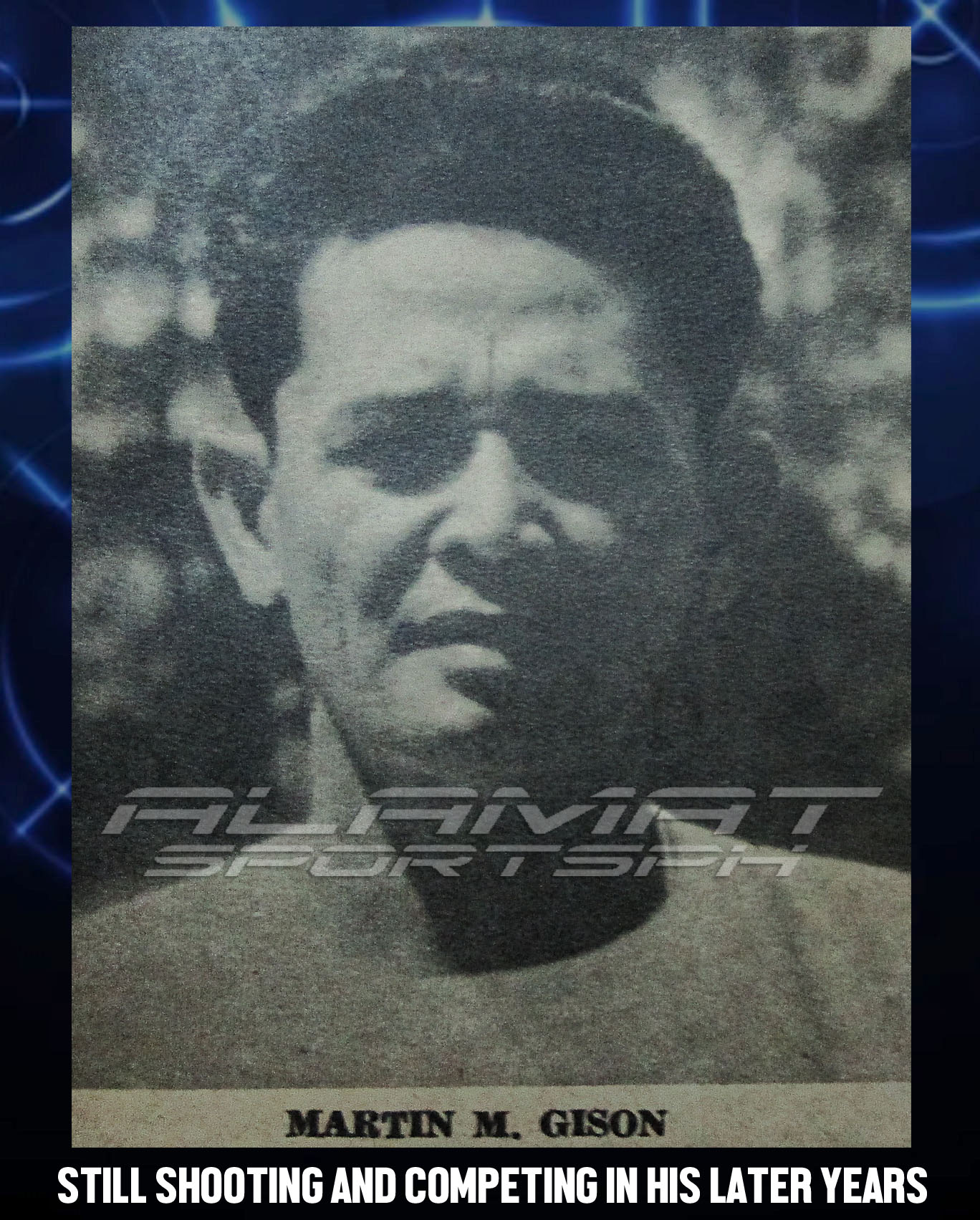
One of our greatest shooting sports legends was the marksman MARTIN MAURICIO GISON. (b.14 March 1914) who had a long, sterling shooting career that began in his college days at the University of the Philippines, to 5 Olympic stagings and 3 Asian Games editions.

Growing up in his home province in Iloilo, the young Martin loved playing with his “tirador”, aiming and slinging his shot at any target he could find-- a fruit hanging from a tree, an empty can, or even pesky, stray animals. He earned a reputation as a sure shot, foreshadowing his future as a world-class shooter.

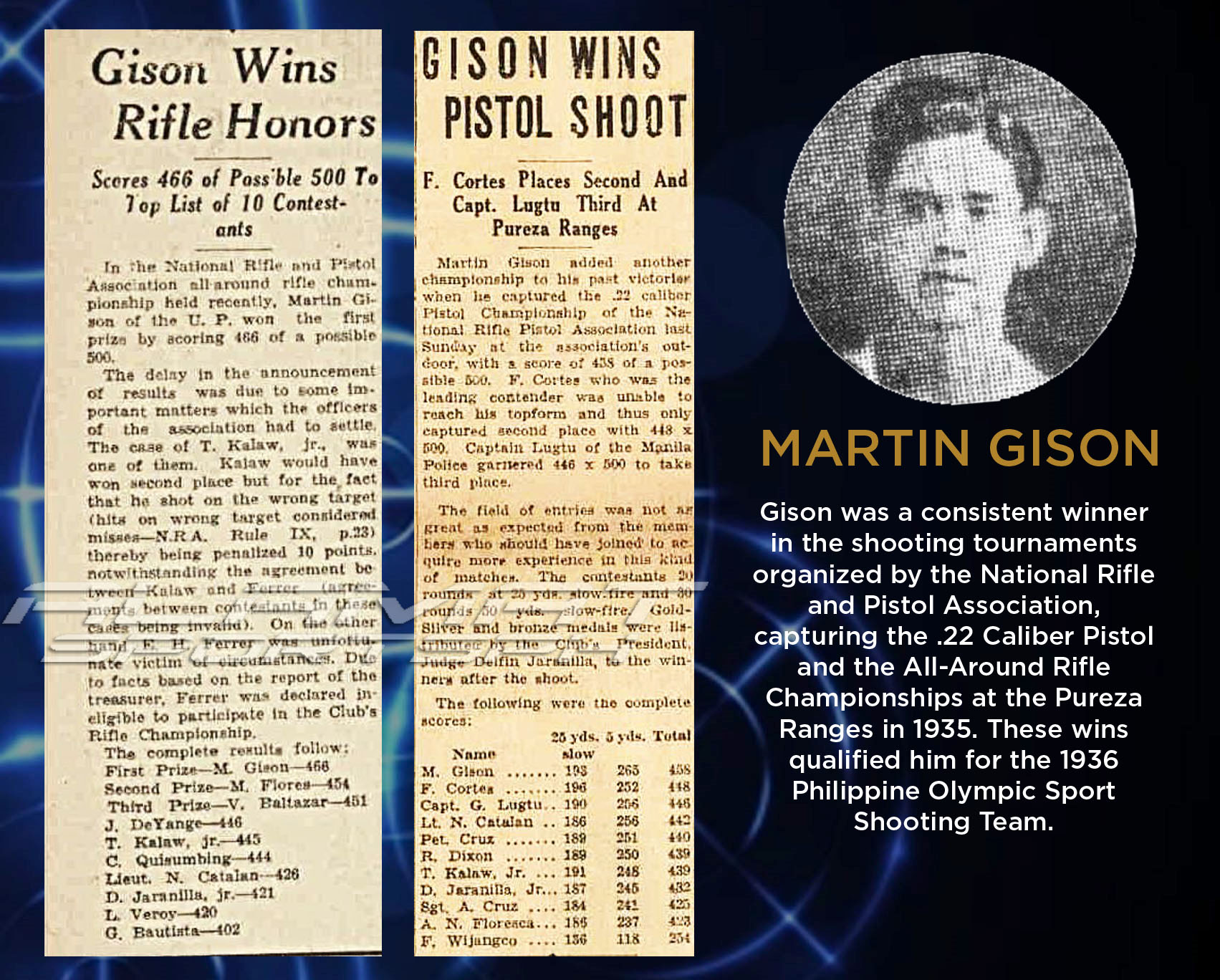
As a University of the Philippines R.O.T.C. cadet in the mid 1930s, Gison  joined the U.P. Shooting Team, and quickly built a reputation as an elite marksman in rifle and pistol events. The team was often fielded in inter-ROTC Rifle competitions and in events organized by the National Rifle and Pistol Association  of the Philippines under Judge Delfin Jaranilla.

In June 1935 alone, he won 2 titles, claiming the All-Around Rifle Championship in the first week of the month, by scoring 466 out of 500. Three weeks later, on June 23, Gison added another outdoor championship title in the .22 Pistol category (20 rounds at 25 yards slow-fire and 25 rounds 50 yards slow-fire), with a score of 458 out of 500, edging favorites Felix Cortes and Capt. G. Lugtu.

These victories paved the way for Gison’s inclusion in the 1936 Philippine Olympic Team that went to Berlin in August. Against the world’s sharpest marksmen, he started strong in 5-way tie for 2nd place  in the Small-bore .22 Rimfire Rifle, Prone event. After the countback that decided the winner, he dropped to 4th , edged for the Bronze by the Polish Wladislaw Karas, who had an identical score of 297. Still, it was the closest podium finish ever by a Filipino shooter. However, Gison was not able to hold his form in the target pistol and revolver events, where he was also entered. 

His U.P. team mate, Otoniel Gonzaga, failed to advance in his events. Nevertheless, the Olympics proved to be an enriching experience to the young sport shooter and his modest accomplishment, so close to winning a medal in Berlin,  was reported in major newspapers back home.

At the 1937 U.P. Athletic Commencement and Physical Education Day, the U.P. varsity athlete and Olympian received his major letters for his rifle and pistol achievements, along with his certificate and sweater, at the Rizal Tennis Stadium.

In 1938, Gison became the coach of the Colegio de San Juan de Letran Shooting Team. He was also selected by the P.A.A.F affiliated National Rifle and Pistol Association to be one of the country’s representatives to an international shooting tilt in July 3, against Saigon sharpshooters from the Federation Cochinchinois de Tir et Preparation Militaire.

Gison joined the USAFFE (Unites States Armed Forces in the Far East) and was stationed in Camp Murphy (later Camp Aguinaldo). One of his last tournaments before the war was the 1940 Philippine Army-Philippine Constabulary Meet at the Pureza ranges of N.R.P.A. using .45 caliber service pistols or revolvers, which his team won.

At the height of the war, Lt.  Gison was among those captured in 1942 by the Japanese imperial forces. He survived the infamous Bataan Death March, and on 25 Dec. 1942, he, along with 238 former USAFFE servicemen, took their oath of loyalty before the Director General to support the New Philippines under the Japanese empire. When the country was liberated, Gison started anew by going back to sport shooting.

In 1948, he qualified for the much-delayed Olympics in London that were supposed to have been hosted by Japan in 1940.  He came in 25th in the Free Pistol, 50 m.; 40th in the Rapid-Fire Pistol, 25 m. , and 43rd in his pet event, the Small-Bore Rifle, Prone, 50 m. 

 Gison had mixed results at the 1952 Helsinki Olympics, improving his standing to 32nd place in the Free Pistol, 50m., but skidded down to 36th place in the Rapid-Fire Pistol, 25 m.. He placed a creditable 13th in the Small-Bore Rifle, Prone, 50 m.

The 1950s saw Gison at his peak, as in-between Olympics, he participated in the Asian Games that were first instituted in India in 1951. At the 2nd Asian Games in Manila held in 1954, he bagged a complete set of medals of every color:  Gold for the Rapid Fire Pistol, 25m.; a pair of Silvers for the Free Rifle, 3 positions, 300 m., and the Free Rifle, 3 positions, 50 m.. and Bronze for the Rapid-Fire Pistol, 25 m.

The Melbourne Olympics followed in 1956, where Gison qualified in 2 events. He placed 13th in a new event, Free Rifle, 3 Positions, 300 m., and 22nd in the Rapid-Fire Pistol, 25 m. Two years after, the 3rd Asian Games in Tokyo saw him winning a Bronze in the Rifle, Prone, 50 m.

Defying age, Gison, at 50 years old, qualified for his 5th Olympics at the 1964 Tokyo Games, along with 8 other Filipino marksmen. In his swan song, he finished in 48th place in the Small-Bore, 3 Positions, 50 m.

 Martin Mauricio Guison may not have medalled in his shooting events but he holds an extraordinary record that has never been matched—for making the most number of appearances at the Olympics—5 times—from 1936 to 1964, spanning 28 years. No other Filipino athlete has ever come close to this feat, a lesson on achieving greatness, through perseverance, endurance, and the will to win.

SOURCES:

The Tribune, various issues: 5 June, 25 June, 5 Sep. (1935), 27 April, 11 Aug. (1936); 27 Feb.(1937); 19 July (1938); 20 Jul. (1940); 25 Dec. (1942).

Photo of M. Gison with Letran Shooting Team, Colegio de Letran College Yearbook, 1938

Main Photo: Olympedia

Records, Martin Gison, Wikipedia.com


66. Post-War Belles of the Breaststroke: NORMA GUERRERO & LOLITA RAMIREZ, National Record Holders

The Philippine Women’s University was one of the first schools to have a competition-size pool—the Belen Perez Swimming Pool -- as part of ...