Showing posts with label Asian Games. Show all posts

36. VIVENCIA SUBIDO, Champion Javelin Thrower of the '50s

VIVENCIA SUBIDO is a petite well-turned out athlete from Cebu Institute of Technology, known for its roster of nationally-ranked female athletes. At the 1954 2nd Asian Games in Manila, she reached the finals of the Women’s Javelin Throw and captured the only Bronze medal in that field event with a heave of 123 feet 2 inches. Two Japanese women were ahead of her, Akiko Kurihara (Gold, 144.5 ft. ) and Yasuko Inden (Silver, 139.63 ft.). Her team mate, Francisca Sanopal, placed 5th (118.67 ft.), and she later shifted to the 80 m. low hurdles that allowed her to gain entry to the 1956 Melbourne Olympics.

In two meets in Formosa in 1953, Subido won Gold medals in Tai Chung and Kao Hsiung. Thirteen years after, in the 1966 Bangkok Asiad, Marcelina Alonso duplicated her feat by winning Bronze in the same field event.

SOURCES: 

Progress Magazine, 1955 edition

Athletics at the 1954 Asian Games,https://en.wikipedia.org/wiki/Athletics_at_the_1954_Asian_Games


13. World and Olympic Weightlifting Record Setter: RODRIGO DEL ROSARIO

RODRIGO DEL ROSARIO  (b. 11 Jun. 1917) was a 3-time Olympian from Cabangan, Zambales. Standing only 5’4”, he never won an Olympic medal but he broke Olympic and world records in his long career.

Physical culture and weightlifting were already established sports by the mid 1930s, and interest peaked when menfolk were required to do military training as a looming war approached. Del Rosario discovered weightlifting in Manila, and he came under the training of the Ben Gallegos Club which had a gym in Sta. Mesa, Manila. The Club also held regular weightlifting tournaments and fielded qualified members to the National Weightlifting Championships. It was in these championships that Del Rosario began making his mark.

At the nationals held in Cebu on 21 Mar. 1948, Del Rosario, competing in the featherweight division, managed a total of 712. 2 lbs. in 3 lifts. He also made a lift of 236.2 lbs. in the military press. These broke the world records established by American lifter Bob Higgins at the Philadelphia Championship in Sep. 1947, where he lifted 231.5 lbs. in military press, and a 3-lift total of 638.5 lbs.

His peak was at the 1952 Helsinki Olympics, he came closest to winning a weightlifting medal when 110 lbs. Del Rosario placed fourth in his featherweight division. He pressed 105 lbs . in the (231 ¼ ) lbs. which was declared an Olympic Mark, surpassing the previous record of Jafar Salmasi of Iran . This also equaled that year’s world mark. His combined lifts, adding his 92.5 kilos in the snatch (203 ¾ lbs.), and 120 kilos in the jerk (264 ½ lbs), totaled 317.5 kilos  (699 ½ lbs), trailing the Bronze medalist R. Wilkes of Trinidad, by just 5 pounds.

Del Rosario may have lost the Bronze by a whisker, but the record he set for the press lift remains the first and only Olympic record set by a Filipino, which caught the attention of international lifters. He reset this world record in the press lift to 108.75 kg. (or  239.75 lbs.) at the 1954 Asiad in Manila. The record, though, lasted just for 6 days, surpassed thrice by international lifters.

Like all carry-over athletes from the thirties, he continued to join competitions past his peak, finishing second in his class in the 1955 National Champioships. Del Rosario has always found the 2-hand snatch an enigma and he was unable to lift over 200 pounds, that thwarted his 1955 title hopes.

Pushing 40, Del Rosario made it to his 3rd Olympics in Melbourne in 1956, along with fellow lifter Pedro Landero. He failed to lift his clean and jerk portion, so he was not ranked for his incomplete lifts.

Del Rosario became a trainer of young weightlifters and coached the 1968 Philippine Weightlifting Team to the Mexico Olympics.  His last competition was in the World Weightlifting Championships  in Columbus, Ohio in 1970. By dint of good luck, he was awarded 1st place in the flyweight division after the Top 3 lifters were disqualified for drug use.

After his competitive years were over, Del Rosario took on a job as a security officer at the Rizal Memorial Stadium, where retired athletes would congregate at the P.A.A.F. office. He continued mentoring young weightlifters including his nephew Salvador del Rosario who would win a world title, paving the way for a stint at the Olympics in 1968 and 1976. His son Arturo, followed suit, becoming an Olympian in 1972 and 1976.

Rodrigo del Rosario, our finest Olympic strongman, died on 10 October 2009, at the venerable age of 92.

SOURCES:

Olympedia, https://www.olympedia.org/athletes/56487

Progress 1955, Report on Postwar Sports

Abesamis, M. E. 13 Oct. 1968, The Sunday Times Magazine, “All the Weights for Gold” 13 Oct. 1968. p. 30

1952 Official Olympic Report, LA 1984 Digital Collection

Alex R. Castro, FilipiKnow. 13 Sports Legends Who Proved Filipinos Are Kickass Athletes, https://filipiknow.net/legendary-filipino-athletes-in-sports-history/

10. LOLITA R. LAGROSAS: The Philippines’ All-Around Iron Woman (active 1958-1970)

Before Elma Muros, no other female athlete was as well-rounded as LOLITA R. LAGROSAS  whose track career spanned over two decades, involving three major sports disciplines—High Jump, Broad Jump (now Long Jump) and Pentathlon.  On the side, she even played Basketball for the National Women’s Team!

Born in Naawan, Misamis Oriental on 24 August 1938,  her versatile athletic skills in provincial meets—she was an excellent jumper, hurdler, sprinter and thrower-- paved the way for her relocation to Manila, where Far Eastern University gave her a scholarship.

In her prime, the five foot four and a half, 113 lb.  Lagrosas went through 5 hours of training every day. This served her very well indeed, as she gained attention when, at age 20, she snagged a Silver in her favorite favorite High Jump at the 1958 Tokyo Asiad, behind the Japanese entry.

In 1965, right after winning Gold for High Jump and Long Jump at the National Open at Roxas City, she went to Taipei and copped 3 Gold Medals in her 3 events, and was adjudged “Most Outstanding Athlete” in the Nationalist China-Philippines dual meet. A few days after returning to Manila, Lagrosas had to fly back to Taipei to serve as a guard to the Philippine basketball team at the Asian basketball championship.

In the next Asian Games she appeared in, she earned 2 more medals for High Jump: 1966 Bangkok (Silver) and 1970 Bangkok (Bronze). Also at the 1966 and 1970 Bangkok Asiads, this Filipina Iron Woman won a pair of Bronzes in Pentathlon, the counterpart of the Men’s Decathlon, which involved completing 5 gruelling events for points: High Jump, Shotput, Hurdles, Long Jump and 200 m. dash, contested in 2 days.

Lagrosas was also a two-time Olympian, having competed in the jumping and pentathlon events at the 1964 Tokyo and 1968 Mexico Olympics.  Her personal bests: High Jump – 1.69 m. (1966); Long Jump– 5.71m. (1970); Pentathlon – 4131 points (1968, accomplished at the Mexico Olympiad, putting her in 25th place in a field of 33 ). After retiring from the sports, Lagrosas and served as a long time Head Coach of the track and field team of De La Salle University.

SOURCES:

List of Philippines Asian Games Medalists: https://en.wikipedia.org/wiki/All-time_Asian_Games_medal_table

“Bumper of Bronzes”, The Sunday Times Magazine, 1 Jan. 1967, p. 20-23

“Long Distance to Fame”, The Sunday Times Magazine, 13 Oct. 1968, p. 18

“Stars in Sports”, The Sunday Rimes Magazine, 1 Jan. 1969, p 28

“Meet the Athletes”, The Sunday Times Magazine, 6 Dec. 1970, p. 6-7

9. JOHNNY JOSE, World-Class Tennis Prodigy, active 1949-1964

JOHNNY JOSE, Hall of Fame, Philippine Davis Cupper, Asian Games Medalist
,
JUAN MARIA  J. JOSE or Johnny Jose (b. 8 Aug. 1938) was the son of Guillermo Jose and Encarnacion Ybañez Johnson, a former Miss Rizal who competed in the Manila Carnival Queen 1927 . Guillermo was named as the consort of the eventual winner, Luisa Marasigan, but it was with Encarnacion that he fell in love, and eventually got married with.

Guillermo was a tennis aficionado  so he encouraged his son Johnny to take up the sports. Jose started his sports career at 7 and won his first tennis title, the National Elementary Singles, at 9. He retained this title until 1951 when he copped the National Secondary titles. In high school at La Salle, Johnny, along with his older brothers, Guillermo and Emilio, were tennis standouts, who made regular winning appearances at the N.C.A.A. tennis tournaments.

In 1952, the 14 year old Jose played in England, Spain and France (under the sponsorship of well-known sportsman, Manolo Elizalde), and came home with the Junior Singles Championship of Kent, England by defeating India’s Ramanathan Krishnan, now rated as one of the top players of the world. The following year, he played in Japan and won both  the All-Japan Singles Title and Junior Doubles Championships.

In 1955, at age 17, Jose was rated as no. 3 man in Philippine tennis. He later made his debut at the Forest Hills, New York in the U.S. Open Championship. In the same year, he was named to the Philippine Davis Cup Team and remained a member of this team for 5 years (1955-1960). Jose was barely 18 when he graduated to the senior ranks, copped several collegiate titles, then went to the US where he and Gregory Grant won the Junior Doubles trophy.

In 1956, Jose teamed up with Ampon to win three major doubles titles: the PTA Open, the Metropolitan, and the National. In the same year, they won the Saigon Doubles title. A year later, Jose was honored as “Athlete of the Year” by De La Salle College, also won the PTA Open Singles title. 1957 became doubly memorable when he scored a major upset in the South Australian Championships by ousting Belgium’s no. 1 Davis cupper, Philippe Washer.

At his debut at the 1958 Asian Games in Tokyo, Johnny Jose bagged his first medal with a Bronze in the men’s singles, completing a 1-2-3 all-Filipino podium finish (Raymundo Deyro and Felicisimo Ampon took Gold and Silver, respectively).

Jose retained his No. 3 position during 1958-1959 and 1959-1960, then jumped to the no. 1 ranking when he won the national singles championship by defeating England’s top ranking player, Mike Sangster. This year (1961), he copped the Malayan Open (singles and doubles), the Malayan Interport Team, and the Singapore Open (doubles).

In 1961, Johny Jose was elected outstanding young man in sports for 1961 not only for the international prestige he has won for the Philippines but also for the fine sportsmanship and gentlemanly deportment off and on the tennis courts.

 Jose made it to his second Asian Games outing held in Jakarta in 1962. Here, he finally secured a Gold medal, trouncing Japan’s Atsushi Miyagi in a hotly-contested final match. This would be the last time that a Filipino would claim a tennis Gold in the Asiad. Jose also won Silver with partner Raymundo Deyro in the doubles, against Japan’s Myagi and M. Fujii,

 At age 26, Jose made a final appearance in the sport at the 1964 Davis Cup Eastern Inter-Zonal Championships and then retired. Johnny, a La Salle chemical engineering graduate, had also worked as head of  the laboratory control department of the Elizalde Iron and Steel Co. He also became a tennis coach, mentoring young tennis stars like the Castillejo sisters, and the women’s tennis national team.

He was inducted into his alma mater’s Lasallian Sports Hall of Fame in 1996, and was honored with a Davis Cup Commitment Award Trophy in 2013, for their long years of Philippine representation at the premiere tennis tournament. In 2016, Johnny Jose was inducted into the Philippine Sports Hall of Fame.

He passed away on October 23, 2018 at St. Luke’s Hospital. He is survived by his wife Olivia and 5 children Ina, Juanchit, Annalisa, Fatima, and basketball coach Mon Jose.

SOURCES:

“TOYM”, The Sunday Times Magazine, 26 Aug. 1961, Cover

“Johnny Jose, Malayan Open Singles Champ”. Mirror Magazine, 26 Nov. 1960, p. 30

Screen grab from: Juan "Johnny" Jose BNP Paribes Commitment Award Recipient PHILTA 2013”, uploaded by Davis Cup Philippines, https://www.youtube.com/watch?v=-z9IbuYscEc

Medal Record: wikipedia

7. Reflections of a Life in the Fast Lane: HAYDEE COLOSO-ESPINO, Asia’s Swim Queen

In her time, she was hailed as the country’s greatest Filipina swimmer. She swam for the Philippines in 3 editions of the Asian Games, collecting 10 medals, in all colors. At age 18, she held 5 Philippine swimming records, 4 of them for individual events, In 1960, she qualified for the Olympics, competing against the world’s best in Rome. She was such a prolific producer of medals in the pool that she was dubbed as Asia’s Swim Queen, a title that HAYDEE COLOSO-ESPINO embraced and proudly wore all her life. After all, no Filipina swimmer has yet to surpass her colossal triumphs in the water, the lone Filipina triple gold medalist in swimming at the continental Asian Games.

Haydee was born on 28 August 1937 in Dueñas, Iloilo, the daughter of Atty. Lorenzo Coloso & Alicia Lanestosa Coloso. She was not exactly to the water born; at age 10, she came close to drowning when a boatload of picknickers she was with, capsized. As a precaution, her father gave her swimming pointers “so I won’t drown helplessly”, she recalled in an interview. From frolicking on the beach, she developed a deeper interest in swimming and began taking formal lessons.

By the time she was 13 and in high school, Haydee was competing and winning in national meets. She became a star swimmer of  Iloilo City College (now University of Iloilo), ably coached by Mr. Leon Tirol. Her rigorous training consisted of two hours of swimming before dawn and two more hours at sunset. She was soon surprising her coach and mentors with her fast clockings. Her best time in her pet 100 meter freestyle event qualified her for the 1952 Helsinki Olympics, but at age 15, she was deemed underaged for international competitions.

Nonetheless, the aquatic feats of the young teen caught the attention of sports officials from Far Eastern University which boasts of one of the best women’s swim teams in the country. Haydee thus moved to Manila to take up Physical Education at FEU and joined the swim team coached by Mr. Freddy Cruz and Mrs. Dolores Alforte, who also acted as the girls’ chaperone. Under the guidance of her coach, she improved her times significantly in inter-collegiate swimming championships, and started amassing medals for her school, to the delight of her mentors.

Haydee even put her swimming prowess to good use by moonlighting as a stunt swimmer. In 1953, she doubled for Nida Blanca for the actress’s  swimming scenes in the 1953 movie “Hiyasmin”. Indeed, more exciting times ahead awaited this talented Ilongga who was now making a splash in the big city. With more stiff competition to contend with, Haydee was pushed to give her best, and her hard work paid off when she broke 2 national records. For the 100 meters free, she clocked 1 minute 11 seconds. This led to her being named to the Philippine Swimming Team for the 2nd Asian Games in Manila.

1954 was a banner year for Haydee as it was her first time to compete under the Philippine flag. She was entered in her favorite 100 meter freestyle event. Bolstered by the confidence of breaking 2 Philippine records, she vanquished the top Japanese bets, Tomiko Atarashi and Olympian Shizue Miyabe, to win Gold with the time of 1:09.7 min., shattering her personal best.  She did so in the last 5 meters of the race, mustering up strength to pip them at the finish, thrilling the hometown crowd, and her mother Alicia, who fainted in disbelief at her come-from-behind victory.

She returned to the pool to win the 100 m. butterfly Gold with a Games Record of 1:28.3 min. She was trailed by teammates Norma Yldefonso (daughter of legendary Olympic medalist swimmer Teofilo Yldefonso) and Sandra von Giese for a rare 1-2-3 all-Filipino finish. At the 4 x 100 m. freestyle finals, she snagged her 3rd medal—a Silver for the Philippines—shared with Sonia von Giese, Gertrudes Vito and Nimfa Lim behind the Japanese quartet.

Suddenly, Haydee Coloso became the toast of the country, and the Philippine Sportswriters Association acclaimed her as the Women’s Swimmer of the Year. The teener was as much thrilled to receive the award as meeting then undefeated heavyweight boxing legend Rocky Marciano, who was invited to grace the affair. Haydee would go on to win the same award for the next 2 years.

As these significant moments in her sporting life were happening, Haydee’s love life was also unfolding. In Manila, she had settled in a boarding house beside Philippine Women’s University along Taft Avenue, just a short commute to FEU. As luck would have it, a fellow Ilonggo was boarding there as well, reviewing for the upcoming bar exams.

Young army captain Rodolfo Espino, son of former mayor Marcos J. Espino of Leganes, struck up a friendship with Haydee, which soon blossomed into a real romance. On 22 May 1955, Haydee Coloso failed to come home, and her disappearance was reported by her father, Atty. Coloso. It turned out that Haydee and Rodolfo eloped, much to the initial shock of their parents, prompting them to charge their daughter with parental disobedience, as she was only 17. Eventually, young couple's love prevailed, and after their secret marriage, all the hurt was forgotten, their impetuousity forgiven.

The collegiate swimmer, now a young wife,  resumed her swimming career and whipped herself back into shape daily at the Rizal Memorial pool. At the start of 1955, the prodigious swimmer held 5 Philippine national records: 100 m. freestyle at 1:09.5 mins. (1st heat, 2nd Asian Games-Manila, 5 May 1954); 200 m. freestyle at 2:45.5 mins. (National Open Championship, Manila, 9 Jan. 1954); 400 m. freestyle (National Collegiate Championship at 5:51.8 mins. (FEU, Manila, 17 Dec. 1953); 100 m. butterfly at 1:27.0 mins. (National Open Championship, 7 Jan. 1954), 4 x 100 m. relay at 5:15.6 mins. (with Sonia von Giese, G. Vito, N. Lim, 2nd Asian Games, May 5 and 7, 1954).

In 1956, Coloso-Espino competed at the National Swimming Championships in March where she swam the 400 meters freestyle. She was upset by the young 13 year old sensation Gertrudes Lozada, who erased Espino's record of 5:30.0 mins. to 5:27.7 mins. Coloso-Espino, however, beat her in their next matches, the 100 m. freestyle and the 100 m. butterfly. She was all set to represent the country at that year’s Melbourne Olympics, but this did not materialize as that same year, Haydee became pregnant with her first baby, Daisy. Only 2 Filipina swimmers went to Melbourne, her FEU teammate Gertrudes Lozada, and  Jocelyn von Giese, of U.E.

 By the time the 1958 3rd Asian Games were announced to open in Tokyo, Japan, Haydee was back in fighting form. Her stint at the games in Tokyo proved to be her most productive yet, winning 4 medals: Individual Silver for the 100 m. free (1:06.4 min.) and 200 meter freestyle (2:32.2 min); Silver in 4x100 m. free (4:50.4 min), and a precious Gold in the 4 x100 medley relay, where she anchored the team in a new games record of 5:22.2 mins. In one rare moment, Haydee recalled, the Philippine delegation came face to face with Emperor Hirohito of Japan, who had invited the athletes in the spirit of peace and goodwill.

1960 would prove to be a historic milestone for Haydee as she finally realized her dream to be an Olympian. The Philippines sent a delegation of 5 women athletes, 3 of whom were swimmers: Sandra von Giese, Gertrudes Lozada and Haydee Coloso-Espino, who, at 23 was the oldest member of the team.

Arriving in Rome, she was starstruck to see world-class athletes—from American heavyweight boxer Cassius Clay, and fellow swimmers like the celebrated Olympic multi-medalist Dawn Fraser of Australia, who practiced alongside her in the training pool. During the qualifying heats, she was placed in Heat 4, against the American champion freestyler Chris von Saltza, who would later place 2nd to Fraser and win 3 Gold medals. Haydee clocked 1:07.8 in the 100 m. free and placed 6th in heat 4, failing to advance to the semifinals. Overall, she placed 25th in a field of 32 swimmers.

Of her first and only Olympic experience, she reflected: “At least, hindi naman ako last! My trip to Rome was not without its high points. We visited many churches and, being from a Catholic country, we were given a special audience by Pope John Paul XXIII after officiating Mass at Castle Gandolfo. That was a historic occasion, and the news landed in the papers back home”.\\

She returned to the country a proud and fulfilled Olympian, and went on to continue with her studies and training. After finish her Physical Education course, she was immediately taken in by her alma mater, FEU, to handle P.E. swimming classes. She would also take assignments in Lyceum and Araullo High School. Weekends were devoted to training at the Rizal Stadium pool.

In 1962, Haydee was called again to lead the Philippine swimming campaign at the 4th Asian Games in Jakarta, Indonesia from 24 August to 4 September 1962. At age 25, she would bring home 3 medals to solidify her reputation as Asia’s premiere Swim Queen –a Team Silver for the 4 x 100 m. freestyle (shared with Corazon Lozada, Gertrudes Lozada, and Connie Paredes), a Team Bronze for the 4 x 100 medley relay (with Tessie Lozada, Gertrudes Lozada and Dolores Agustin), and an Individual Bronze for the 100 m. women’s freestyle.

 The 4th Asiad would be the last international swimming event she would compete in as a Philippine national athlete. After all, the young mother’s priorities had shifted to her growing family. She would have 7 kids in all: after Daisy came Debbie, Dennis, Dindo, Dino, Dwight and Daphne. She retired from competitive swimming to focus on raising her kids and establishing her teaching career at Far Eastern University.  But her love for the water never waned, she continued to swim at the Rizal pool whenever she could. Second son Dindo seemed to have inherited her swimming genes as he became an accomplished swimmer, with breast stroke as his forte.

 As a swim teacher, she kept an eye on promising swimmers and it is a little-known fact that she discovered young William “Billy” Wilson, who, at age 18, would go on to rule the 200 m. men’s freestyle event at the 1982 Asian Games in New Delhi, India, swim in the 1984 L.A. Olympics, and become a bemedalled SEA Games swimmer. Haydee also chaperoned the Philippine swimming team to several international meets and was sent to the U.S. to attend a swimming seminar in 1985.

Haydee had a long and fruitful career in education, teaching continuously in Far Eastern University, her alma mater, until 1993. That same year, the family migrated to Canada. She would return to the Philippines for good in 2007 and settled back to her home province of Iloilo.

In 2016, Haydee Coloso-Espino, the country’s greatest Filipina swimmer, received the highest accolade by being inducted into the Philippine Sports Hall of Fame, the first Filipina swimmer to be installed in the hallowed list.

Looking back at her glorious career and the rewards of swimming, she said: “I am glad I have contributed something to Philippine sports”. At the same time, she pondered,  “I wonder…had the Incentive Act been given in my time, why maybe, I could have been richer than Hidylin Diaz! Now there are only 17 of us pensioners alive, with a small monthly pension of Php 5,000. I hope the incentive act will be improved. That's the irony of life. Just giving out of my sentiments. Anyways thanks just the same. Thanks for the recognition of being in the "Hall of Fame"

Haydee continued to be active despite a mild stroke she suffered in her 80s. She used a walker to get around Iloilo, and discovered the wonders of technology, including cellphones and facebook, where she would post pictures of her family, her daily activities, her travels and nostalgic photos of her wonder years.  “At least, I still have use of my fingers, and I have textmates to share stories with!”, she quips with a tone of gratitude.

Just about to weeks from her 84th birthday, the greatest Filipina swimmer of all time passed away on 12 August 2021 in her home province, surrounded by her loved ones and family. The feats of Haydee Coloso-Espino, whether in, and out of the water,  remain unsurpassed, and her life journey stands as a testament to the spirit of a Filipina, empowered early by the love of her sports,  to give her best every day, test her limits, and then exceed them. All these she accomplished in the multiple roles she chose to assume: as an athlete,  an educator, a wife,  a mother.

Haydee Coloso-Espino found triumphs amidst her trials, successes amidst her losses, and the perfect balance that allowed her to live a long, purposeful and peaceable life. Her story should thus inspire the next generation of Philippine swimmers to dream beyond big, by putting country first before personal glory. Medals will tarnish, and records will fall, but the nobility of purpose which she pursued with all vigor and heart, is for her, a reward more fulfilling, more enduring. Her legacy she left behind is sure to live on and on.

SOURCES:

Progress 1955, Year End Report on Philippine Sports

Series of FB interviews via FB messenger with Mrs Haydee Coloso-Espino, between 28 Aug. 2017 to 26 November 2018.

Interview with Mr. Dwight "Ike"  Espino, son of Mrs. H. Espino

Photos from Mrs. Haydee Coloso-Espino Archives, used with permission. All others, Author's Collection.


2. LET THE GAMES BEGIN!

Brief histories of major international sporting competitions with Philippine participation.

·       THE MODERN OLYMPIC GAMES (1896)

Based on the ancient Olympic Games held in Olympia, Greece every 4 years, from at least 776 B.C. until they were banned by Emperor Theodosius in 393 A.D. Inspired by the original, Baron Pierre de Coubertin of France conceived the modern Olympic Games. Thus, the first modern Olympiad unfolded with much success in its original birth country, Greece—the 1896 Athens Olympics. Fourteen nations and 241 athletes (all males) took part in 9 sporting disciplines (Athletics, Cycling, Fencing, Gymnastics, Shooting, Swimming, Tennis, Weightlifting, Wrestling. 

In 1918, the Philippines was accepted by the International Olympic Committee in 1918. But it was only in 1924--the 8th staging of the Games--that the Philippines sent a lone athlete accompanied by his coach. That honor belongs to Bicolano David Nepomuceno, a sprinter who raced in the 100 meter and 200 meter events. The first-ever Filipino to medal at the Olympics was the swimmer Teofilo Yldefonso who took home a Bronze medal at the 1928 games in Amsterdam. Filipino athletes have appeared in every edition of the Summer Olympic Games from 1924 onwards, except for Moscow 1980 when the nation was part of the American-led boycott.

·       THE FAR EASTERN CHAMPIONSHIP GAMES (1913-1938)

Also known as the Far Eastern Olympic Games, Far Eastern Championships, Far Eastern Games, and the Oriental Olympics,  this was the first  Asian multi-sport event considered to be the predecessor of the Asian Games.

In 1913, Elwood Brown, president of the Philippine Amateur Athletic Association, proposed the creation of the "Far Eastern Olympic Games" to China and Japan. The Far Eastern Olympic Assocation (FEOA) was thus formed to organize the  first edition that was held on the Manila Carnival grounds (the future Rizal Memorial Sports Complex) from 1-9 February 1913.  Japan sent 12 delegates, China 40, and the host Philippines a whopping 103 athletes.  Gov. Gen. Wiliam Cameron Forbes welcomed the athletes who contested medals in 5 sports: Athletics, Swimming, Soccer, Basketball, and Volleyball. The Games were a huge success. As the Philippine Free Press reported: "the Far Eastern Olympiad is quite the most significant event that has touched Oriental peoples in united action. They have never met before for united action on any basis other than athletics". Brown reported its success  to Olympic founder Pierre de Coubertin, who approved of the  games but suggested to drop the term "Olympiad"  as it was already in use by the Olympic Games. hence, in 1915, it was called the Far Eastern Championship Games.  The Games would come to include China, Empire of Japan, British East Indies (Malaysia), Thailand and British crown colony Hong Kong.  The Far Eastern Games ran every 2 years from 1913 to 1935, but the 1937 edition slated in Osaka, Japan was cancelled with the brewing second world war.

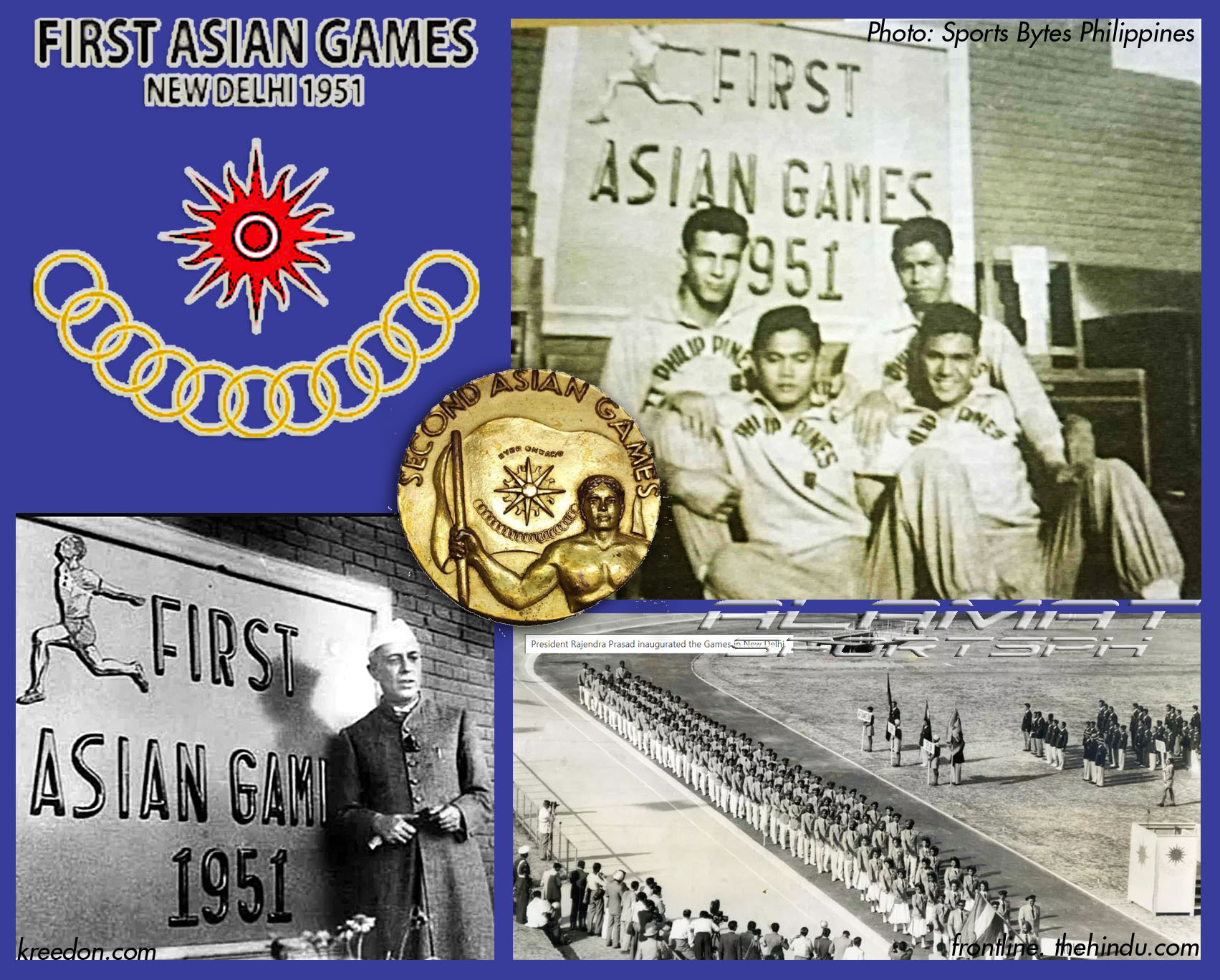
·       THE ASIAN GAMES (1951)

The Asian Games or the Asiad, is considered second-largest multi-sport event in the world after the Olympics. India took the lead in recommending a more inclusive competition to include more than just Far Eastern countries in 1949. The 1st Asian Games were held in New Delhi from 4-11 March 1951. A total of 489 athletes from 11 National Olympic Committees competed in 12 sports. Japan was allowed to compete in the inaugural Asiad, after being banned at the 1948 London Olympics. The Philippines placed a creditable 5th  (5 Golds, 6 Silvers, 8 Bronzes)   in the medal tally, and 3rd in the actual number of medals won.

Since the 1982 Games, the quadrennial events have been organized by the Olympic Council of Asia (OCA). The Games are recognized by the International Olympic Committee (IOC).

·       THE SOUTH EAST ASIAN GAMES (1959)

The SEA Games is a biennial multi-sport event involving participants from the current 11 countries of Southeast Asia. It is one of the five subregional Games of the Olympic Council of Asia (OCA).  First launched as the South East Asian Peninsular Games or SEAP Games (abbreviated as SEAPG), the event was an offshoot of a post-Asian Games in Japan in 1958.

Founding member countries Burma (Myanmar), Cambodia, Laos, Malaya (Malaysia), Thailand and Vietnam, agreed to hold a sports event to promote relations among countries of the region. The 1st SEAP Games was held in Bangkok from 12 to 17 December 1959, with the addition of Singapore. In 1977, the admission of the Philippines, Brunei and Indonesia to the games, prompted a name change to Southeast Asian Games Federation (SEAGF). In its debut appearance at the 1977 games, the Philippines placed 3rd overall, with 31 Golds, 30 Silvers and 30 Bronzes.


INTERNATIONAL SPORTS FEDERATIONS

Today, Olympic sports are represented by their own international sports federations and are an essential part of the Olympic movement. Some of these governing bodies include: World Athletics, FIBA (Fédération Internationale de Basketball) for basketball, FIFA (Fédération Internationale de Football Association) for football and soccer, FIG (Fédération Internationale de Gymnastique) for gymnastics, ISSF (International Shooting Sport Federation) for shooting, ITF (International Tennis Federation), and World Aquatics, for swimming, diving, water polo, artistic swimming.

There are 30 members of the Association of Summer Olympic International Federations which are recognized by the International Olympic Committee. The International Boxing Association (IBA) was dropped from this roster in June 2023 due to managerial, finance, refereeing and ethical issues

These federations mount a series of world cup or world championship tournaments that serve as Olympic qualification events as well. Filipino athletes like gymnast Carlos Yulo, hurdler Eric Cray, pole vaulter Ernest Obiena, swimmer Jessie lacuna, and the Philippine Basketball Team have represented the country in these international championship events.

SOURCES/ CREDITS:

Olympics: https://en.wikipedia.org/wiki/Olympic_Games

David Wallechinsky, “A Brief History of the Modern Olympics”, xxi-xxiii. The Complete Book of the Olympics, Penguin Books, 1988, p.

Far Eastern Games: Frederick O. England, History of the Far Eastern Athletic Association, from the  OFFICIAL BULLETIN of the INTERNATIONAL OLYMPIC COMMITTEE, p. 18.

Asian Games, Wikipedia: https://en.wikipedia.org/wiki/Asian_Games

Southeast Asian Games: https://en.wikipedia.org/wiki/SEA_Games

Logos of international federations, via google.

66. Post-War Belles of the Breaststroke: NORMA GUERRERO & LOLITA RAMIREZ, National Record Holders

The Philippine Women’s University was one of the first schools to have a competition-size pool—the Belen Perez Swimming Pool -- as part of ...