Showing posts with label Philippine sports history. Show all posts

3. Making History: Sprinter DAVID NEPOMUCENO, The 1st Philippine Olympian

The honor of becoming the first Philippine athlete to participate in the World Olympics belongs to DAVID NEPOMUCENO, a trackster who was officially sent to the 8th Olympiad in Paris, France, held from 4 May to 27 July, 1924.

Though still under American rule, the Philippines was allowed to join the International Olympic Committee in 1918, on the basis of its established Philippine Amateur Athletic  Federation (PAAF) which became the governing body of Philippine sports in 1911. It was only in 1924 though, that a Filipino athlete was sent to compete officially under our flag, making the Philippines the first country from Southeast Asia to join the world’s premiere sporting event.

David Nepomuceno was born in Oas, Albay on 29 June 1900. Not much is known about him before 1924, except that he comes from a quiet, unassuming family who valued hard work and simple living. He grew up in his humble town and obviously benefitted from the American physical education programs that were introduced in local public schools. The smalltown youngster proved proficient in both athletics and baseball which led to his participation in many interscholastic and regional meets.

As he came of age, Nepomuceno joined the U.S. Army’s Philippine Scouts based in Fort McKinley, Manila. His athletic prowess came into good use at the Philippine Department Athletic Tournament that was regularly held at Fort W. McKinley. Also known as McKinley Games, the large sporting event was participated in by members of the Philippine Scouts of the U.S. Army, various infantry units and air corps who competed in athletics, swimming, boxing and ball games.

Many of the top athletes from these games saw action at the PAAF Championships that were timed with the holding of the 1924 Manila Carnival at Wallace Field in February. That same year, the Olympic body opened slots for the Philippines in athletics at the scheduled Paris Olympiad. Barely 3 months after the carnival games, PAAF had to mount a series qualifying events in May 5, at Wallace Field.

The formidable sprinter from Leyte, Fortunato Catalon, was heavily favored to make it to Paris. After all, he was the Far Eastern Champion Games winner  for 4 consecutive editions (1917, 1919, 1921), winning Gold for both 100 yard and 220 yard races. But it was the younger Nepomuceno who pulled a major surprise, by running 100 yards in a sensational 9.54 seconds. Though Catalon matched his time for the same distance, he was overshadowed by Nepomuceno, as it was he was chosen to run the 100 m and 200 m. at the games, with Catalon as a “non-partant” (non-runner) in the sprint doubles, as listed on the official program, along with Juan Taduran in Decathlon.

Nepomuceno lost no time in preparing for his trip to French capital where the games were scheduled for 3 months, starting May and ending in July. In fact, he applied for a passport on May 14—7 days after the opening of the Olympics. Hi passport forms give us a glimpse of David’s personal details. The brown-complexioned Filipino listed his occupation as a soldier, standing 5 feet 3 inches tall, with an oval face and round chin. His mouth and forehead were of medium size. His hair was black, his eyes dark brown, with a turned-up nose (retrousse).

Three days later, he left on board passenger and cargo ship Sui Sang, along with PAAF official Dr. Regino Ylanan, who doubled as his coach, being a Far East Games veteran himself. After over a month of sea travel, the Philippine delegation of 3 people (the 3rd was attache B. Minelle) arrived in time for the start of the athletic events. Nepomuceno barely had a month to get adjusted to the European weather, size up the competition and  train for the heats that were set on the first week of July.

Nepomuceno was grouped with 5 other runners in Heat 6, of 17 heats total. These include Antonin Svoboda  (Czechoslovakia), Henricus Adrianus “Harry” Broos (Holland), George Dustan (South Africa), Poul Schiang (Denmark), and José-María Larrabeiti (Spain). With his physical condition affected by the long trip, Nepomuceno had an unremarkable run, trailing all the runners, finishing sixth, and last.

The 100 meter dash finals was won by Harry Abrahams of Great Britain, whose victory was retold in the 1981 Oscar award-winning film, “Chariots of Fire”. Despite being branded as a true story, it has a few factual errors. For example, Abrahams did not look at the 100 meter race as a chance to redeem himself for his 200 meter loss, since the 100 m. preceded the 200 m. finals.

Our valiant Olympian fared better in the heats for the 200 meter-dash.  Lumped in Heat 15 with Maurice Degrelle (France) , Marinus van den Berge (Holland), Lawrence Betts (South Africa) and Henricus Cockuyt (Belgium), Nepomuceno placed third. Unfortunately, only the first 2 fastest could advance to the quarterfinals.

Still, Nepomuceno came home with head up high, as his Olympic experience only served to bolster his reputation as a major force to reckon with in Asian athletics. The next year, he proved just that in the 1925 Far Eastern Games in Manila, recording a personal best of 22.5 secs. in the 200 meter dash, defeating the strong Japanese contenders.

Then, in the 1927 staging of the Games in Shanghai, he won the Gold medal in the 100 meter dash, registering a record-breaking time of 10.6 secs., the first Filipino athlete to run the distance under 11 seconds, a clocking that stood for many years.

He continued to compete sporadically in the 1930s, and newspapers would still refer to him as “the 1st Filipino in the Olympics”, “former Olympic ace”, and “brilliant Olympic veteran” years after his Paris odyssey. In 1934, David was still good to be shortlisted for training by American coaches for possible inclusion in the next Philippine Olympic Team. Few years later, he opted to retire early from the Philippine Scouts and retreat to his quiet, domestic life. He was afflicted with a lingering lung disease which led to his hospitalization at the Sternberg General Hospital beginning in May 1939.

He never recovered from his disease and passed away 4 months later at age 39 on 7 September 1937. David Nepomuceno will go down in the history of Philippine sports as a pioneer athlete who made history by raising the flag of the Philippines for the very first time on the world’s biggest sports stage, for other great Filipino athletes to follow.

Source: wikimedia, David Nepomuceno

SOURCES/REFERENCES:

David Nepomuceno phot, https://catalog.archives.gov/id/143942829?objectPage=320

The Far East Games, https://www.rsssf.org/tablesf/fareastgames.html

“Two Filippinos did 100 Yards in 9.45 secs.The Boston Globe, Mass. 5 May 1924 issue, p.13

“107 Athletes are on Tentative List”, Tribune (Philippines : 1932 - 1945), Saturday 17 February 1934, page 9

“Track Contest On Next Month, Entries Now Open at PAAF Office; Several Veteran Athletes Competing”, The Tribune, 9 Sep. 1933 issue, p. 7.

“Nepomuceno, Former Olympic Ace, Passes”, The Tribune, Thursday 28 Sept.  1939 issue, p. 11

Jojo de Jesus for Dateline Ibalon,”David Nepomuceno, Pioneer Filipino Olympian from Oas, Albay”,  3 Aug. 1924.

David Wallechinsky, The Complete Book of the Olympics, published by the Penguin Group, 1988.

Official Report of the 1924 Paris Olympic Games, LA84 Digital Library.

2. LET THE GAMES BEGIN!

Brief histories of major international sporting competitions with Philippine participation.

·       THE MODERN OLYMPIC GAMES (1896)

Based on the ancient Olympic Games held in Olympia, Greece every 4 years, from at least 776 B.C. until they were banned by Emperor Theodosius in 393 A.D. Inspired by the original, Baron Pierre de Coubertin of France conceived the modern Olympic Games. Thus, the first modern Olympiad unfolded with much success in its original birth country, Greece—the 1896 Athens Olympics. Fourteen nations and 241 athletes (all males) took part in 9 sporting disciplines (Athletics, Cycling, Fencing, Gymnastics, Shooting, Swimming, Tennis, Weightlifting, Wrestling. 

In 1918, the Philippines was accepted by the International Olympic Committee in 1918. But it was only in 1924--the 8th staging of the Games--that the Philippines sent a lone athlete accompanied by his coach. That honor belongs to Bicolano David Nepomuceno, a sprinter who raced in the 100 meter and 200 meter events. The first-ever Filipino to medal at the Olympics was the swimmer Teofilo Yldefonso who took home a Bronze medal at the 1928 games in Amsterdam. Filipino athletes have appeared in every edition of the Summer Olympic Games from 1924 onwards, except for Moscow 1980 when the nation was part of the American-led boycott.

·       THE FAR EASTERN CHAMPIONSHIP GAMES (1913-1938)

Also known as the Far Eastern Olympic Games, Far Eastern Championships, Far Eastern Games, and the Oriental Olympics,  this was the first  Asian multi-sport event considered to be the predecessor of the Asian Games.

In 1913, Elwood Brown, president of the Philippine Amateur Athletic Association, proposed the creation of the "Far Eastern Olympic Games" to China and Japan. The Far Eastern Olympic Assocation (FEOA) was thus formed to organize the  first edition that was held on the Manila Carnival grounds (the future Rizal Memorial Sports Complex) from 1-9 February 1913.  Japan sent 12 delegates, China 40, and the host Philippines a whopping 103 athletes.  Gov. Gen. Wiliam Cameron Forbes welcomed the athletes who contested medals in 5 sports: Athletics, Swimming, Soccer, Basketball, and Volleyball. The Games were a huge success. As the Philippine Free Press reported: "the Far Eastern Olympiad is quite the most significant event that has touched Oriental peoples in united action. They have never met before for united action on any basis other than athletics". Brown reported its success  to Olympic founder Pierre de Coubertin, who approved of the  games but suggested to drop the term "Olympiad"  as it was already in use by the Olympic Games. hence, in 1915, it was called the Far Eastern Championship Games.  The Games would come to include China, Empire of Japan, British East Indies (Malaysia), Thailand and British crown colony Hong Kong.  The Far Eastern Games ran every 2 years from 1913 to 1935, but the 1937 edition slated in Osaka, Japan was cancelled with the brewing second world war.

·       THE ASIAN GAMES (1951)

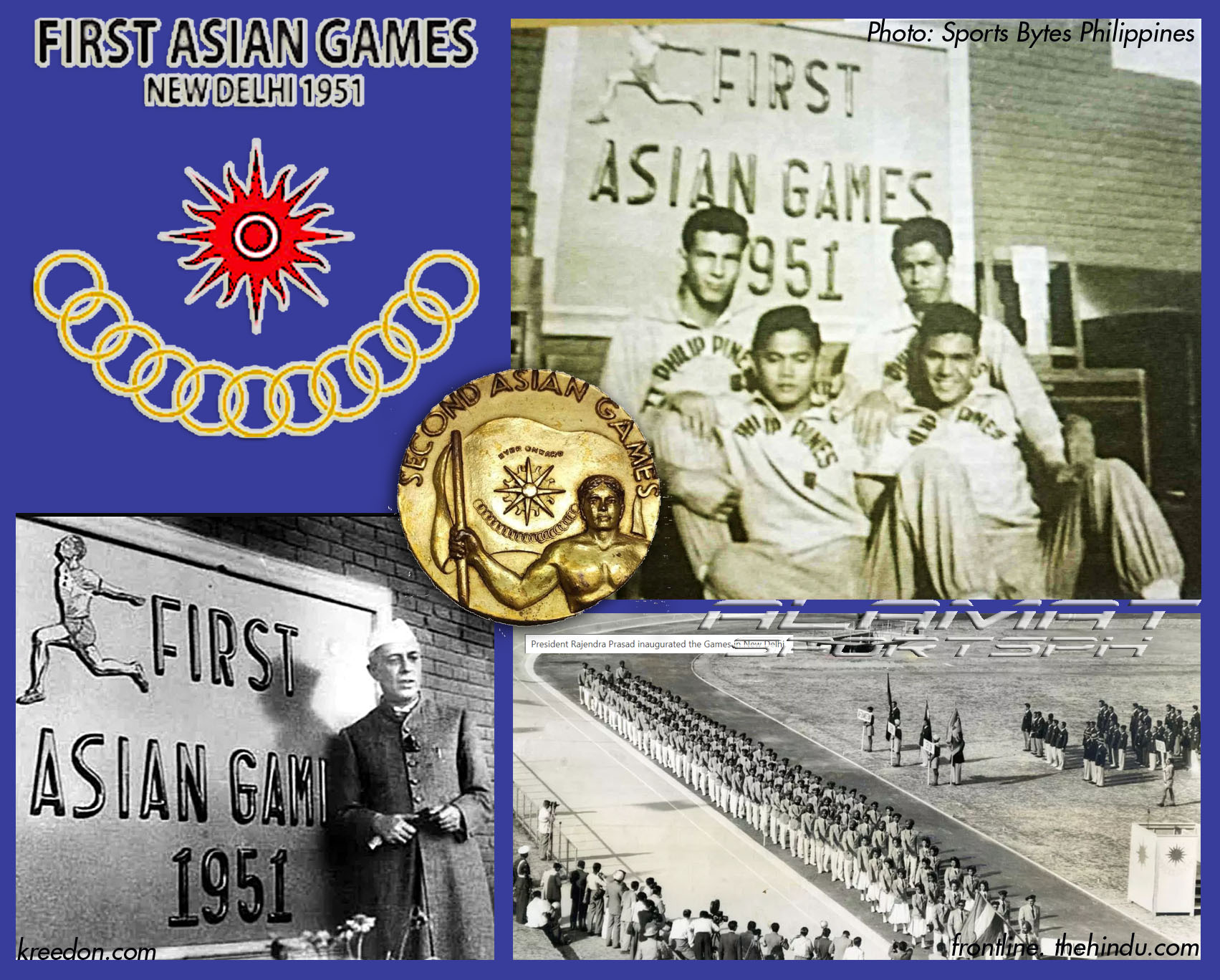
The Asian Games or the Asiad, is considered second-largest multi-sport event in the world after the Olympics. India took the lead in recommending a more inclusive competition to include more than just Far Eastern countries in 1949. The 1st Asian Games were held in New Delhi from 4-11 March 1951. A total of 489 athletes from 11 National Olympic Committees competed in 12 sports. Japan was allowed to compete in the inaugural Asiad, after being banned at the 1948 London Olympics. The Philippines placed a creditable 5th  (5 Golds, 6 Silvers, 8 Bronzes)   in the medal tally, and 3rd in the actual number of medals won.

Since the 1982 Games, the quadrennial events have been organized by the Olympic Council of Asia (OCA). The Games are recognized by the International Olympic Committee (IOC).

·       THE SOUTH EAST ASIAN GAMES (1959)

The SEA Games is a biennial multi-sport event involving participants from the current 11 countries of Southeast Asia. It is one of the five subregional Games of the Olympic Council of Asia (OCA).  First launched as the South East Asian Peninsular Games or SEAP Games (abbreviated as SEAPG), the event was an offshoot of a post-Asian Games in Japan in 1958.

Founding member countries Burma (Myanmar), Cambodia, Laos, Malaya (Malaysia), Thailand and Vietnam, agreed to hold a sports event to promote relations among countries of the region. The 1st SEAP Games was held in Bangkok from 12 to 17 December 1959, with the addition of Singapore. In 1977, the admission of the Philippines, Brunei and Indonesia to the games, prompted a name change to Southeast Asian Games Federation (SEAGF). In its debut appearance at the 1977 games, the Philippines placed 3rd overall, with 31 Golds, 30 Silvers and 30 Bronzes.


INTERNATIONAL SPORTS FEDERATIONS

Today, Olympic sports are represented by their own international sports federations and are an essential part of the Olympic movement. Some of these governing bodies include: World Athletics, FIBA (Fédération Internationale de Basketball) for basketball, FIFA (Fédération Internationale de Football Association) for football and soccer, FIG (Fédération Internationale de Gymnastique) for gymnastics, ISSF (International Shooting Sport Federation) for shooting, ITF (International Tennis Federation), and World Aquatics, for swimming, diving, water polo, artistic swimming.

There are 30 members of the Association of Summer Olympic International Federations which are recognized by the International Olympic Committee. The International Boxing Association (IBA) was dropped from this roster in June 2023 due to managerial, finance, refereeing and ethical issues

These federations mount a series of world cup or world championship tournaments that serve as Olympic qualification events as well. Filipino athletes like gymnast Carlos Yulo, hurdler Eric Cray, pole vaulter Ernest Obiena, swimmer Jessie lacuna, and the Philippine Basketball Team have represented the country in these international championship events.

SOURCES/ CREDITS:

Olympics: https://en.wikipedia.org/wiki/Olympic_Games

David Wallechinsky, “A Brief History of the Modern Olympics”, xxi-xxiii. The Complete Book of the Olympics, Penguin Books, 1988, p.

Far Eastern Games: Frederick O. England, History of the Far Eastern Athletic Association, from the  OFFICIAL BULLETIN of the INTERNATIONAL OLYMPIC COMMITTEE, p. 18.

Asian Games, Wikipedia: https://en.wikipedia.org/wiki/Asian_Games

Southeast Asian Games: https://en.wikipedia.org/wiki/SEA_Games

Logos of international federations, via google.

1. ALL THE WORLD'S A SPORTS STAGE

WELCOME TO PHILIPPINE SPORTS ALL-STARS! This blog recalls the greatest moments in Philippine sports and the glorious athletes of yesteryears, both celebrated and unsung, who animated the sports arenas, here and around the world, with their show of strength, endurance, resilience and national pride.

Ever since the age of organized sports, Filipinos have been competing for God, country and personal glory with varying degrees of success. Before that, the only competitive game known in the country was the noncontact sport of  “sipa”- where a small bamboo ball kicked back and forth between 2 lines of players. Another leisure game popular in rural areas was ‘sabong’ or cockfighting.

It was during the American Regime that sports came into full flower, deeming it essential to keep the people of their new territory physically and morally fit. An American soldier introduced baseball in 1899, gaining such wide popularity—until basketball took over. Taught through the school system, basketball was an instant hit.

Filipinos took to these sports not only for leisure, but also to assert their nationalism, as they competed against their taller, heavier opponents.

By 1913, sports was making rapid advancements in the country. “In no other part of the world has physical education and recreation made such remarkable progress in so brief a time as in the Philippines”. Manila YMCA director Elwood S. Brown observed. The Bureau of Education reported that 400,000 Filipino children are engaged in some form of activity. There were “hundreds of baseball teams, leagues in many kinds of sports, frequent track and field meets, …and an Amateur Athletic Federation that promoted competitive athletics in the community..”

Americans organized athletic meets of all sorts, beginning in schools and in national events like the annual Manila Carnival that began in 1908. The 2-week fair held sports competitions for participating schools and government bureaus, that included disciplines like athletics and swimming events.

There were regular Army Athletic meets known as McKinley Games that had a mix of American and Filipino participants, who competed in separate divisions. The major meet, held at Fort McKinley, included Aquatics (swimming), Track and Field (sprint and long distance running, pole vault),  Ball Games (baseball, basketball), and Boxing. The annual meet that began in the 1920s, is credited with developing athletics in the country.

The performance standards of Filipino athletes leveled up as they began pitting their skills against their counterparts from other countries. From regional athletic meets, they found their way representing the Philippines in the earliest international sports competitions that would of course, come to include the premier and most celebrated sporting events in the world--the Olympics.

SOURCES/ CREDITS:

Elwood S. Brown, Athletics in the Philippines Islands and the Far Eastern Olympic Games

McKinley Games, The Tribune, Sports Page, 19 Dec. 1931.

64. FELICISIMO ‘Mighty Mite’ H. AMPON: Tennis Giant, by Dr. Rey E. De La Cruz

(This original article is reposted here with permission from the author, Dr. Rey E. De La Cruz, via "Positively Filipino". Origina...