Showing posts with label SEA Games. Show all posts

56. The Flight of Her Javelins: ERLINDA LAVANDIA (1975 to present)

There have only been a handful of successful female javelin throwers from decades in the Philippines—names like Asian Games medalists Vivencia Sabado (1954) , Marcelina Alonso (1966), and national record holder Josephine de la Viña (1971) come to mind.  But no other athlete was as stellar as the ERLINDA LAVANDIA, who dominated the field event for decades, beginning with her debut appearance at the Northern Mindanao Regional Athletic Meet, leading to her amazing medal run in 9 editions in the Southeast Asian Games, where she secured 9 podium finishes, 4 of them Gold.

So untouchable was Lavandia, that she extended her wins long after her retirement, by participating in Asian Masters and  World Masters Athletic Championships, winning more medals even beyond the age of 70. 

Her incredible story began in the small barangay of Marga, Tubod town in distant Surigao del Norte, where she was born on 9 April 1952, to parents Pedro Lavandia Sr. and Eustaquia Bacasnot. Erlinda was the eldest of 8 children ((four girls and four boys) and was destined to be the only athlete in the family.

Her early years were spent in Surigao, where she studied at Tubod Elementary School and proceeded to the Surigao Del Norte National High School.  A sporty kid, she was into everything, from volleyball to running, but it was baseball that became her first love, where she excelled as a catcher. Seeing her far-reaching throws, her first coach Lotheo Seftimo, a college PE teacher, lured her back to athletics—but this time, to the field events of javelin throw, discus throw, hammer throw and shot put.

In 1972, while in her senior year in high school, she was spotted by then Surigao del Norte Gov. Jose C. Sering, and president of the Philippine Amateur Track and Field Association (PATAFA). The sports executive had seen her performances at the Northern Mindanao Meet in Cagayan de Oro City, Misamis Oriental where she won the javelin Gold, along with her Palarong Pambansa triumph in Bacolod City, Negros Occidental, and was duly impressed. He recruited her for the national team pool and she started her intensive training under Sering’s watchful supervision.

In 1975, the Philippines was invited to join Singapore’s “Festival of Sports”, Pesta Sukan, and it sent a basketball team and a small contingent of athletes including Lavandia. In her first international meet, she won the Gold in javelin. From then on, there was not stopping the hefty, 5’4” thrower.

But Lavandia’s test would come two years later at the very first 1977 Southeast Asian Games at the Merdeka Stadium, Kuala Lumpur, Malaysia. It was the inaugural appearance of the Philippines in the multi-sports subregional meet, an off-shoot of the Southeast Asian Peninsular Games that had its final staging in 1975.  The unheralded Lavandia was chosen as one of the pioneer athletes to debut in the games, and she came through with a milestone win—winning the Gold with a throw of 45.22 m., more that 3 meters away from the Singaporean Silver medalist Chua Kim Tee, who did 41.98 m. In so doing, Lavandia established a new Games Record in Javelin Throw, a feat she would repeat in the next two SEA Games.

By 1979, Lavandia had joined the Gintong Alay project sports development and training project that would further hone her athletic skills. She not only defended her javelin title in Jakarta in 1979 with an improved 45. 78 m. throw, and in Manila in 1981, with a 46.20 m. effort, but she broke her own championship records in the process.

Her arch-rival Norsham Yoon of Malaysia would snap her golden streak at the 1983 Singapore SEA Games but Lavandia would reclaim the title in 1985 Thailand SEA Games with a personal best of 47.96 m., another games record. In her 9 years of continuous SEA Games participation,  she always medalled; her last 4 games (1987 Jakarta, 1989 Kuala Lumpur, 1991 Manila, 1993 Singapore) earned her 2 more Silvers and 2 Bronzes.

For many athletes, retirement from the playing field comes at 40. But Lavandia was not done competing yet, for in 1994, at the age 42, she began joining the Asian Masters on a regular basis, collecting a total of 12 Gold Medals by 2016---and she is not stopping. Some of her spectacular wins in the Asian Masters was in 2012, with her record-breaking victory in the javelin event for women 60-64 years old. Lavandia’s new mark was at 32.26 m., accomplished in her final throw. She smashed the old record of 27.36 m. set by Japan’s Kato Atsuko in Thailand in 2009. With that’s, she became the owner of all javelin throw records in the 40 (set in Jakarta, 1994), 45 (Okinawa, 1998), 50 (Dalian, China 2002), and 55 year-old category (Kuala Lumpur, 2010).

In the 2013 World Masters Athletic Championship, Lavandia also made news with her golden win,  hurling the javelin to a distance of  39.83 m. At the 23rd World Masters Athletics Championships in Malaga, Spain, she placed third in the women’s 65-69 javelin throw, doing 27.95 m. on her first attempt.

Her best year was in 2019 at the  Southeast Asia Athletic Championship held in Singapore in May, when the 67-year-old won 4 Golds in different throwing events: javelin, discus, shotput and hammer throw. Her winning momentum continued in 2022 at the Kuala Lumpur International Masters Athletics Championships, where brought home three medals -- 2 Golds (javelin throw and discus throw) and 1 Silver (shot put) .

Her latest feat was at the 22nd Asia Masters Athletics Championships held on November 8-12, 2024 at New Clark City stadium. Before a home crowd Lavandia, now 72, won Golds in the javelin and hammer throw,  plus a Silver in the discus.

Lavandia belongs to an elite field of rare, competitive, more mature athletes—the likes of Felicisimo Ampon, Robert Jaworksi, Elma Muros, Efren Bata Reyes, and even Manny Pacquiao—who do not consider age as a barrier. Our greatest javelin thrower however, believes also in a winning formula she calls her 3Ds -- dedication, determination and discipline, which she has been following all these years to stay in winning form.

The 73 year old legend is also grateful for the sports that has opened opportunities for her to make her dreams take flight and fulfill her role as the eldest in the family. Since the start of her sporting career, she has been doling out financial aid, helping out with family expenses, and sending her siblings to school. Most of all, she believes in giving back to the country she loves. In between competitions, Lavandia  served in the police force, rising to become a Police Chief Inspector until her retirement in 2008. "I always do my best in every competition”, she says, “ Every victory is special for me because I know that I'm doing it for my country.”

SOURCES:

Photos: Erlinda Lavandia FB Page

Athletics at the 1977 SEA Games, https://en.wikipedia.org/wiki/Athletics_at_the_1977_SEA_Games

Erlinda Lavandia Athletic Records: https://athleticspodium.com/athlete/27950/erlinda-lavandia

 “Erlinda Lavandia shares how she started playing Javelin throw”|Magandang Buhay”, ABS-CBN youtube channel, https://www.youtube.com/watch?v=xco-dgsNPD0&t=170s

“PH javelin queen Lavandia still in top form”, by Jean Malanum, January 14, 2023,

https://www.pna.gov.ph/articles/1192734

2. LET THE GAMES BEGIN!

Brief histories of major international sporting competitions with Philippine participation.

·       THE MODERN OLYMPIC GAMES (1896)

Based on the ancient Olympic Games held in Olympia, Greece every 4 years, from at least 776 B.C. until they were banned by Emperor Theodosius in 393 A.D. Inspired by the original, Baron Pierre de Coubertin of France conceived the modern Olympic Games. Thus, the first modern Olympiad unfolded with much success in its original birth country, Greece—the 1896 Athens Olympics. Fourteen nations and 241 athletes (all males) took part in 9 sporting disciplines (Athletics, Cycling, Fencing, Gymnastics, Shooting, Swimming, Tennis, Weightlifting, Wrestling. 

In 1918, the Philippines was accepted by the International Olympic Committee in 1918. But it was only in 1924--the 8th staging of the Games--that the Philippines sent a lone athlete accompanied by his coach. That honor belongs to Bicolano David Nepomuceno, a sprinter who raced in the 100 meter and 200 meter events. The first-ever Filipino to medal at the Olympics was the swimmer Teofilo Yldefonso who took home a Bronze medal at the 1928 games in Amsterdam. Filipino athletes have appeared in every edition of the Summer Olympic Games from 1924 onwards, except for Moscow 1980 when the nation was part of the American-led boycott.

·       THE FAR EASTERN CHAMPIONSHIP GAMES (1913-1938)

Also known as the Far Eastern Olympic Games, Far Eastern Championships, Far Eastern Games, and the Oriental Olympics,  this was the first  Asian multi-sport event considered to be the predecessor of the Asian Games.

In 1913, Elwood Brown, president of the Philippine Amateur Athletic Association, proposed the creation of the "Far Eastern Olympic Games" to China and Japan. The Far Eastern Olympic Assocation (FEOA) was thus formed to organize the  first edition that was held on the Manila Carnival grounds (the future Rizal Memorial Sports Complex) from 1-9 February 1913.  Japan sent 12 delegates, China 40, and the host Philippines a whopping 103 athletes.  Gov. Gen. Wiliam Cameron Forbes welcomed the athletes who contested medals in 5 sports: Athletics, Swimming, Soccer, Basketball, and Volleyball. The Games were a huge success. As the Philippine Free Press reported: "the Far Eastern Olympiad is quite the most significant event that has touched Oriental peoples in united action. They have never met before for united action on any basis other than athletics". Brown reported its success  to Olympic founder Pierre de Coubertin, who approved of the  games but suggested to drop the term "Olympiad"  as it was already in use by the Olympic Games. hence, in 1915, it was called the Far Eastern Championship Games.  The Games would come to include China, Empire of Japan, British East Indies (Malaysia), Thailand and British crown colony Hong Kong.  The Far Eastern Games ran every 2 years from 1913 to 1935, but the 1937 edition slated in Osaka, Japan was cancelled with the brewing second world war.

·       THE ASIAN GAMES (1951)

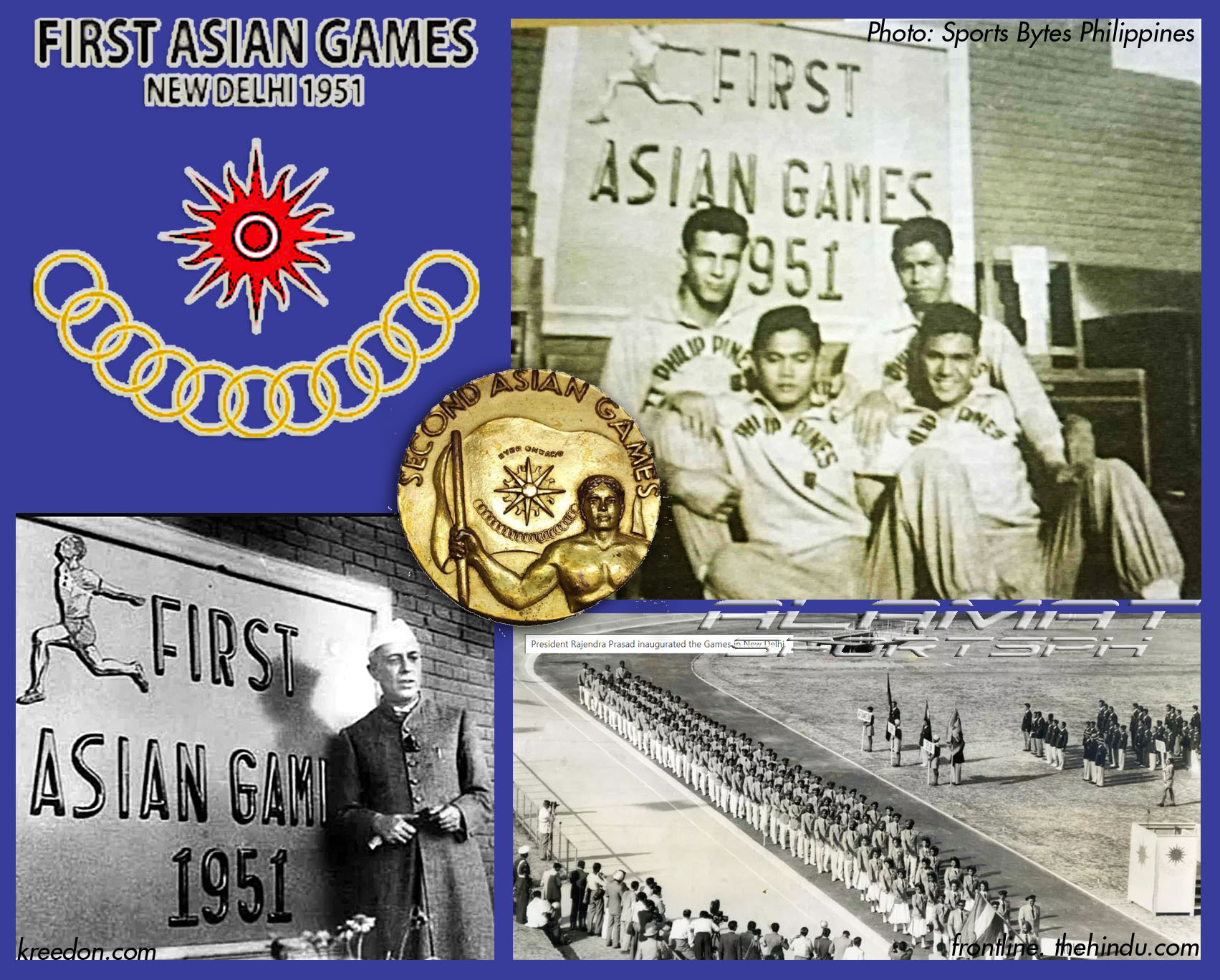
The Asian Games or the Asiad, is considered second-largest multi-sport event in the world after the Olympics. India took the lead in recommending a more inclusive competition to include more than just Far Eastern countries in 1949. The 1st Asian Games were held in New Delhi from 4-11 March 1951. A total of 489 athletes from 11 National Olympic Committees competed in 12 sports. Japan was allowed to compete in the inaugural Asiad, after being banned at the 1948 London Olympics. The Philippines placed a creditable 5th  (5 Golds, 6 Silvers, 8 Bronzes)   in the medal tally, and 3rd in the actual number of medals won.

Since the 1982 Games, the quadrennial events have been organized by the Olympic Council of Asia (OCA). The Games are recognized by the International Olympic Committee (IOC).

·       THE SOUTH EAST ASIAN GAMES (1959)

The SEA Games is a biennial multi-sport event involving participants from the current 11 countries of Southeast Asia. It is one of the five subregional Games of the Olympic Council of Asia (OCA).  First launched as the South East Asian Peninsular Games or SEAP Games (abbreviated as SEAPG), the event was an offshoot of a post-Asian Games in Japan in 1958.

Founding member countries Burma (Myanmar), Cambodia, Laos, Malaya (Malaysia), Thailand and Vietnam, agreed to hold a sports event to promote relations among countries of the region. The 1st SEAP Games was held in Bangkok from 12 to 17 December 1959, with the addition of Singapore. In 1977, the admission of the Philippines, Brunei and Indonesia to the games, prompted a name change to Southeast Asian Games Federation (SEAGF). In its debut appearance at the 1977 games, the Philippines placed 3rd overall, with 31 Golds, 30 Silvers and 30 Bronzes.


INTERNATIONAL SPORTS FEDERATIONS

Today, Olympic sports are represented by their own international sports federations and are an essential part of the Olympic movement. Some of these governing bodies include: World Athletics, FIBA (Fédération Internationale de Basketball) for basketball, FIFA (Fédération Internationale de Football Association) for football and soccer, FIG (Fédération Internationale de Gymnastique) for gymnastics, ISSF (International Shooting Sport Federation) for shooting, ITF (International Tennis Federation), and World Aquatics, for swimming, diving, water polo, artistic swimming.

There are 30 members of the Association of Summer Olympic International Federations which are recognized by the International Olympic Committee. The International Boxing Association (IBA) was dropped from this roster in June 2023 due to managerial, finance, refereeing and ethical issues

These federations mount a series of world cup or world championship tournaments that serve as Olympic qualification events as well. Filipino athletes like gymnast Carlos Yulo, hurdler Eric Cray, pole vaulter Ernest Obiena, swimmer Jessie lacuna, and the Philippine Basketball Team have represented the country in these international championship events.

SOURCES/ CREDITS:

Olympics: https://en.wikipedia.org/wiki/Olympic_Games

David Wallechinsky, “A Brief History of the Modern Olympics”, xxi-xxiii. The Complete Book of the Olympics, Penguin Books, 1988, p.

Far Eastern Games: Frederick O. England, History of the Far Eastern Athletic Association, from the  OFFICIAL BULLETIN of the INTERNATIONAL OLYMPIC COMMITTEE, p. 18.

Asian Games, Wikipedia: https://en.wikipedia.org/wiki/Asian_Games

Southeast Asian Games: https://en.wikipedia.org/wiki/SEA_Games

Logos of international federations, via google.

66. Post-War Belles of the Breaststroke: NORMA GUERRERO & LOLITA RAMIREZ, National Record Holders

The Philippine Women’s University was one of the first schools to have a competition-size pool—the Belen Perez Swimming Pool -- as part of ...