Showing posts with label 1956 Melbourne Olympics. Show all posts

62. Hurdler Supreme of the 1950s: FRANCISCA SAÑOPAL

The best and most successful Filipina hurdler of the 50s decade , was without a doubt, the Ilongga all-around athlete FRANCISCA SAÑOPAL. Born on 1 Jan, 1931 in the small barrio of Montinola, in San Joaquin town, Francisca, as a teen, was drawn to the different disciplines of Athletics, competing in throwing events, the sprints and relays, and the short hurdles.

These achievements would pave the way for her trailblazing international stints, competing in 2 editions of the Asian Games and the Olympics. She was a product of the Cebu Institute of Technology, that was renowned for its excellent women’s sports programs, producing a pool of runners, jumpers and throwers of world-class calibre, Some of its outstanding athletes include Asia’s fastest, Inocencia Solis, top broad jumper Visitacion Badana, and the young discus thrower, Josephine dela Viña.

She made her presence felt as a sprinter in the National Intercollegiate, Intersecondary, and Women’s Track & Field beginning in 1954, when she won the 100 meter dash. The next year, Sañopal took the limelight from national record holder Manolita Cinco of the University of Southern Philippines, when she broke her record by 0.2 seconds  at the 1955 National Open Track & Field Meet. The two would become dominant names in women’s hurdles for the next few years—and also the fiercest rivals.

Francisca Among the First Filipina Olympians

This led to her selection by the Philippine Amateur Athletic Federation to the 1956 Philippine Olympic Team—a historic and unprecedented one as it marked the first time that Filipinas will compete in the world’s premiere and biggest sporting competition. Also chosen to go to Melbourne for the Summer Olympics were her worthy competitor, Manolita Cinco and two swimmers, Jocelyn von Giese, and 13 year old Gertrudes Lozada, who turned out to be the youngest athlete of the games.

Coached by Jose Ravello, Sañopal and Cinco were actually entered in the 100 m. dash and the 80 m. low hurdles, but it was decided that they had better chances at the hurdles so they did not go thru with the sprint heats. There were only 22 athletes from 11 country participants, with the Philippines as the lone Asian entry.

 In the qualifying heat for the hurdles, Sañopal ran in Heat #4—the last heat that only had 5 participants. It was won by Australian Norma Claire Thrower (10.8 secs.), followed by the Russian Galina Bystrova (10.9 secs.), the French Marthe Lambert, (10.9 secs.), the German Maria Sander (11.1 secs). Sañopal was 5th and last with a time of 11. 8 secs. Cinco fared no better, timing in at 12.1 secs. in placing 7th and last in Heat#3. The Australian legend, Shirley Strickland won the 80 m. hurdle with a new Olympic record of 10.7 sec. trailed by Gisela Kohler of Germany (10.9 secs.) Thrower, who topped Sañopal’s heat, placed 3rd in 11 secs. flat.

 Overall, Sañopal ranked 17th from among the 22 athletes, while Cinco was second to the last. The Melbourne Olympics were a good experience for the 2 hurdlers, and upon returning home, the inspired Sañopal lost no time in training for the next important races schedules for 1957.

Hurdling for Honor, Among Others

It was at the 1957 National Intercollegiate, Intersecondary and Women’s Track and Field Championship that Sañopal would serve notice of her significant improvement and unparalleled athletic versatility. Held from 23-24 February 1957 at the Rizal Track-Football Stadium, Sañopal was entered by her school in 2 track races (the 80 m. hurdles, and the 100 m. dash)  and 2 throwing events (javelin throw and the shot put). She reached all the finals of those events, garnering various degrees of success.

As expected, she ruled the 80. m. low hurdles, winning the Gold in 12.4 secs, followed by schoolmate, Lilia Heramis in 12.5.  Manolita Cinco of USP settled for 3rd, also with  12.5 seconds.

In the century dash, Sañopal placed second to the seasoned Inocencia Solis, clocking in at 13.3 secs., just 0.1 behind Solis. Up and coming sprinter Rogelia Ferrer of Manila Central University  was 3rd in 13.4 seconds.

She then moved to the field events, where she threw the Javelin to a distance of 112’ 7 3/8” to claim Gold, with  Presentacion Juele of MCU a distant second with her 108’ 11 ¼” effort. Sañopal relegated the 1954 Asian Games bronze medalist Vivencia Sabido of CIT, who managed only 108’5”.

But she was not done yet—in her last event, she put the shot at a distance of  28’6” , good for 4th place behind USP’s  Gloria Villanueva ( 33’ 6 1/8”), CIT’s Perla Pimentel

( 31’9”) and the comebacking Vivencia Sabido (29’ 1/8”).

 Most Outstanding Athlete of 1957

In 1957, the 2-day National Track & Field Championships were held in the first week of March. It proved to be the best season for Sañopal as she outclassed competition, capturing 3 Golds: first, for her pet event, the 80 m. hurdles, timing in at 12 secs. flat, pushing Cinco to 3rd. Her 2nd Gold was in the Javelin which she heaved at distance of 127 ft. 8 5/8 in., a full 9 inches farther than Corazon Barredo of the Bureau of Education.

Her 3rd and last Gold was the women’s 4 x100 m. relay, where she and teammates  Lucrecia Casorla. Inocencia Solis, Visitacion Badana smashed the 50 sec. barrier, setting a new record of 49.6 secs. This was one of only 2 records set in the meet, so it was a very special win for the Cebu Tech amazons.

As a bonus, the sturdy Sañopal added a Bronze (13.3. secs.) to her medal harvest after placing 3rd to Inocencia Solis (12.4 secs.) and Rogelia Ferrer (12.9 secs.)  in the 100 m. dash. For these extraordinary feats, Francisca Sañopal was singled out and acclaimed as the Most Outstanding Athlete of the National Open meet, and was honored with a trophy by P.A.A.F. meet officials.

Milestone Triumphs at the Asian Games

Though exalted as the most exemplary athlete in the country for 1957,  there was still that yearning for Sañopal to see how far she could push herself, by testing her limits against the best in the world. The Olympics had given her that glimpse, but she was still so inexperienced then, she needed more exposure to more intensive competition. In 1958, another opportunity opened, with the staging of the third Asian Games in Tokyo, Japan. 

At 27,  Sañopal was at the peak of her strength and power. She was entered in her favorite event, the 80 m. hurdles—along with Manolita Cinco-- as well as the relay races. The Philippine women’s team made an auspicious start when Visitacion Badana won the Long Jump Gold in the first day of the athletic competition.

Seven finalists entered the stadium for the finals of the 80 meter low hurdles that fateful day to get into their positions At the sound of the gun, 2 Filipinas ran the best race of their lives as they left their starting blocks to clear the hurdles before them en route to honor and glory for their country.

The highly vaunted hefty Japanese Michiko Iwamoto and Francisca Sañopal ran stride-for-stride, clearing the hurdles with precision all the way to the finish, and both crossed the line with identical 11.6 secs. –a new Games Record. The judges however, awarded Iwamoto the Gold medal based on the photo finish. Sañopal got the Silver, though Cinco somehow eased the loss by scooping the Bronze with her 12.1 secs. run.

Sañopal’s final race was the 4 x100 m. women’s relay.  Again, the strong Japanese team were figured to win. The strategy was to put the 2 fastest Filipinas—Inocencia Solis and Rogelia Ferrer---as the lead runners. Youngest member Irene Penuela will then take over and pass on the baton to Francisca Sañopal, known for her strong finishing kick. With the Japanese ahead, the Filipinas maintained their 2nd place position against the fast-catching Indians, with Sañopal as anchor. Japan won the Gold as expected, while the Filipinas secured the Silver with a new Philippine record of 49.0 secs, bettering their 3rd place finish in the last Asiad. The dethroned Indians came in 3rd place.

Francisca Sañopal would return to the Asian Games and run the same events a second time—but this time, with biggest difference. The event was the 1962 Asian Games in Jakarta, Indonesia, and the setting was the National Senayan Stadium where all athletic sports were contested.

In the 80 m hurdles, she had to run against the strong Japanese Olympian, Ikuko Yoda who won the race in 11.6 secs. Only split seconds later, Sañopal and another Japanese, Kiyoko Shimada, crossed the finish line with the same time of 12 secs. This time, Sañopal was awarded the Silver, for a rare back-to-back finish.

The best race of her career was saved for last—the 4 x100 m. relay. This event has been monopolized by the Japanese women for so long, but little did they know that the Philippine quartet had something in their sleeves. The 4 women included 2 tried and tested veterans—Solis and Sañopal—with 2 young, brilliant sprinters: Aida Molinos and the stellar Mona Sulaiman.

The women were strategically arranged from the one with the slowest time, to the fastest, hence: Molinos, Sañopal, Solis and Sulaiman. With excellent running and precise baton passes, the Filipina squad matched the Japanese with every stride resulting in an exciting photo-finish.

When the times were shown on the screen,  the Philippines completed the race in 48.67 secs, a new national record, with the Japanese registering 48.74 secs.—just a mere  .07 secs. away. The Filipinas had won the Gold! The Indons came in 3rr in 50.71 secs., a cause for celebration for the host country.  

The victory was a fitting punctuation  to Sañopal’s sensational athletic career. After a jubilant welcome for the returning heroes, the self-effacing 31 year old Sañopal faded quietly from the limelight. In 2014, when a rare gathering of former Olympians organized by the Philippine Olympians Association (POA) only her rival Manolita Cinco, was there to share her reminiscences of their glory days.No more was heard about Francisca Sañopal, not even her passing—the day she crossed over her last hurdle to the great beyond—and to immortality--as the most accomplished Filipina hurdler of her time.

SOURCES:

The Filipino Athlete (Official Publication of the P.A.A.F.), 1957 National Intercollegiate, Intersecondary and Women’s Track and Field Championship, Apr. 1957, p. 8

The Filipino Athlete (Official Publication of the P.A.A.F.), 1957 National Track & Field Championships, May 1957, 3, p. 3-7

The Filipino Athlete (Official Publication of the P.A.A.F.), C.I.T. Takes Women’s Title, June 1958, p. 8-13

 Francisca Sañopal Wikipedia, https://en.wikipedia.org/wiki/Francisca_Sanopal

Athletics at the 1958 Asian Games, https://en.wikipedia.org/wiki/Athletics_at_the_1958_Asian_Games

Athletics at the 1962 Asian Games, https://en.wikipedia.org/wiki/Athletics_at_the_1962_Asian_Games

Athletics Podium, https://athleticspodium.com/champs/asian-games/1958-asian-games

“Progress in Sports”, Progress, 1955

1956 Official Olympics Program, Melbourne, Australia

61. CARLOS, THE KING RETIRED, by Jose Quirino, The Sunday Times Magazine, 1964

“Undoubtedly, the greatest cager the country ever produced.." 

by Jose Quirino, STM, 16 Aug. 1964, p. 30-32

Last April 15, CARLO MATUTE LOYZAGA, Asia’s exponent of the dash and dribble game, retired from the basketball scene after taking part in 12 international cag competitions since 1951. Just about everybody who knows something about basketball, including the superstar’s former detractors, said something about Philippine basketball not being the same again without the Great Difference.

Caloy’s retirement was the end of a long journey. The journey spanned 15 years of of spectacular performance on the mahogany court—here and abroad. In those 15 years King Caloy made 12 Philippine teams. He was the spark plug of the local quintet in all four Asian Games (1951, New Delhi; 1954, Manila; 1958, Tokyo; and 1962, Jakarta) where the Philippines maintained its supremacy as Asia’s cage champions.

 Loyzaga was one of the country’s mainstays in two Olympics (1952 in Helsinki; 1956 in Melbourne); two world championships (1954 in Rio de Janeiro; 1959 in Santiago, Chile) and two Asian Basketball Conference Championships (1960 in Manila; 1963 in Taipei).

 RP’s finest

In 1962, The Manila Times conducted a poll among basketball experts to chose the country’s greatest basketeer of all time. Four of the jurors—Lou Salvador, himself an outstanding cager of yesteryear (he holds the record of 116 points in one game), handily picked Loyzaga. Only one chose Jacinto Ciria Cruz, yesteryear’s “Jumping Jack”.

Says Tony Siddayao of the Times: “There is no basis for comparing Loyzaga with the greats of the past. Unlike baseball and several other sports, basketball has undergone revolutionary changes over the last 2 generations and individual merits can only be measured in relation to the period they belong.

 “Man for man, the Ciria Cruzes and the Borcks and the Martinezes might have been superior to Loyzaga in respect to the position they played. But then Loyzaga handled all 3 slots (center, forward, guard), probably not with same devilish ability but certainly with as remarkable effectiveness….when Loyzaga was named utility man of the Philippine team, he gave new meaning to the term, for his was the supreme honor of being able to be assigned to any position.”

 Augusto Villanueva, sports editor of The Daily Mirror, chimed in (upon earning of Caloy’s retirement): “Philippine basketball lost its toughest pillar last night with the retirement of Carlos Loyzaga, undoubtedly the greatest cager the country has ever produced.”

Loyzaga Day

Probably the greatest accolade ever rendered to a Philippine athlete occurred last July 7 when the Manila Industrial-Commercial Athletic Association (MICAA) observed a “Carlos Loyzaga Day.” A special award was presented to the Great Difference on that day by Atty. Jose G. Syjuco, MICAA president, amidst impressive rites held at the Rizal Memorial Basketball Coliseum, scene of many a Loyzaga triumph.

“It was one of the greatest moments of my life when I received the award, “Caloy told us sheepishly during a recent interview. He cited four unforgettable moments in his life, namely:

1.     When he was hailed as a conquering hero of the RP cage Team from the 1954 World Cage Tournament from Brazil.

2.     The day he joined YCO basketball team in 1954, just after that year’s national open tournament and just before the Brazil cage war.

3.     The day he got married to Victoria Cuerva in 1957.

4.     The day his first child (Joaquin Loyzaga II, named after Caloy’s father) was born at the Lourdes Hospital on Aug. 28, 1958, just one day before Caloy’s 28th birthday.

 Manileño

Caloy was born in Intramuros, Manila on Aug. 29, 1930, the third among 4 children of the late Joaquin Loyzaga, one of the best football players of the Bohemian Athletic Club, and the former Carmen Matute. Caloy’s father died in 1935 when Caloy was just five.

The other Loyzagas are: Nieves (now Mrs. Carlos Merlo), 39; Joaquin Jr. 37, now working as a chemist in Sydney, Australia; and Eduardo, 31, who is also in Sydney.“Late this year, I shall take my family to Sydney to visit the folks,” Caloy disclosed.

Loyzaga’s immediate family include his wife, Victoria, and their 3 children, Joaquin II, 5; Ernesto 2; and Carmen, 1.

 A colleague of the late Joaquin Loyzaga said, “Caloy inherited the aggressiveness and fighting spirit of his father.”

Caloy underwent early schooling at De La Salle grade school and his secondary education at San Beda College. One semester before he could finish his commerce degree at San Beda, he quit schooling to concentrate his talents on basketball.

 Start of a great career

Loyzaga’s long journey as a basketball superstar started in 1947 when he was a spindly-legged, 130 pound six-footer who was called “Mr. Toothpick” by his friends.

“You’ll never amount to anything on the basketball court,” said one cynic to Loyzaga when the former saw the latter’s maiden attempts to shoot the ball at the basket. But Loyzaga persisted in practicing on the mahogany. Besides, somebody had told him that one way of improving his frail physique was to play basketball.

 Today, despite injuries from countless cage competitions, Loyzaga would make an ideal model for Charles Atlas body-building poster. The six-foot-three Caloy weighs 200 pounds of solid flesh and muscle.

The first quintet which Caloy joined was the Tervalac team. Surprisingly enough, he led his team in the scoring parade. Mr. Toothpick was turning inot a valuable cage asset.

 Sobriquets

In the course of his basketball career, Loyzaga has earned several sobriquets including such terms as The Great Difference or The Big Difference (popularized by sportscaster Willie Hernandez), High Pockets,King Caloy, Stupendous Spire and El Leon.

 When he was new in the game, he earned the title of Promfet because according to his team mates, he then had a playing style similar to that of Promfet , one of the stars of the Canadian Red Roses, a terrific team that invaded the Philippines 15 years ago.

After leading the Tervalac team at the Intergovernmental Playground Championship in 1947, Caloy powered the same quintet to an unbelievable victory over the star-studded Black and White team which was then coached by Gabby Fajardo.

 Fajardo was so impressed by Loyzaga’s playing style that he persuaded Caloy to join the PRATRA Juniors to the MICAA title: the following year, he became a senior and was the sparkplug of the team that won the MICAA and the National Open crowns.

 25 Gold Medals

It was in 1951 when he became a member of the Philippine team for the first time and distinguished himself in the 1st Asian Games in New Delhi. That same year, he led the San Beda Red Lions to the NCAA gonfalon. In fact, he led the Lions to four NCAA titles and one national title in 1952. All told, Caloy has earned 25 gold medals since his first participation in the Asian Games in 1951.

Says The Mirror’s Augusto Villanueva: “A strong rebounder, heavy court general, and a brilliant scorer, Loyzaga was the sparkplug of every team he played for the moment he graduated from the junior ranks in 1949.”

It was Loyzaga who powered th the YCO Redshirts in an unprecedented seven straight National Championships (1954-1960) and five MICAA cage crowns. Moreover, Loyzaga has won the title of Mr. Basketball for three times and Athlete of the Year one time.

In the 1954 World Cage Tournament in Brazil, where the Philippines placed third, Loyzaga was chosen one of the 10 best cagers in the world by sportswriters who covered the games. What’s more, he was the only Filipino who scored over 100 points (his total for the tournament, in fact was, 147).

What lies ahead

What lies ahead for this superstar? “I have no complaints,” he told us. “Life has been good to me. Despite my injuries, I feel fine—as long as I’m not playing on the hardcourt.”

Caloy lives with his family in a comfortable bungalow at Baesa, Quezon City.  “I used to raise lovebirds but I abandoned this hobby because the birds kept multiplying and I had to keep adding rooms to our house,” he laughed.

Caloy is now a successful underwriter with the Metropolitan Insurance Co., and a trouble shooter at Elizalde International. But more than the visible signs of prosperity which spell success for the former toothpick, and more than the many medals won in international competitions, Caloy Loyzaga has finally found himself.

The last time talked to Caloy, we noted that he had attained genuine humility, he only genuine yardstick for real greatness. Caloy Loyzaga’s long journey has, indeed, ended.

***********

 POSTSCRIPT:

 BASKETBALL COACH

After Carlos Loyzaga announced his retirement in 1964, he embarked on a coaching career (he had been a playing coach for YCO until 1964), mentoring the UST Glowing Goldies (1964-1966) in the UAAP and the Manila Bankers  in the MICAA. He was the coach of the Philippine Team which captured the 1967 Asian Basketball Conference Championship. In 1968, Loyzaga was the coach of the national team that saw action in the basketball events of the Mexico Olympics. In the Phil. Basketball Association Games, he handled the U/Tex (1975-76)  and Tanduay Distillery (1977-79) cage teams.

 PUBLIC SERVICE

Loyzaga also forayed into government service, an elected member of the Manila Municipal Board (3rd district) and was in office from 1967-75.

 HONORS & RECOGNITIONS

1999 Philippine National Basketball Hall of Fame

2000 Philippine Sportswriters Association Athletes of the 20th Century award

2016 Philippine Olympic Committee Presidential Olympism Award

2023 FIBA HALL OF FAME

On June 2, 2023, CARLOS “Caloy” LOYZAGA  became the first Filipino player to be inducted into the FIBA Hall of Fame, an auxiliary lead-up to the 2023 FIBA Basketball World Cup, co-hosetd by the Philippines.

SOURCES:

 “Progress in Local Sports”, PROGRESS Philippines, 1955 Edition

 Bocobo C., Celis, E. Legends and Heroes of Philippine Basketball, “Carlos Loyzaga”,pp. 93-95, by Christian Bocobo, 2004

 “King Carlos, Retired”, by Jose Quirino, The Sunday Times Magazine, 16 Aug. 1964, p. 29-33

 Carlos M. Loyzaga, Wikipedia, https://en.wikipedia.org/wiki/Carlos_Loyzaga

 2023 Hall of Fame, Carlos Loyzaga, FIBA Website, https://www.fiba.basketball/en/news/2023-hall-of-fame-class-carlos-%E2%80%98caloy%E2%80%99-loyzaga

 Other Photo Sources: PH Sports Bureau FB page, Philippine Passport Applications-Philippine Islands Vol. 17, PinoyMiler (Asian Games 1951 photo) , Rappler sports, Tiebreaker Times, screengrabs from Loyzaga FIBA Hall of Fame youtube video


60. The Great Difference: CARLOS M. LOYZAGA (1955-1963)

In 1955 CARLOS M. LOYZAGA ended his years as a San Beda Red Lion, after giving his college the prestigious Zamora Cup, given to 3-time winners of the NCAA cage tournament. It was a feat he helped accomplished in 1951, 1952 and in 1955, where he earned the monicker “the great difference”. The year before retiring from San Beda, Loyzaga had signed up with the multi-titled Filipino basketball team -- YCO Athletic Club--where he continued his dominance and find success in the country’s premiere basketball tournaments of the Manila Industrial and Commercial Athletic Association (MICAA).

Highlighting Loyzaga’s  decade of dominance are the following achievements, convincing reasons why he deserves to be called “the greatest Filipino basketball player of all time”.

 AS AN  YCO PAINTER AT THE NATIONAL OPEN AND THE MICAA (1956-1964)

Loyzaga rose to become its YCO's most famous player. As an  YCO Painter, he got to compete in the National Open Cage Championships that year, with Loyzaga helping capture the team’s 3rd consecutive triumph. The National Open, one of the 3 “cage diadems” in basketball, was open to all private and public athletic clubs and top collegiate teams from around the country. 

The National Open went underway from 21-23 Jan., with 23 teams contesting the crown. In his appearance as an YCO Painter, Loyzaga helped clinch the title by defeating the 1955 MICAA champions 7-Up that had dethroned the YCOans that year with a final score of 78- 69. Mapua placed 3rd, with UST in 4th . They would defend their National Open title in 1957 and in the next 3 more years.

At the Manila Industrial and Commercial Athletic Association (MICAA) tournament held later that year from June 3 to July 11, 1956, the YCO Painters and the 7-Up Bottlers found themselves again tangling for the top title after hurdling 2 rounds--along with PAL, San Miguel Beer, Heacock’s, and Yellow Taxi.

In the first round, YCO soundly beat the defending champions 7-Up, 72-63. The crucial 2nd round,  held on the Jul. 11, was won in dramatic fashion. At the sound of the buzzer to signal the end of the playing time, both teams were tied 56 all. The game went on a 5 minute overtime, with YCO dealing 7-Up team their final blow 63-58. In individual scoring, Loyzaga came in 4th,  making 138 points in 9 games, or an average of 15.33 points per game, after PAL’s Leo Schweiger (23.86 ave.), SMB’s Rafael Barretto  (16.90), and 7-Up’s Adriano Mora (15.70).

 At its peak, the YCO Painters was such a dominant force, with Loyzaga steering his team to historic wins at the National Open Championship (7 consecutive national wins), and MICAA (7 titles, from 1954-1960).

 AS A 2-TIME OLYMPIAN (1956, 1952)

In 1956, Loyzaga once more donned the country’s tri-colors to represent the country at the 1956 Summer Olympics in Melbourne, Australia. He had participated in his first Olympics in 1952 at Helsinki, where the Philippines placed 9th, a meritable performance that thrilled Filipinos back home. But in Melbourne, the Philippine team improved on their record by clinching 7th place out of 15 country participants.

Loyzaga could have played in his 3rd Olympics in Rome had he not sustain a broken wrist in an accident. He was so bent in joining his team mates  that he cried and begged  his coach to grant him permission to play for the Philippines, which his coach, understandably, could not give.

 4-TIME ASIAN GAMES MEDALIST (1962, 1958, 1954, 1951)

The Philippine winning streak at the much-followed basketball games at the Asiad continued with Loyzaga at the helm of the team. He had powered the team to its first Gold at the very 1st Asian Games in New Delhi in 1951, followed by a second golden performance at the 1954 Asian Games before a jubilant home crowd.


But in 1958, the Philippines found a new competition other than Japan; Loyzaga and his team mates had to contend with another basketball power, Nationalist China. The Filipinos had easily disposed Thailand (97-40), Malaya (110-60), Korea (99-85) and Singapore (93-55) in their first 4 games. But in their next fight against China, the Filipino were defeated (88-93). In turn, Japan defeated Nationalist China in a game that went overtime 87-85. The Philippines came back when they beat Japan convincingly 90-83.

When all the wins and losses were tallied, the Philippines, China and Japan were tied with 4 games won and 1 loss each. The point margin system was applied in all the 5 games to determine the placements—with the Philippines as the clear winner, followed by Nationalist China, and Japan

The Philippine golden triumph continued in the 1962 Asian Games in Jakarta, when they routed perennial foe Japan, 103-67 before a record crowd  of 20,000. After Japan led with 6  points in the first 2 and a half minutes of play, the Filipinos rallied, taking the halftime with a 12 point lead, 40-28—and never looked back. Skipper Loyzaga was one of the top shooters in the finals with 15 points, while Narciso Bernardo topscored with 23 points, Eduardo Pacheco with 22, and Eddie Cruz contributing 19 big points.

2-TIME FIBA WORLD CHAMPIONSHIP PLAYER (1959, 1954)

Four years after winning the FIBA World Championship Bronze in Brazil, Loyzaga had a second crack at another basketball world cup title when he was named to the team that went to Chile, the host for the games.The Philippines was in Group C that included powerhouse Bulgaria, Puerto Rico and Uruguay. The Philippines managed to beat Uruguay (68-59), before losing to Bulgaria (85-61) and Puerto Rico (76-63).

The Philippines would secure the 8th position in the the play-offs by pipping United Arab Republic (66-65) in the first round, and Uruguay in the decisive 2nd round (78-70).

·       The 1962 Philippine International Invitational Basketball Tournament

 For its active participation in the FIBA World Cup, the Philippines was chosen to be the venue for the 4th edition of the basketball championship. Unfortunately, then Pres. Diosdado Macapagal refused visas to participating members of socialist countries including Yugoslavia and the Soviet Union. The games were aborted and moved to Brazil. 

Instead, a FIBA-authorized Philippine International Invitational Basketball Tournament was held here in 1962, with 7 country participants: Australia, Nationalist China, Spain, Puerto Rico, Canada, U.S.  The demoralized Filipino led by Loyzaga could only placed 5th, beating Australia and China, and losing the rest of their games. The U.S. won the invitationals, with Canada, pulling a surprise in 2nd place, followed by Puerto Rico.

2-TIME FIBA ASIA CHAMPIONSHIP CHAMPION (1963, 1960)

Also formerly known as the Asian Basketball Confederation (ABC) Championship, the biennial continental tournament was meant to determine Asia’s best in basketball. The tournament served also as a qualifying event for the FIBA World Cup Championship and the Olympic Games. Loyzaga captained the team that placed 1st in the inaugural Asia championship held in Manila in 1960, with Republic of China and Japan, in 2nd and 3rd places, respectively.

In 1963, at the FIBA Asia Championship in Taiwan (ROC), the Philippines scored a back-to-back victory, placing first again, followed by the Republic of China and South Korea. Since 2017, the championship has been renamed FIBA Asia Cup, with FIBA Oceania teams included. Played every 4 years, it has ceases to be a qualifying event for both the World Cup and the Olympics.

 This was to be the last  international outing for Carlos Loyzaga as he pondered on his retirement plan at age 34.

 SOURCES:

“Progress in Local Sports”, PROGRESS Philippines, 1955 Edition

Perez de Tagle, E. “Mighty Yco Keeps Open Cage Diadem for Third Straight Year”, The Filipino Athlete, The Official Publication of the Philippine Amateur Athletic Federation, Feb. 1956

 Perez de Tagle, E. “Yco Cagers Retain MICAA Title”, The Filipino Athlete, The Official Publication of the Philippine Amateur Athletic Federation, July 1956.

 “Philippine Basketball Deglamorized”, Philippine Free Press, 1962

 Bocobo C., Celis, E. Legends and Heroes of Philippine Basketball, “Carlos Loyzaga”,pp. 93-95, by Christian Bocobo, 2004

 Carlos M. Loyzaga, Wikipedia,

 Other photos: PH Sports Bureau FB page, Philippine Passport Applications-Philippine Islands Vol. 17, PinoyMiler, screengrabs from Loyzaga FIBA Hall of Fame youtube video,


54. Olympic Weightlifter PEDRO LANDERO, Asia's Senior Strongman (1950-1956)

At the Weightlifting finals in the bantamweight division at the 1952 Helsinki Olympics, a stocky Filipino—balding, short in stature, almost 39 years old, considered  rather advanced in age for the sports—stunned the audience when he placed 6th overall after all his lifts were totaled. PEDRO LANDERO, born on 19 Oct. 1913, was the oldest among the competitors who placed in the Top 12, most of whom were just in their 20s and early 30s. So to barge into the Top 6 was no mean feat, but a  small victory in itself, for in so doing,  he also set a new bantamweight record lift  that would endure for years.

There is scant information about Landero’s beginnings but we do know he was trained under Prof. Candido Bartolome, considered the father of Physical Education of the Philippines. The American-schooled professor established the Department of Physical Education at the University of the Philippines and acted as head of the country’s delegation to the Olympics. He taught Landero and classmates Reynaldo Perez, Ruperto Villamor, Jose Chen and Esmeraldo Eco how to do gymnastic stunts for events and socials. They once entertained 700 guests at a rooftop garden party hosted by the  U.P. President Bienvenido Gonzales on 24 June 1939, which received much praises.

Weightlifting was not Landero’s first sport---it was wrestling. He joined the Ben Gallegos Club (BGC), which was a gym club that trained its members and fielded them to various competitions—from weightlifting, physical culture contests, to wrestling. He participated in  wrestling tournaments  and began winning most matches.

At the 1948 National Wrestling Championship, he represented his club and won the Bantamweight division title, by decisioning AFPs’ Lt. J. Carreon after 15 minutes of strenuous wrestling. The next year, at the 1949 Wrestling Championship, he would retain that title by default—when his opponent did not show up. That’s when he realized perhaps, that wrestling was a sport that held little to Filipinos. Fewer contestants signed up for the tournament this year and that the same old names—Landero, Luna, Bernabe and Florendo—keep dominating the events, due to the absence of competition.

 In 1950, Landero made a major career shift and decided to join the 1950 National Weightlifting Championships—he had been lifting heavy weights at Javier Brothers Gym for some time now,  as part of his wrestling training, so it wouldn’t hurt if he tried another sport that called for a show of lifting strength. On April 16, he joined 32 lifters from schools and clubs at the Rizal Memorial Coliseum to test how far he could go in this new endeavor.

With a body weight of 136 pounds, he qualified for the Lightweight Division, ten went on to surprise himself with a 3rd place finish, lifting a combined total (press, snatch, jerk) of 600 lbs. The unattached lifter, Luis Dumag won the Gold with his 625 lbs. effort, followed by Gervacio Canlas of BGC with a 620 lbs. lift.

Thus began an unexpected journey to the sport of weightlifting. He made so muchprogress that in a year, he was handpicked, along with Rodrigo del Rosario, to compete in the inaugural multi-sports continental games--the 1st Asian Games in New Delhi, India. His lucky streak continued as he bagged his first international weightlifting medal—a Bronze—in the bantamweight class (56 kg.) . Gold and Silver went to Mahmoud Namjoo and Ali Mirzaei, both Iranians, whom he would meet again in the premiere sporting event of all—the 1952 Helsinki Olympics.

 In Finland, Landero had to yield the spotlight to the biggest star of the Philippine weightlifting stage, Rodrigo del Rosario, who held multiple current national records.  There, at the Messuhalli  Exhibition Hall, del Rosario shone his brightest, placing fourth  in the featherweight class, his best Olympic finish, setting a world record in the military press portion, in the process.  

Lost in the hoopla of del Rosario’s triumph was the remarkable 6th place finish of 39 year-old bantamweight Landero in a field of 19 starters,  one of only 2 senior lifters who completed their lifts (2 lifters from Japan and Romania dropped out). The other was Germany’s Josef Schuster, age 46, but he ended a distant 14th. Gold went to Russian Ivan Udodov (age 28), while Iran’s Namjoo (age 34)  and Mirzaei (age 23) claimed Silver and Bronze.

Though Del Rosario got the lion’s share of sports fans’ attention, Landero’s top 6 finish was, to him, a cherished one. He vowed to train harder, as has already set his sight on the next Olympics, in Melbourne. The 2nd Asian Games hosted by Manila in 1954 was another chance to chase weightlifting honors, but it was Rodolfo Caparas who battled it out at the bantamweight finals and won a prized Silver. Landero opted to wait for the 1955 National Weightlifting Championships where he moved up to the featherweight class—and clinched the title, along with lightweight Kuan Sun, middleweight Higinio Villar, and middle-heavyweight Manuel Tan.

That win became Landero’s passport to the 1956 Melbourne Olympics, the first to be held outside Europe. It is also known for the multi-nation boycotts that marred the Games. But yesteryear’s sports fans remember it for early exit of the now 43 year old Landero who was expected to do well. He opted to start his Press lift at 95 kgs. , but failed not once, but thrice. Thus, Landero could no longer proceed and bowed out of contention. He was declared retired. From 6th place in Helsinki, he finished last in 16th place. American Charles Vinci topped the bantamweight division that year. Landero’s   ignominous defeat led to his decision to retire permanently from weightlifting.

After the Olympics, not much was heard about his life, his family, and even his eventual passing. Landero seemed to have gone from a place of renown  to complete obscurity. But certainly, what will not pass into oblivion is Pedro Landero’s  weightlifting legacy, achieved in his maturity and reaching its peak in his seniority, proving to all that in the pursuit of excellence, age is no barrier.

SOURCES:

“U. P. President and Mrs. Gonzalez To Entertain for Faculty “, The Tribune, 22 Jun. 1939, p. 5

“1948 Wrestling Championship”, The Filipino Athlete,, May 1948, p. 11

“1949 Wrestling Championship”, The Filipino Athlete, June 1949, p. 16

“Winners of the 1955 National Weightlifting Championship”, PROGRESS 1955

1951 Asian Games, Wikipedia

1952 Helsinki Oympic Games, Wikipedia

1956 Melbourne Olympic Games, Wikipedia

Photo: Olympedia, Pedro Landero, https://www.olympedia.org/athletes/56489

Udodov, Namjoo,

31. Ageless Shooting Star: MARTIN M. GISON, The Only 5-Time Filipino Olympian


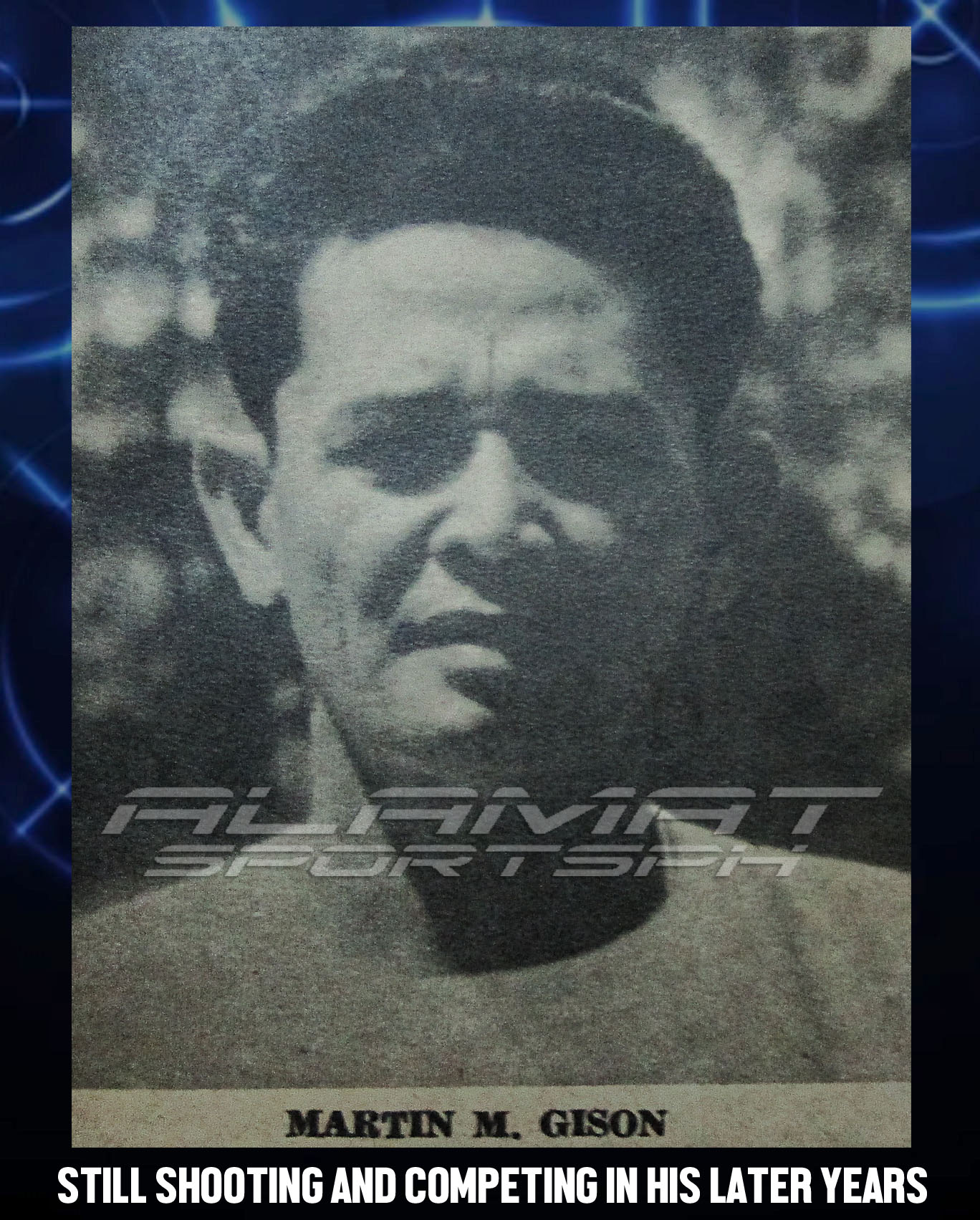
One of our greatest shooting sports legends was the marksman MARTIN MAURICIO GISON. (b.14 March 1914) who had a long, sterling shooting career that began in his college days at the University of the Philippines, to 5 Olympic stagings and 3 Asian Games editions.

Growing up in his home province in Iloilo, the young Martin loved playing with his “tirador”, aiming and slinging his shot at any target he could find-- a fruit hanging from a tree, an empty can, or even pesky, stray animals. He earned a reputation as a sure shot, foreshadowing his future as a world-class shooter.

As a University of the Philippines R.O.T.C. cadet in the mid 1930s, Gison  joined the U.P. Shooting Team, and quickly built a reputation as an elite marksman in rifle and pistol events. The team was often fielded in inter-ROTC Rifle competitions and in events organized by the National Rifle and Pistol Association  of the Philippines under Judge Delfin Jaranilla.

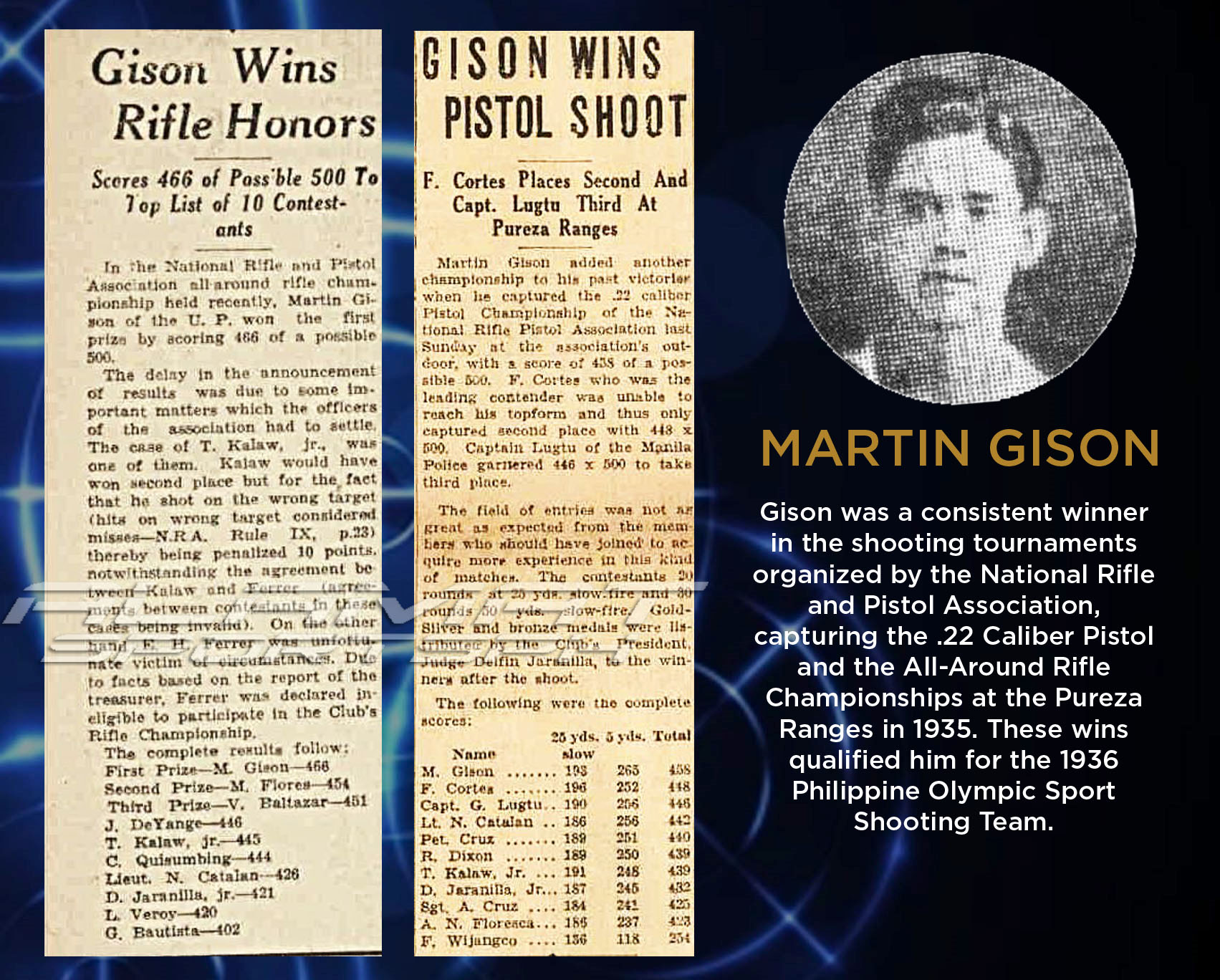
In June 1935 alone, he won 2 titles, claiming the All-Around Rifle Championship in the first week of the month, by scoring 466 out of 500. Three weeks later, on June 23, Gison added another outdoor championship title in the .22 Pistol category (20 rounds at 25 yards slow-fire and 25 rounds 50 yards slow-fire), with a score of 458 out of 500, edging favorites Felix Cortes and Capt. G. Lugtu.

These victories paved the way for Gison’s inclusion in the 1936 Philippine Olympic Team that went to Berlin in August. Against the world’s sharpest marksmen, he started strong in 5-way tie for 2nd place  in the Small-bore .22 Rimfire Rifle, Prone event. After the countback that decided the winner, he dropped to 4th , edged for the Bronze by the Polish Wladislaw Karas, who had an identical score of 297. Still, it was the closest podium finish ever by a Filipino shooter. However, Gison was not able to hold his form in the target pistol and revolver events, where he was also entered. 

His U.P. team mate, Otoniel Gonzaga, failed to advance in his events. Nevertheless, the Olympics proved to be an enriching experience to the young sport shooter and his modest accomplishment, so close to winning a medal in Berlin,  was reported in major newspapers back home.

At the 1937 U.P. Athletic Commencement and Physical Education Day, the U.P. varsity athlete and Olympian received his major letters for his rifle and pistol achievements, along with his certificate and sweater, at the Rizal Tennis Stadium.

In 1938, Gison became the coach of the Colegio de San Juan de Letran Shooting Team. He was also selected by the P.A.A.F affiliated National Rifle and Pistol Association to be one of the country’s representatives to an international shooting tilt in July 3, against Saigon sharpshooters from the Federation Cochinchinois de Tir et Preparation Militaire.

Gison joined the USAFFE (Unites States Armed Forces in the Far East) and was stationed in Camp Murphy (later Camp Aguinaldo). One of his last tournaments before the war was the 1940 Philippine Army-Philippine Constabulary Meet at the Pureza ranges of N.R.P.A. using .45 caliber service pistols or revolvers, which his team won.

At the height of the war, Lt.  Gison was among those captured in 1942 by the Japanese imperial forces. He survived the infamous Bataan Death March, and on 25 Dec. 1942, he, along with 238 former USAFFE servicemen, took their oath of loyalty before the Director General to support the New Philippines under the Japanese empire. When the country was liberated, Gison started anew by going back to sport shooting.

In 1948, he qualified for the much-delayed Olympics in London that were supposed to have been hosted by Japan in 1940.  He came in 25th in the Free Pistol, 50 m.; 40th in the Rapid-Fire Pistol, 25 m. , and 43rd in his pet event, the Small-Bore Rifle, Prone, 50 m. 

 Gison had mixed results at the 1952 Helsinki Olympics, improving his standing to 32nd place in the Free Pistol, 50m., but skidded down to 36th place in the Rapid-Fire Pistol, 25 m.. He placed a creditable 13th in the Small-Bore Rifle, Prone, 50 m.

The 1950s saw Gison at his peak, as in-between Olympics, he participated in the Asian Games that were first instituted in India in 1951. At the 2nd Asian Games in Manila held in 1954, he bagged a complete set of medals of every color:  Gold for the Rapid Fire Pistol, 25m.; a pair of Silvers for the Free Rifle, 3 positions, 300 m., and the Free Rifle, 3 positions, 50 m.. and Bronze for the Rapid-Fire Pistol, 25 m.

The Melbourne Olympics followed in 1956, where Gison qualified in 2 events. He placed 13th in a new event, Free Rifle, 3 Positions, 300 m., and 22nd in the Rapid-Fire Pistol, 25 m. Two years after, the 3rd Asian Games in Tokyo saw him winning a Bronze in the Rifle, Prone, 50 m.

Defying age, Gison, at 50 years old, qualified for his 5th Olympics at the 1964 Tokyo Games, along with 8 other Filipino marksmen. In his swan song, he finished in 48th place in the Small-Bore, 3 Positions, 50 m.

 Martin Mauricio Guison may not have medalled in his shooting events but he holds an extraordinary record that has never been matched—for making the most number of appearances at the Olympics—5 times—from 1936 to 1964, spanning 28 years. No other Filipino athlete has ever come close to this feat, a lesson on achieving greatness, through perseverance, endurance, and the will to win.

SOURCES:

The Tribune, various issues: 5 June, 25 June, 5 Sep. (1935), 27 April, 11 Aug. (1936); 27 Feb.(1937); 19 July (1938); 20 Jul. (1940); 25 Dec. (1942).

Photo of M. Gison with Letran Shooting Team, Colegio de Letran College Yearbook, 1938

Main Photo: Olympedia

Records, Martin Gison, Wikipedia.com


66. Post-War Belles of the Breaststroke: NORMA GUERRERO & LOLITA RAMIREZ, National Record Holders

The Philippine Women’s University was one of the first schools to have a competition-size pool—the Belen Perez Swimming Pool -- as part of ...