Showing posts with label 1952 Helsinki Olympics. Show all posts

59. His Early Basketball Years: 1949-1955: CARLOS M. LOYZAGA, “The Great Difference”

The life of CARLOS MATUTE LOYZAGA  (b. 29 Aug. 1930/d. 27 Jan. 2016) –The Greatest Filipino Basketball Player of All Time—cannot be contained in a single article, so we look to the reportage of the renown sportscaster and writer Willie Hernandez (+) for Loyzaga's early beginnings in the hardcourt, en route to becoming the country’s biggest basketball legend. It was Mr. Hernandez himself who dubbed him, “The Great Difference’, for his amazing playing skill that can turn what seems like a sure loss into a resounding victory.

To think that Carlos Loyzaga’s first sport was not even basketball—but football. Born on 29 August 1930 to couple  María del Carmen Matute y Sequera and Joaquin de Loyzaga Martinez. His father was a national football player who competed and won medals at the Far East Games.

The Loyzagas lived through the war with his mother and siblings---2 brothers and 1 sister. It was during that time that he discovered basketball after years of playing football in his grade school years at Padre Burgos Elementary School in Santa Mesa until 1948.  At the National University, he became a basketball standout. But his mastery in ball handling became more apparent when he joined the San Beda basketball team where his exceptional skills were recognized.

This short article of Willie Hernandez, which appeared as part of the post-war sports coverage of the Philippines, follows the incredible progress of Loyazaga’s illustrious basketball career.

*************

In the opinion of this reporter of vintage, who traces his cubship to the early 30s, no dribbler has dominated  the sport as has the YCO and San Beda standout, CARLOS “Caloy” LOYZAGA dubbed “The Great Difference”.

Standing 6’3” at 175 pounds, the 24 year old court ace caught the experts’ eye in 1949 in his debut as a Junior PRATRA (Philippine Relief and Trade Rehabilitation Administration) and as Rookie in the MICAA (Manila Industrial and Commercial Athletic Association) loop.

A season later, he went up the senior ranks and as a freshman in our big league,  aided nobly in PRATRA’s conquest of the national crown.

A trip in Hongkong in May of the same season with the Kai Ming Press toughened the rookie and primed him for the MICAA series late in 1950. He paced PRATRA to the industrial title with 15 points in the finale. That night, he assumed kingship in the sport. He is still on the throne.

Returning to his studies in 1951, he made a transition to collegiate ball, standing head and shoulders over the field as a San Beda Red Lions. He was the keyman in the Beda’s two NCAA titles in 1951 and 1952 and the National Open Championship in January, 1952.


The years 1951 and 1952 were both significant to Loyzaga as they were the years when he made the Philippine National Basketball Team--qualifying him to play in at the 1951 New Delhi Asiad in India--the first of 4 Asian Games he would participate in, achieving 4 consecutive Gold medal finishes.  

In 1952, Loyzaga officially became an Olympian when he went to Helsinki with his team, landing in  9th place among the best basketball players in the world. In 1954, he made his second apperance at the Manila Asiad Games, where again, the Philippines reigned supreme, helping establish the country as Asia's basketball powerhouse.

Loyzaga returned to the MICAA loop in 1954 where he was a smashing hit as YCO Painter. He totalled points in 13 engagements against specialists and his average of 15 points per game was the margin in YCO’s first MICAA Championship.

Hs finest local accomplishments were fashioned in the two title playoffs of the MICAA tourney against Republic Super Market when he averaged 22 points per game against Lauro Mumar, regarded by many observers as a logical nominee to the national all-time mythical selections (Loyzaga, Charlie Borck, Jacinto Ciria-Cruz and Primitivo Martinez) completing the quintet.

Loyzaga’s peak, at least for the period covered by this report, July to June 30, 1955, was attained in the Rio World Championship, indeed a serve gauge for he was up against the best in the world. Caloy burned the Rio strings at a sparkling per game average of 16.3 points. His foul shootout was vigorous, 73% on 57 hit in 75 trips to the foul circle. In seven games of the title round in the World tournament, he placed third in point making with 121 points.

Against the American team, the champion sank 12 points and averaged 16.2 per game in the 2 P.I. engagements against runner-up Brazil.

Experts in Rio were quick to recognize his efficiency. He was nominated to the mythical second-team World selection, an honor never before gained by a Filipino.

Unquestionably, he is the most efficient post-war exponent of the various phases of the game. Loyzaga straddles our cage world and the wonder of it all. He has yet to reach his maximum efficiency.

EARLY CAREER HIGHLIGHTS

NCAA (National Collegiate Athletic Association)

1951 NCAA Basketball Champions (San Beda College)

1952 NCAA Basketball Champions (San Beda College)

1955 NCAA Basketball Champions/Zamora Cup (Retirement Red Lions San Beda College)

PHILIPPINE NATIONAL BASKETBALL TEAM

1951 Asian Games Gold Medal , India

1952 Olympic Games, Helsinki, Finland, 9th  place

1954 Asian Games Gold Medal, Manila

1954 FIBA World Championship, Bronze Medalist, Brazil, 

FIBA World Championship All-Star Mythical Five (1954)

SOURCES:

Post-War Sports, Progress 1955

Bocobo, Christian and Celis, Beth, Legends and Heroes of Philippine Basketball, (Philippines, 2004)

Carlos Loyzaga, https://en.wikipedia.org/wiki/Carlos_Loyzaga

54. Olympic Weightlifter PEDRO LANDERO, Asia's Senior Strongman (1950-1956)

At the Weightlifting finals in the bantamweight division at the 1952 Helsinki Olympics, a stocky Filipino—balding, short in stature, almost 39 years old, considered  rather advanced in age for the sports—stunned the audience when he placed 6th overall after all his lifts were totaled. PEDRO LANDERO, born on 19 Oct. 1913, was the oldest among the competitors who placed in the Top 12, most of whom were just in their 20s and early 30s. So to barge into the Top 6 was no mean feat, but a  small victory in itself, for in so doing,  he also set a new bantamweight record lift  that would endure for years.

There is scant information about Landero’s beginnings but we do know he was trained under Prof. Candido Bartolome, considered the father of Physical Education of the Philippines. The American-schooled professor established the Department of Physical Education at the University of the Philippines and acted as head of the country’s delegation to the Olympics. He taught Landero and classmates Reynaldo Perez, Ruperto Villamor, Jose Chen and Esmeraldo Eco how to do gymnastic stunts for events and socials. They once entertained 700 guests at a rooftop garden party hosted by the  U.P. President Bienvenido Gonzales on 24 June 1939, which received much praises.

Weightlifting was not Landero’s first sport---it was wrestling. He joined the Ben Gallegos Club (BGC), which was a gym club that trained its members and fielded them to various competitions—from weightlifting, physical culture contests, to wrestling. He participated in  wrestling tournaments  and began winning most matches.

At the 1948 National Wrestling Championship, he represented his club and won the Bantamweight division title, by decisioning AFPs’ Lt. J. Carreon after 15 minutes of strenuous wrestling. The next year, at the 1949 Wrestling Championship, he would retain that title by default—when his opponent did not show up. That’s when he realized perhaps, that wrestling was a sport that held little to Filipinos. Fewer contestants signed up for the tournament this year and that the same old names—Landero, Luna, Bernabe and Florendo—keep dominating the events, due to the absence of competition.

 In 1950, Landero made a major career shift and decided to join the 1950 National Weightlifting Championships—he had been lifting heavy weights at Javier Brothers Gym for some time now,  as part of his wrestling training, so it wouldn’t hurt if he tried another sport that called for a show of lifting strength. On April 16, he joined 32 lifters from schools and clubs at the Rizal Memorial Coliseum to test how far he could go in this new endeavor.

With a body weight of 136 pounds, he qualified for the Lightweight Division, ten went on to surprise himself with a 3rd place finish, lifting a combined total (press, snatch, jerk) of 600 lbs. The unattached lifter, Luis Dumag won the Gold with his 625 lbs. effort, followed by Gervacio Canlas of BGC with a 620 lbs. lift.

Thus began an unexpected journey to the sport of weightlifting. He made so muchprogress that in a year, he was handpicked, along with Rodrigo del Rosario, to compete in the inaugural multi-sports continental games--the 1st Asian Games in New Delhi, India. His lucky streak continued as he bagged his first international weightlifting medal—a Bronze—in the bantamweight class (56 kg.) . Gold and Silver went to Mahmoud Namjoo and Ali Mirzaei, both Iranians, whom he would meet again in the premiere sporting event of all—the 1952 Helsinki Olympics.

 In Finland, Landero had to yield the spotlight to the biggest star of the Philippine weightlifting stage, Rodrigo del Rosario, who held multiple current national records.  There, at the Messuhalli  Exhibition Hall, del Rosario shone his brightest, placing fourth  in the featherweight class, his best Olympic finish, setting a world record in the military press portion, in the process.  

Lost in the hoopla of del Rosario’s triumph was the remarkable 6th place finish of 39 year-old bantamweight Landero in a field of 19 starters,  one of only 2 senior lifters who completed their lifts (2 lifters from Japan and Romania dropped out). The other was Germany’s Josef Schuster, age 46, but he ended a distant 14th. Gold went to Russian Ivan Udodov (age 28), while Iran’s Namjoo (age 34)  and Mirzaei (age 23) claimed Silver and Bronze.

Though Del Rosario got the lion’s share of sports fans’ attention, Landero’s top 6 finish was, to him, a cherished one. He vowed to train harder, as has already set his sight on the next Olympics, in Melbourne. The 2nd Asian Games hosted by Manila in 1954 was another chance to chase weightlifting honors, but it was Rodolfo Caparas who battled it out at the bantamweight finals and won a prized Silver. Landero opted to wait for the 1955 National Weightlifting Championships where he moved up to the featherweight class—and clinched the title, along with lightweight Kuan Sun, middleweight Higinio Villar, and middle-heavyweight Manuel Tan.

That win became Landero’s passport to the 1956 Melbourne Olympics, the first to be held outside Europe. It is also known for the multi-nation boycotts that marred the Games. But yesteryear’s sports fans remember it for early exit of the now 43 year old Landero who was expected to do well. He opted to start his Press lift at 95 kgs. , but failed not once, but thrice. Thus, Landero could no longer proceed and bowed out of contention. He was declared retired. From 6th place in Helsinki, he finished last in 16th place. American Charles Vinci topped the bantamweight division that year. Landero’s   ignominous defeat led to his decision to retire permanently from weightlifting.

After the Olympics, not much was heard about his life, his family, and even his eventual passing. Landero seemed to have gone from a place of renown  to complete obscurity. But certainly, what will not pass into oblivion is Pedro Landero’s  weightlifting legacy, achieved in his maturity and reaching its peak in his seniority, proving to all that in the pursuit of excellence, age is no barrier.

SOURCES:

“U. P. President and Mrs. Gonzalez To Entertain for Faculty “, The Tribune, 22 Jun. 1939, p. 5

“1948 Wrestling Championship”, The Filipino Athlete,, May 1948, p. 11

“1949 Wrestling Championship”, The Filipino Athlete, June 1949, p. 16

“Winners of the 1955 National Weightlifting Championship”, PROGRESS 1955

1951 Asian Games, Wikipedia

1952 Helsinki Oympic Games, Wikipedia

1956 Melbourne Olympic Games, Wikipedia

Photo: Olympedia, Pedro Landero, https://www.olympedia.org/athletes/56489

Udodov, Namjoo,

31. Ageless Shooting Star: MARTIN M. GISON, The Only 5-Time Filipino Olympian


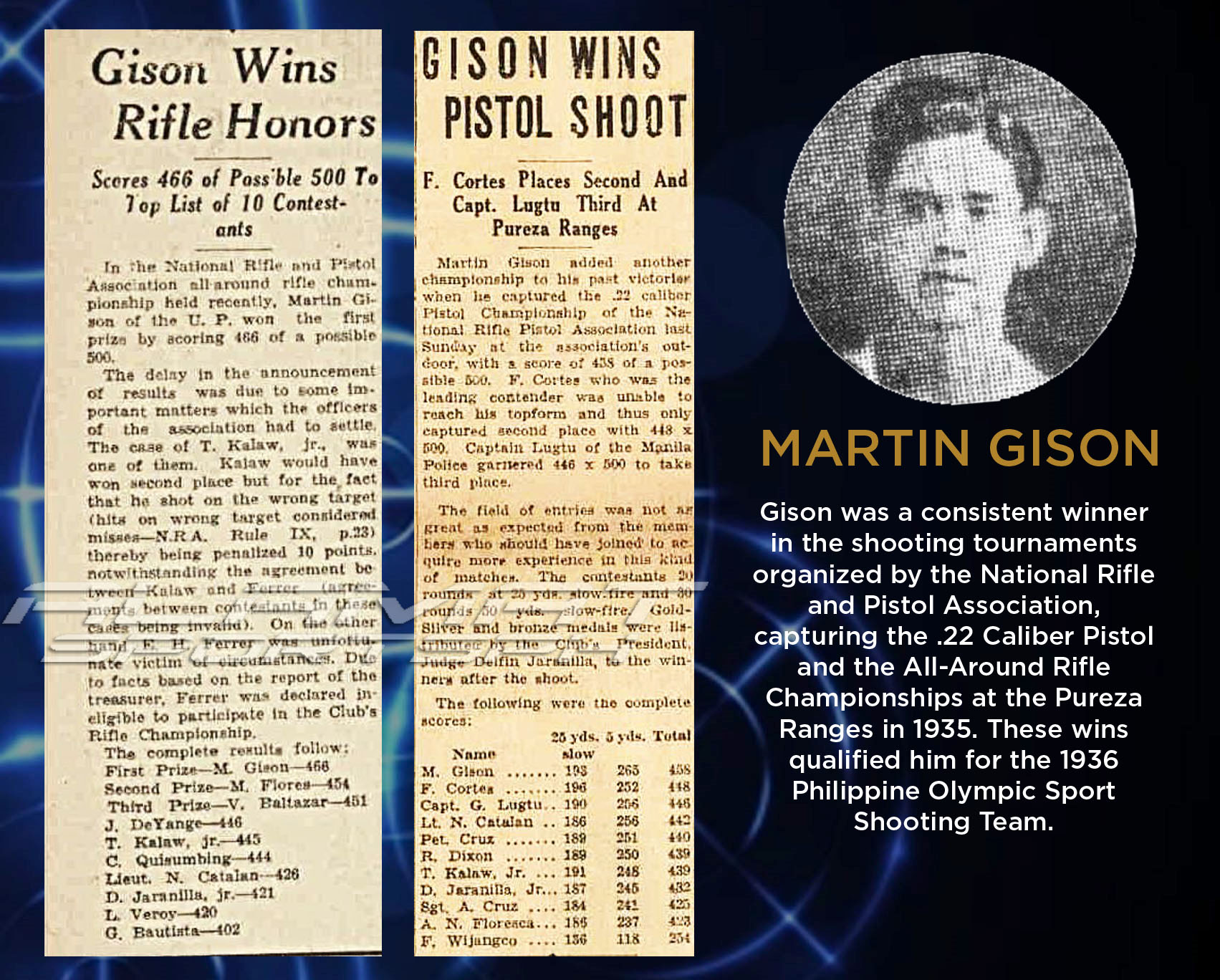
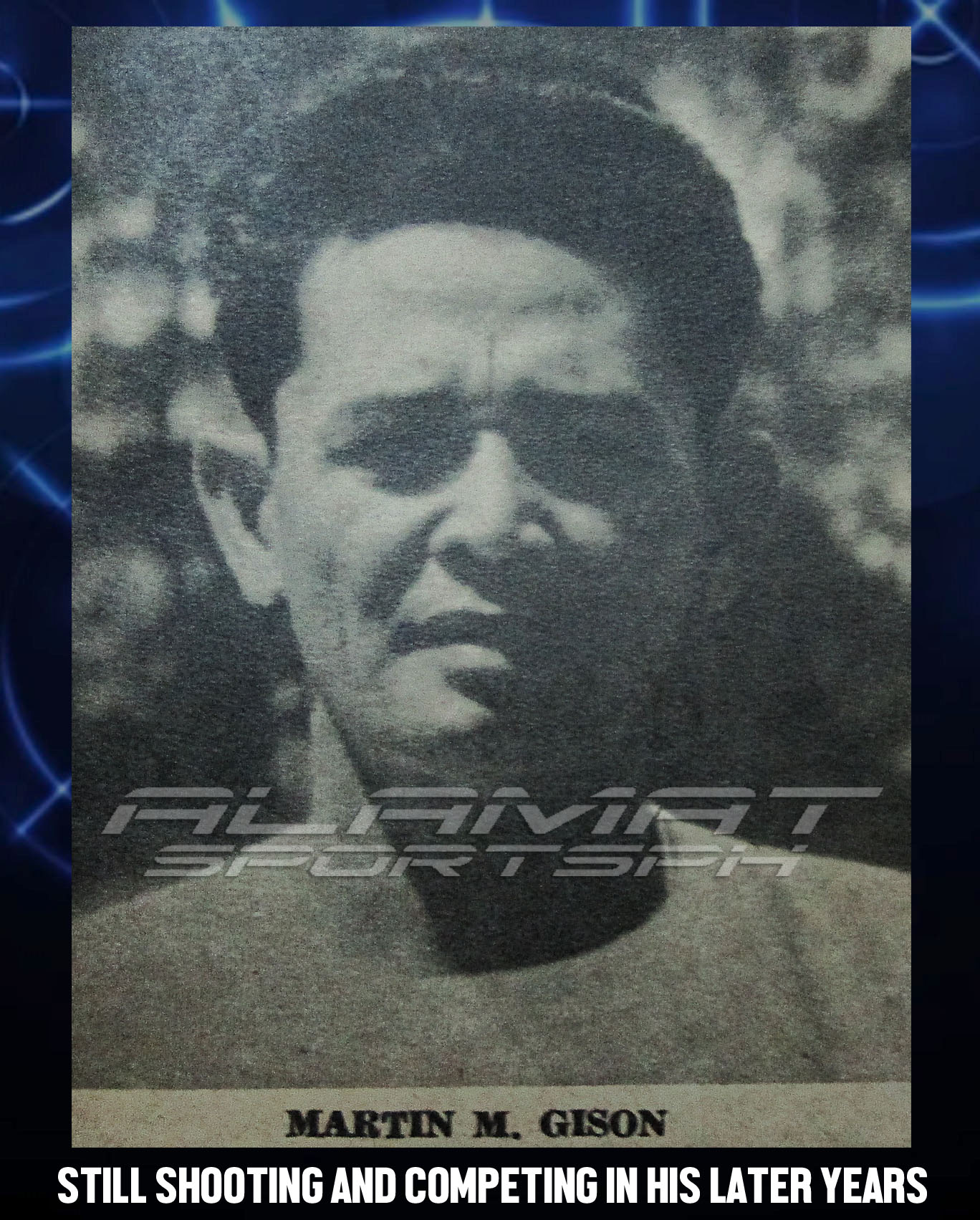
One of our greatest shooting sports legends was the marksman MARTIN MAURICIO GISON. (b.14 March 1914) who had a long, sterling shooting career that began in his college days at the University of the Philippines, to 5 Olympic stagings and 3 Asian Games editions.

Growing up in his home province in Iloilo, the young Martin loved playing with his “tirador”, aiming and slinging his shot at any target he could find-- a fruit hanging from a tree, an empty can, or even pesky, stray animals. He earned a reputation as a sure shot, foreshadowing his future as a world-class shooter.

As a University of the Philippines R.O.T.C. cadet in the mid 1930s, Gison  joined the U.P. Shooting Team, and quickly built a reputation as an elite marksman in rifle and pistol events. The team was often fielded in inter-ROTC Rifle competitions and in events organized by the National Rifle and Pistol Association  of the Philippines under Judge Delfin Jaranilla.

In June 1935 alone, he won 2 titles, claiming the All-Around Rifle Championship in the first week of the month, by scoring 466 out of 500. Three weeks later, on June 23, Gison added another outdoor championship title in the .22 Pistol category (20 rounds at 25 yards slow-fire and 25 rounds 50 yards slow-fire), with a score of 458 out of 500, edging favorites Felix Cortes and Capt. G. Lugtu.

These victories paved the way for Gison’s inclusion in the 1936 Philippine Olympic Team that went to Berlin in August. Against the world’s sharpest marksmen, he started strong in 5-way tie for 2nd place  in the Small-bore .22 Rimfire Rifle, Prone event. After the countback that decided the winner, he dropped to 4th , edged for the Bronze by the Polish Wladislaw Karas, who had an identical score of 297. Still, it was the closest podium finish ever by a Filipino shooter. However, Gison was not able to hold his form in the target pistol and revolver events, where he was also entered. 

His U.P. team mate, Otoniel Gonzaga, failed to advance in his events. Nevertheless, the Olympics proved to be an enriching experience to the young sport shooter and his modest accomplishment, so close to winning a medal in Berlin,  was reported in major newspapers back home.

At the 1937 U.P. Athletic Commencement and Physical Education Day, the U.P. varsity athlete and Olympian received his major letters for his rifle and pistol achievements, along with his certificate and sweater, at the Rizal Tennis Stadium.

In 1938, Gison became the coach of the Colegio de San Juan de Letran Shooting Team. He was also selected by the P.A.A.F affiliated National Rifle and Pistol Association to be one of the country’s representatives to an international shooting tilt in July 3, against Saigon sharpshooters from the Federation Cochinchinois de Tir et Preparation Militaire.

Gison joined the USAFFE (Unites States Armed Forces in the Far East) and was stationed in Camp Murphy (later Camp Aguinaldo). One of his last tournaments before the war was the 1940 Philippine Army-Philippine Constabulary Meet at the Pureza ranges of N.R.P.A. using .45 caliber service pistols or revolvers, which his team won.

At the height of the war, Lt.  Gison was among those captured in 1942 by the Japanese imperial forces. He survived the infamous Bataan Death March, and on 25 Dec. 1942, he, along with 238 former USAFFE servicemen, took their oath of loyalty before the Director General to support the New Philippines under the Japanese empire. When the country was liberated, Gison started anew by going back to sport shooting.

In 1948, he qualified for the much-delayed Olympics in London that were supposed to have been hosted by Japan in 1940.  He came in 25th in the Free Pistol, 50 m.; 40th in the Rapid-Fire Pistol, 25 m. , and 43rd in his pet event, the Small-Bore Rifle, Prone, 50 m. 

 Gison had mixed results at the 1952 Helsinki Olympics, improving his standing to 32nd place in the Free Pistol, 50m., but skidded down to 36th place in the Rapid-Fire Pistol, 25 m.. He placed a creditable 13th in the Small-Bore Rifle, Prone, 50 m.

The 1950s saw Gison at his peak, as in-between Olympics, he participated in the Asian Games that were first instituted in India in 1951. At the 2nd Asian Games in Manila held in 1954, he bagged a complete set of medals of every color:  Gold for the Rapid Fire Pistol, 25m.; a pair of Silvers for the Free Rifle, 3 positions, 300 m., and the Free Rifle, 3 positions, 50 m.. and Bronze for the Rapid-Fire Pistol, 25 m.

The Melbourne Olympics followed in 1956, where Gison qualified in 2 events. He placed 13th in a new event, Free Rifle, 3 Positions, 300 m., and 22nd in the Rapid-Fire Pistol, 25 m. Two years after, the 3rd Asian Games in Tokyo saw him winning a Bronze in the Rifle, Prone, 50 m.

Defying age, Gison, at 50 years old, qualified for his 5th Olympics at the 1964 Tokyo Games, along with 8 other Filipino marksmen. In his swan song, he finished in 48th place in the Small-Bore, 3 Positions, 50 m.

 Martin Mauricio Guison may not have medalled in his shooting events but he holds an extraordinary record that has never been matched—for making the most number of appearances at the Olympics—5 times—from 1936 to 1964, spanning 28 years. No other Filipino athlete has ever come close to this feat, a lesson on achieving greatness, through perseverance, endurance, and the will to win.

SOURCES:

The Tribune, various issues: 5 June, 25 June, 5 Sep. (1935), 27 April, 11 Aug. (1936); 27 Feb.(1937); 19 July (1938); 20 Jul. (1940); 25 Dec. (1942).

Photo of M. Gison with Letran Shooting Team, Colegio de Letran College Yearbook, 1938

Main Photo: Olympedia

Records, Martin Gison, Wikipedia.com


15. PONCIANO SALDAÑA, 1954 World Cup Basketball Hotshot

PONCIANO “Pons”SALDAÑA  (b. 19 Nov. 1928) comes from the well-known Saldañas of Guagua, a family that played a big role in developing the town’s economy through their fishpond and cigarette industries .  His  family line relocated to Iloilo in the 40s, but "Ponching" stayed on in Manila for his studies. He enrolled at San Beda where he became a popular campus figure for his basketball skills. He graduated in 1948--a batchmate of the late Sen. Benigno "Ninoy" Aquino Jr. His ECOS yearbook described Pons as "silent, dignified and religious....with a rare technique for bewitching people."

Saldaña remained in San Beda for his college education, where he took up B.S. in Commercial Science. He was elected Class President in his Freshman and Sophomore years, and served as well as an officer of the Students'  Chamber of Commerce. He graduated in 1952.

In his 4 years in college, Saldaña was a stand-out varsity basketball player of the San Beda College Lions serving first as a Skipper (1947-1951) and  Team Captain, leading the Red Lions to the 1951-52 NCAA Championships as well as the National Open Championships.  The team was coached by Antonio Rius and Olympian Fely Fajardo. Early on, he was known for his shooting prowess in the court, and was part of the team that ended the Letran Knights unbeaten streak of games in 1950.

After graduation, he played for Philippine Airlines in the MICAA (Manila Industrial and Commercial Athletic Association) games. In 1952, Saldaña was named to the national basketball team, which played at the Helsinki Olympics, placing 9th place overall, a respectable showing. He was a consistent double point-shooter against power teams from Argentina and Brazil.

At the 1954 Asian Games in Manila, the national team bagged Gold, beating toprated South Korea, Japan, and Taiwan. The Asian victory paved the way for a ticket to the 1954 FIBA World Championship in Rio de Janeiro, Brazil. Included in the team were Bedan schoolmates Caloy Loyzaga, Tony Genato and Rafael Barretto. Newspapers reported how the speedy Saldaña scored 20 points in the team’s match against Israel, thus putting the Philippines up for the finals.  The Philippines won a historic Bronze in the tourney, behind USA and host country Brazil, the best finish by an Asian nation in FIBA history.

In his later years, Pons Saldaña married Dra. Alice Tayag, a UST medical graduate of Concepcion, Tarlac and made their residence in Tabucan, Iloilo, where they owned and managed Isla Naburot, a nationally-famous island resort in Guimaras. His wife also worked as Chief Pathologist of St. Paul's Hospital in Iloilo City. Their children include a son, Boy, a proficient golfer, and Anne, a chef who currently manages the Naburot resort.

On the other hand, Saldaña had a successful post-basketball career himself. He was named provincial manager of the Philippine Air Lines in Iloilo, a position he held before succumbing to a heart attack in Makati on 21 Jul. 2006.


SOURCES:

Christian Bocobo, Beth Celis, Legends and Heroes of Philippine Basketball, “Ponciano

13. World and Olympic Weightlifting Record Setter: RODRIGO DEL ROSARIO

RODRIGO DEL ROSARIO  (b. 11 Jun. 1917) was a 3-time Olympian from Cabangan, Zambales. Standing only 5’4”, he never won an Olympic medal but he broke Olympic and world records in his long career.

Physical culture and weightlifting were already established sports by the mid 1930s, and interest peaked when menfolk were required to do military training as a looming war approached. Del Rosario discovered weightlifting in Manila, and he came under the training of the Ben Gallegos Club which had a gym in Sta. Mesa, Manila. The Club also held regular weightlifting tournaments and fielded qualified members to the National Weightlifting Championships. It was in these championships that Del Rosario began making his mark.

At the nationals held in Cebu on 21 Mar. 1948, Del Rosario, competing in the featherweight division, managed a total of 712. 2 lbs. in 3 lifts. He also made a lift of 236.2 lbs. in the military press. These broke the world records established by American lifter Bob Higgins at the Philadelphia Championship in Sep. 1947, where he lifted 231.5 lbs. in military press, and a 3-lift total of 638.5 lbs.

His peak was at the 1952 Helsinki Olympics, he came closest to winning a weightlifting medal when 110 lbs. Del Rosario placed fourth in his featherweight division. He pressed 105 lbs . in the (231 ¼ ) lbs. which was declared an Olympic Mark, surpassing the previous record of Jafar Salmasi of Iran . This also equaled that year’s world mark. His combined lifts, adding his 92.5 kilos in the snatch (203 ¾ lbs.), and 120 kilos in the jerk (264 ½ lbs), totaled 317.5 kilos  (699 ½ lbs), trailing the Bronze medalist R. Wilkes of Trinidad, by just 5 pounds.

Del Rosario may have lost the Bronze by a whisker, but the record he set for the press lift remains the first and only Olympic record set by a Filipino, which caught the attention of international lifters. He reset this world record in the press lift to 108.75 kg. (or  239.75 lbs.) at the 1954 Asiad in Manila. The record, though, lasted just for 6 days, surpassed thrice by international lifters.

Like all carry-over athletes from the thirties, he continued to join competitions past his peak, finishing second in his class in the 1955 National Champioships. Del Rosario has always found the 2-hand snatch an enigma and he was unable to lift over 200 pounds, that thwarted his 1955 title hopes.

Pushing 40, Del Rosario made it to his 3rd Olympics in Melbourne in 1956, along with fellow lifter Pedro Landero. He failed to lift his clean and jerk portion, so he was not ranked for his incomplete lifts.

Del Rosario became a trainer of young weightlifters and coached the 1968 Philippine Weightlifting Team to the Mexico Olympics.  His last competition was in the World Weightlifting Championships  in Columbus, Ohio in 1970. By dint of good luck, he was awarded 1st place in the flyweight division after the Top 3 lifters were disqualified for drug use.

After his competitive years were over, Del Rosario took on a job as a security officer at the Rizal Memorial Stadium, where retired athletes would congregate at the P.A.A.F. office. He continued mentoring young weightlifters including his nephew Salvador del Rosario who would win a world title, paving the way for a stint at the Olympics in 1968 and 1976. His son Arturo, followed suit, becoming an Olympian in 1972 and 1976.

Rodrigo del Rosario, our finest Olympic strongman, died on 10 October 2009, at the venerable age of 92.

SOURCES:

Olympedia, https://www.olympedia.org/athletes/56487

Progress 1955, Report on Postwar Sports

Abesamis, M. E. 13 Oct. 1968, The Sunday Times Magazine, “All the Weights for Gold” 13 Oct. 1968. p. 30

1952 Official Olympic Report, LA 1984 Digital Collection

Alex R. Castro, FilipiKnow. 13 Sports Legends Who Proved Filipinos Are Kickass Athletes, https://filipiknow.net/legendary-filipino-athletes-in-sports-history/

66. Post-War Belles of the Breaststroke: NORMA GUERRERO & LOLITA RAMIREZ, National Record Holders

The Philippine Women’s University was one of the first schools to have a competition-size pool—the Belen Perez Swimming Pool -- as part of ...