25. Athlete, Coach, Educator: PEDRO ABLAN, 1917 Far East Games Medalist

One of the most accomplished track coaches in the 1930s was PEDRO ABLAN, himself a talented middle distance race specialist. Born on 9 Dec. 1891 in Laoag, Ilocos Norte, The young Ablan discovered running as part of his school’s physical education classes. He was a constant presence in interscholastic meets, winning many medals. He pursued running when he came to Manila to study at the Philippine Normal School, and managed to improve his times to become a national record holder for 3 consecutive years beginning 1915  in the 440 yard dash.

The 5 foot 4 Ablan became a mainstay of the winningest Philippine team to the Far Eastern Championship Games that took part in the Manila (1913) and Shanghai games (1915). In Shanghai, he was part of the Philippine men's team that won Gold in the 880 m. yard relay, along with  Fortunato Catalon, Genaro Saavedra, and Nicolas Llaneta. His Far East campaign culminated  with a Bronze Medal finish at the 1917 edition in Tokyo, Japan. He placed third behind two Japanese runners Shinsaku Yamanouchi  (Gold, 55.0 secs.) and Iwao Saeki (Silver, 55.2 secs.). Ablan clocked 56.2 secs. , a Philippine record, and became a much-talked about sprinter in the Philippines, China and Japan.

In 1918, Ablan was deep in training for the next Far Eastern Games, when he was found unconscious on the athletic field, stricken with a debilitating illness. He had to stop running and was scratched off from the team. As if that was not enough, his 440 yard record was broken by another Filipino sprinter. He recovered soon enough, but he found out that he had lost his former speed.

But behind every setback, there was a silver lining. When he was well enough, he married Soledad Adiarte (b. 1895) , retired from running to become a track coach at a local high school. It was while coaching that Ablan was selected as a pensionado of the Philippine government to study physical education abroad. Upon the recommendation of Vice-Governor Charles E. Yeater, Ablan was accepted at the Missouri College in Springfield (now Missouri State University), that was known for its outstanding physical education program.

In September 1919, Ablan, together with another Filipino who would also become an eminent sports leader—Serafin Aquino—began his studies at the Missouri college. His reputation as a champion sprinter had preceded him, and his athletic feats were written about in local community newspapers.

After graduating in 1922, Pedro Ablan returned to the Philippine Islands as physical director in the public schools. During World War II, he served as captain in the Philippine Army, and he received an honorable discharge in 1948. Ablan dedicated the remainder of his life to physical education.

He assumed the post of Physical Director of his alma mater Philippine Normal School and led the track team to victory at the Manila Interscholastic Athletic Association (M.I.A.A.) meets in 1932 and 1935. In 1934, he served as assistant coach of the P.A.A.F. athletic events, and helped in the training of the Philippine squad for the 1936 Olympics.

The revered Ablan rose to become a Division Superintendent of the Department of Education, with P.E. as his field of expertise. He retired in 1965 and returned to Springfield College campus for his 50th class reunion in 1972. Pedro Ablan, the multi-tasking athlete, mentor and sports official,  passed away on 16 July 1974, and was survived by 3 daughters and 2 sons.

SOURCES:

Passport, Pedro Ablan: U.S., Passport Applications, 1795-1925, Border Crossings & Passports

Far East Championships, http://www.gbrathletics.com/ic/fec.htm

Photo of Ablan, Merwin and Aquino/ Cosmopolitan Club/ In Memoriam, Courtesy of Springfield College, Archives and Special Collections.

https://cdm16122.contentdm.oclc.org/digital/collection/p15370coll2/id/5236

24. The Country’s Swim Star of the 1930s: ESTELA LOZADA

Philippine Women’s College was founded way back in 1919 during the American regime and even before it attained its university status in 1932, it was already known for its excellent swimming program conducted in its own huge “Belen Perez Swimming Pool”—the country’s 1st indoor competition pool.  From the start, the women’s swimming program, had the full support of the college. After all, one of the founders,  Francisca Tirona was married to the outstanding U.S.-trained swimmer Conrado Benitez, and that the school’s  chairman of the board of trustees was an avid swimming enthusiast himself, Jose Abad Santos.

It was no wonder then that PWU bred some of the most talented women’s swmmers of the country, making a name for themselves first in interscholastic tournaments,  and later, at the national championships and international meets. PWU’s champions included such nationally-ranked swimmers as the Abad Santos mermaids (Amanda, Victoria. Luz), Emma Benitez, and the Gonzaga sisters. But the most accomplished of them all was ESTELA LOZADA, Cebuana lass broke records, and who got to represent the country in meets of international level.

Estela Lozada must have inherited her competitive genes from her father, Jose Lozada, who was a Division Engineer for Mindanao and District Engineer for Lanao. In his prime, Jose was a U.P. athlete who won Golds in the 220 yard hurdles at both 1913 and 1915 Far Eastern Games. He also won Silver for the 100 yard sprint in 1913, and a Bronze for the 120 m. hurdles at the 1917 Far Eastern Games.

Lozada first barged into the national scene during the U.P-PWU Dual Swimming Meet held on 7 Dec. 1934. Before a banner crows at the Rizal Memorial natatorium, the seemingly undefeatable state scholars were shocked when they were routed by the strong PWU swimmers with the score of 35-15.

The PWU swimmers made a clean sweep of all the first places, led by Estela Lozada, who set a new Philippine record for the 100 m. backstroke event, with a time of 1 min, 34.4 secs. On top of that, Lozada won the premiere 100 m. freestyle event in 1 min. 29.8 secs., trailed by 2 PWU team mates. She was also part of the gold-winning 400 m. freestyle relay team.

For this feat, Lozada was chosen to represent the Philippines in the 1934 Far Eastern Games in Manila, on which the first official women's events—that included 4 swimming events-- were held for the first time, at parity with the men’s events. That meant that medals won by women were counted and added to the official medal tally. Lozada, however, came home unplaced, with the Chinese swimmers dominating the pool events. Still, her debut participation in an international event spurred her even more to exceed her best.

Lozada was part of the national team that went to the 1935 Formosa-Philippines Swimming Championship. There, she copped a precious Silver in her pet event—100 m. backstroke, with team mate Natalia Gonzaga in 3rd place.  But bigger things were in store for the swimming star at the 1936 National Swimming Championship, when the powerhouse PWU Women’s Swimming Team emerged as the National Champion, with Lozada winning Gold in the 100 m. free, 100 m. backstroke, and 400 m. relay races.

At the 16th Annual Athletic Commencement of the PWU on 19 March 1936, Lozada was one of the 25 athletes who received their letters and prizes from Mrs. Sergio Osmeña. Lozada was cited for her individual and team achievements at the 1936 National Championships.

She was back in Formosa for the 1937 5th Philippine-Formosa Dual Swimming Meet held from May 15-17, but this time, the Philippine delegation lost. The team, headed by Judge Mariano Nable, president of the Philippine Islands Swimming Association, returned home on May 30.

As a consolation, Estela Lozada, upon her homecoming was shortlisted as a candidate for the T-V-T Women’s Popularity Contest, mounted by the publisher of Tribune, La Vanguardia and Taliba. She also lost the contest, decided by balloting; Mrs. Pacita Villareal won as most popular.

Lozada made up for it 2 years later at the 6th Philippine-Formosa Dual Swimming Meet at the Jose Rizal Natatorium, Manila, when she bagged another Silver in the 100 m. backstroke, clocking in at 1:32.9, edged by Formosa’s T. Yahisa who won Gold with 1:32.3 mins.  Filipina Perla Tagle settled for the Bronze at 1:33.3 mins. This was the last known competition of Estela Lozada. She pretty much disappeared from the limelight and not much was known about the rest of her life.

In the 1950s, the surname Lozada surfaced again when a new generation of Lozadas swam their way to national and international prominence—Remberto, Gertrudes, Corazon, and Tessie—who were, however, unrelated at all with 30s swim star.

SOURCES:

Various Tribune issues, 1933-1939, accessed through Trove.

Graphic Magazine, 1933, Recalling the Far East Championship Games

23. Basketball Great, Sen. AMBROSIO B. PADILLA: A Legacy of Leadership in Sports,

In the annals of Philippine basketball history, one name stands out for achieving his ambitions in two supposedly diametrically opposed fields: Sports and Academics. In both disciplines, AMBROSIO B. PADILLA  left his exemplary mark of excellence—as captain of the Philippine Basketball Team, he gave the country its best-ever finish in the 1936 Olympiad in Berlin, placing 5th among the  world’s best basketeers—an incredible feat that has yet to be duplicated. In the same breath, Padilla was a brilliant student of Ateneo , graduating summa cum laude, and then finishing law at the state university as Class Salutatorian.

Born in Lingayen, Pangasinan on 7 Dec 1910  to Dr. Nicanor Padilla and Ysabel Bibby, “Paddy” as he was called, grew up with 11 siblings. His formative high school and college years were spent at the Ateneo de Manila, where he developed a love for basketball. As a varsity player, he skippered the Blue Eagles that won the 1928 NCAA basketball championship.

At age 20, Padilla made it to the 1930 national cage team that went to Tokyo, Japan for the Far East Games, winning Gold after beating the host country. His team mates included Augusto Bautista (who won his 5th basketball medal, plus medals in volleyball), Alfredo del Rosario, Pedro Villanueva, Mariano Filomeno, Rizalino Gamban, Johnny Schlobohm, Briccio Reynoso, Jesus Lacson Suarez and Jacinto Ciria Cruz. The formidable Filipinos repeated their triumph before a thrilled Manila home crowd in 1934, in what would be the last Far East Games. That same year, he earned his Law degree as Salutatorian  from the University of the Philippines, and became a bar topnotcher by placing 3rd in the exams.

The highlight of his sporting career was to come 2 years later. Though Padilla – now a full-fledged lawyer--had earned a reputation as a skilled basketball player, he still had to pass the tryouts to secure a spot on the Olympic team for Berlin. There was no dearth of talents in the country with the most developed basketball sports program in Asia, thanks to the Americans. Padilla passed the tryouts with flying colors, and was named a member of the elite 1936 Philippine Basketball team.

It was in Berlin that the first official Olympic basketball tournament was played. It was held outdoors in a tennis stadium on courts of clay and sand. The International Basketball Federation passed a rule that would ban all players who were taller than 6 ft. 3 inches. The U.S., who stood to lose 3 players, protested and the rule was rescinded.

The Philippines had a great start, winning two in a row by beating Mexico and Estonia. But then, to shorten the tournament, a new ruling was announced that any loss thereafter would put a team in the consolation bracket.

In the quarterfinal, the Filipinos were pitted against the much taller United States players--and lost 56-23.  Thus ended their Olympic journey, though it was their one and only defeat. Like true sportsmen, the team continued on in the classification rounds, winning over Italy, and then Uruguay, landing the Philippines in 5th place among 21 countries with a 4-1 record. The U.S. won 1st, Brazil in 2nd, and Mexico—which the Philippines had defeated in the early rounds, placed 3rd. Still, this was Asia’s best finish ever in the Olympic Games men’s basketball history.

The Olympians returned to a tumultuous welcome for their unprecedented feat, and when the Olympic hoopla died down, Padilla move on and went back to school at the University of Santo Tomas, earning his doctorate in Civil Law in 1938 with honors. Though officially retired from basketball, he worked tirelessly for the upliftment of the sport, serving as chairman of the Philippine Amateur Athletic Federation (PAAF) Basketball Committee from 1938 to 1954.

In 1941, he married Lourdes “Lily” de las Alas (b. 18 Oct. 1917/d. 29 Jul. 1994) daughter of former finance secretary Antonio de las Alas under the Quezon administration. They became parents of 10 children: Josie, Vicente, Francisco, Ambrosio Jr, Lourdes, Felipe, Manny, Alexander, Gigi, and Rose.

In 1954, Padilla forayed into politics after his appointment as Solicitor General by Pres. Ramon Magsaysay. He was elected Senator in 1957, serving 3 terms until 1969, which was interrupted by Martial Law. After Marcos’s ouster, Pres. Corazon Aquino appointed him to the 1986 Constitutional Commission, which he served as Vice Chair.

His association with basketball continued with his FIBA appointment as Vice President for Asia (1956-1964). He was also elected President of the Asian Basketball Confederation (ABC, now FIBA-Asia). Padilla also had the distinction of being the 1st president of the Philippine Olympic Committee (formerly PAAF)  in 1975.

The acclaimed Olympian and Senator, who served and honored the country in two different fields passed away on 11 Aug. 1996 at the Capitol Medical Center, and laid to rest in his beautiful retreat, Alpadi’s Farm in Antipolo. He was inducted post-humously into the Philippine National Basketball Hall of Fame in January 1999, along with his own Olympic coach, Chito Calvo.

In his honor, an award for top academically-gifted Ateneo student athletes, and a room at the Malcom Hall of the U.P. College of Law, bear his name. In 2010, a stamp was also struck to mark his birth centenary. Today, Ambrosio Padilla is regarded as one of the most important sports figures to shape the course of basketball development in Asia.

SOURCES:

Christian Bocobo and Beth Celis, Legends and Heroes of Philippine Basketball, ©2004 by Christian Bocobo, p. 114

Senator’s profile, Ambrosio Padilla: https://legacy.senate.gov.ph/senators/former_senators/ambrosio_padilla.htm

Ambrosio Padilla, https://en.wikipedia.org/wiki/Ambrosio_Padilla

Bill Velasco, The Game of My Life column, “Unresolved Olympic Controversies”, 13 Feb. 2021, The Philippine Star

David Wallechinsky, The Complete Book of the Olympics, ©1988, Viking Penguin, “Basketball”, p. 173

“Basketball Olympian, Senator Dead at 85”, Manila Standard, 26 Aug. 1996 issue, p.4


22. Hurdler-Hero: MIGUEL S. WHITE: Lone Philippine Medalist,1936 Berlin Olympics

The Olympic Games in Berlin unfolded in Germany from Aug. 1-16, 1936. “Hitler’s Olympics” was used by the Nazi leader as a stage to prove the supremacy of the Aryan race. But this quickly unraveled when sprint sensation Jesse Owens, won 4 gold medals in quick succession, and Cornelius Johnson and David Albritton achieved a 1-2 finish in the high jump—all black Americans. Add to this, the extraordinary Bronze achievement of a Filipino-black American MIGUEL S. WHITE in the 400 m. hurdles; modest it may seem, his win was a statement of defiance against racism, from a small country in the Far East.

Of his beginnings, little is known about the Philippines’ greatest hurdler, MIGUEL SOLANO WHITE (b. 9 Oct. 1909/d. 20 Aug. 1942). Born to a black American father and a mother from Legazpi, Albay, Miguel may have filial ties with the political Solanos of Camalig. He was also believed to have spent his growing up years in Sagmin town.

White’s earliest recorded participation in a major meet was at the 1930 Far East Games in Shanghai. He may have already been a Philippine Scout under the U.S. Army at this point, as the army is known for its excellent sports program that has produced many Filipino athletes of international calibre.  At age 23, White won a Bronze Medal in the 400 m. flat race.

White began specializing in the Hurdles event, doing both 110 m. and 400 m. hurdles. On 21 May 1932, the qualifying trials for a slot in the Philippine Olympic team were held, and he was one of those shortlisted to compete. But, of the only 8 spots available, only one was reserved for a track and field athlete, which went to high jumper Simeon Toribio. This did not deter White at all, continuing his  focus on training for the next best thing—the so-called Oriental Olympics—the 1934 Far East Games of Manila.

Under the tutelage of coach Pedro Ablan, he competed in the preliminary rounds held in early April 1934, against the country’s best hurdlers at that era: Constantino Alhambra, Eliseo Dumaliang, Filomeno Lagasca, Carlos Atud and Jesus Roa. White topped the heat and, along with Alhambra, made it to the Far East team.

In the 400 m. finals held in the second week of May, White proved his superiority by winning Gold, registering a blistering time of 53 seconds, outrunning his teammate Constantino Alhambra (Silver) and Masao Ichihara of Japan (Bronze). He extended his winning streak in a June 1935 dual athletic meet held at the Meiji Shrine in Japan when he won the 400 m. Hurdles, the only Filipino to win top honors in an individual event.

By the time the 1936 Philippine trials for the 1936 Olympics came around in April, White was at his peak. He came out as the fastest qualifier of the 400 m. Hurdles event, with a time of 53.8 seconds.

Miguel Solano White was one of 31-man contingent from the Philippines when the 1936 Berlin Olympics opened on 1 Aug. 1936 under the watchful eyes of Chancellor Adolph Hitler. Three days later, White was in the Olympic stadium for the heats of the 400 m. Hurdles. He heralded his presence when he topped his heat in a very fast 53.4 seconds, with American W. Schofield in 2nd. White advanced to the finals

In the finals, the next day—6 finalists reported to the field: two Americans, Glenn Hardin and Joseph Patterson, John Loaring (Canada), Sylvio de Magalhaes Padilha (Brazil), Christos Mantikas (Greece) and Miguel White (Philippines). At the sound of the starting gun, Patterson led the runners, with Hardin, Loaring and White in hot pursuit.

Hardin caught the fading Patterson in the stretch and won by 4 yards at 52.4 secs., with Loaring just a breath away at 52.7 secs., pipping White who came in 3rd at 52.8 secs.—just .1 from a Silver medal. The unprecedented Bronze was just the 2nd athletic medal for the Philippines, and the number still stands to this day.

White had another chance to win a medal the next day, August 6, as he was also entered in the shorter 110 m. Hurdles. Running in the last heat, White had a bad start and fell while negotiating the second to the last hurdle. He was painfully injured, and withdrew from the race. It really didn’t matter, as by then, White had made history, and was recognized as an outstanding Olympic performer—the only Filipino to bring home a medal for the Philippines.

White came home a hero, and when things settled, the self-effacing corporal resumed his military duties at Fort McKinley. Other than invitations to run in some tournaments in the country, White seemed to have hung up his running shoes after the 1936 Olympiad, as not much was heard about him until the outbreak of World War II in the Philippines.

It will be recalled that the Philippine Scouts played a crucial role in defending the country from the entry of the Japanese into the country. The young lieutenant was called to service to hold the fort during the first wave of the Japanese invasion of  the Philippines. White went missing in action, but was later ruled to have been killed in action on 20 Aug. 1942. Just like Teofilo Yldefonso, Miguel White was another one of our Olympians to become another tragic casualty of a war.  He was yet to turn 33. 

SOURCES:

Abdon M. Balde Jr. ,“AN ALBAYANO WON A MEDAL IN HITLER’S 1936 BERLIN OLYMPICS”.

David Wallechinsky, The Complete Book of the Olympics, “400-M. Hurdles”, Penguin Books, ©1988, p. 62

The Tribune Newspaper, various issues, 1932-1936: 30 May 1932 (Las Pruebas Olimpicas de Pista Mañana);  4 Apr. 1934 p.13: 16 June 1935, p.30 (“White Wins 400 M. Hurdles”); 21 Apr.1936, p. 7 (“Olympic Tryouts”; 4 Aug. 1936, p.1 “:White Placed 1st in Heat”); 5 Aug. 1936, p. 6 (“Outstanding Olympic Performer”); 6 Aug. 1936,p. 6 (“White Painfully Injured”).

Graphic Magazine, 10 May 1934, 10th Far Eastern Games, pp. 28-36

Miguel S. White, Wikipedia, https://en.wikipedia.org/wiki/Miguel_White

 Official Program of the 1936 Berlin Olympics, vol. 1, LA Digital Collection

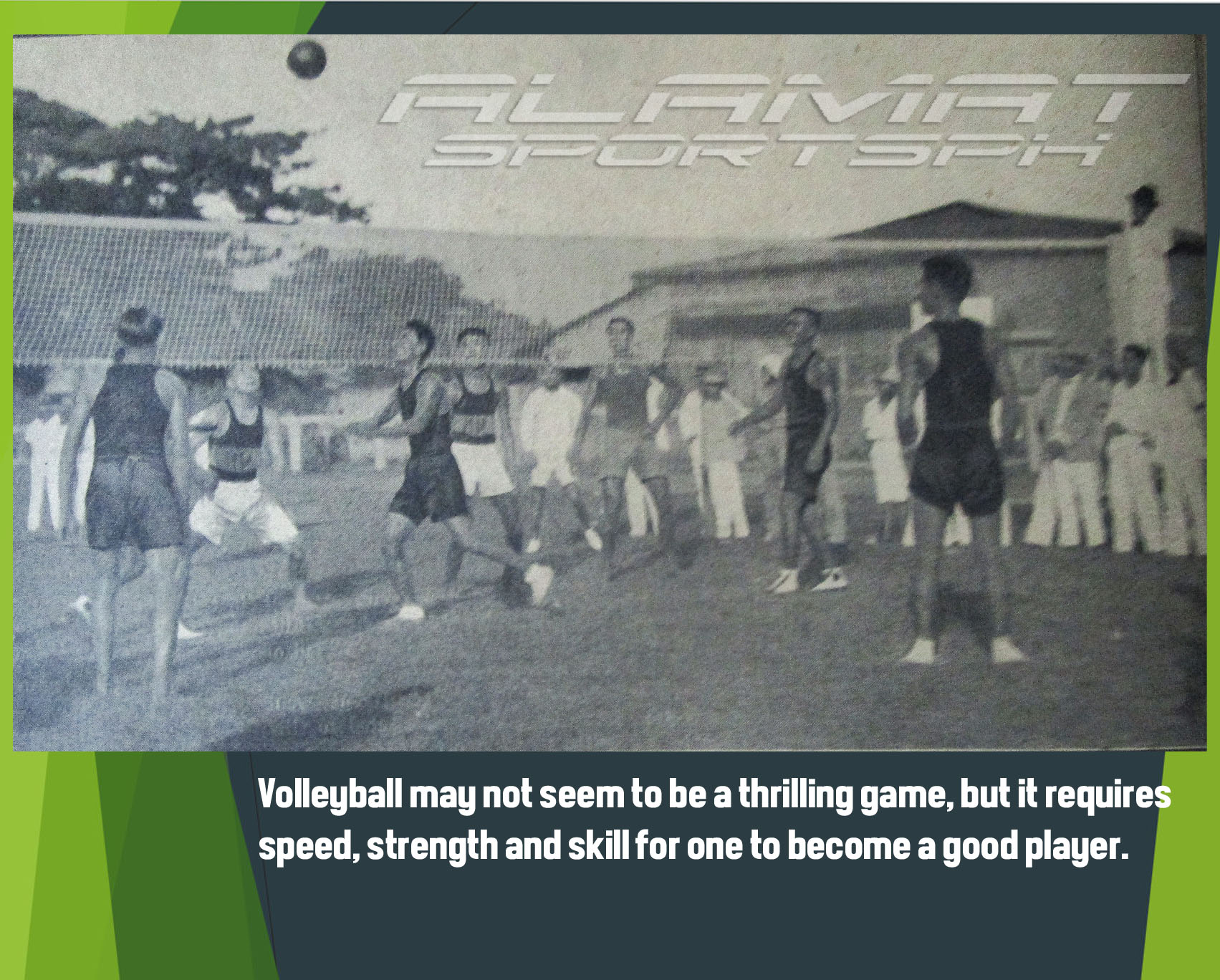
21. My Most Thrilling Game: AUREO AQUINO, Best Filipino Volleyball Player, Graphic Magazine, 20 Nov. 1929

Here is a reproduced article from Philippine Graphic Magazine, from Nov. 20, 1929, part of "My Most Thrilling Game", a series of sports features based on interviews with our most popular athletes of the 1920s generation.

AUREO AQUINO has been playing volleyball since he was in the fourth grade. From that time till and through his high school days, he captained every team with which he was connected and often led it to championship. It was not long before he began to attract attention and his fame went beyond boundaries of his native province, Laguna.

Finally, his brand of playing made such an impression on competetnt observers that he was asked to represent his country in the Far Eastern Olympics. This was in 1925, and the games were held in Manila.

“It was in the first game against China,” relates Mr. Aquino. “It was my first appearance on the field as an Olympic player and I was naturally excited. Added to this fact was the rumor that had reached us that the Chinese had a srong team.

“I remember very well that I was rather nervous as I donned my uniform in the dressing room. When went inot the court, my nervousness increased. I looked around and everywhere saw hundreds and hundreds of people—and most of them were Chinese.  They had come in a body to root for China’s team and although the games was played here at home, the Filipino fans were decidedly outnumbered.

“The first set found us disconcerted. The Chinese methods was so different from ours—from what were used to. You know, our way is this: there are three rows of players in a volleyball team—the netters, the killers, and the stoppers, in the order of their proximity to the net. When the ball comes across the net, it is slammed back in either of the following ways: if the netter gets ot, he tosses it up and a killer drives it back. If a killer or a stopper gets it, he passes it on to a netter for the toss.

“The Chinese did things differently. The netters did not “prepare “ the ball at a great height so that when it was killed, it came sizzling to us just barely above the net. Moreover, they could pass toss, and kill with remarkable swiftness.

“Naturally, at first, they had an easy time of it.But we soon pulled ourselves together and gave them a stiff fight. Their method of attack, after all. Had one disadvantage—their skills necessarily lacked maximum force. Morebover, we gradually became used to their way, so that in the end, we won the set.

“The second set found us more confident—the Chinese more team active. They revealed unexpected strength, played furiously, and despite all that we could do, and the fact that we were now wise to their ways, romped away with the second set—thus making necessary a third set…which would decide the winner.

“I can never forget that third set. Both contenders showed admirable teamwork, training and never-flagging energy. The sphere was simply murdered and see-sawed from side to side over the net. Killed, stopped, passed, tossed, and counter-killed—now with us, now with the Chinese. All were on their toes, giving the best in them to win the deciding set for his team.

“However, the greater speed and force of our kill could not but show results. My team-mates fought like anything. As for myself, being a high jumper, I had an advantage. They could toss the ball very high, and I would jump and slam it towards the Chinese with ease—well-timed, as strongly as I could, and at just the most telling angle.

“But the Chinese struggled gallantly to the end—and beyond. They gave us, as far as I am concerned at least, the fight of our lives, and indeed, had us in a tight fix at one time. With the set nearing its end, they forged ahead and soon piled up twenty points. Trailing behind, we played desperately and held them nailed to twenty, while we strive to overtake them.

Just as we were about to even the score, they shot a hot one into our territory, one of their low kills, which one of our netters fumbled and set back sailing awkwardly to the stoppers, one of whom had to deviate from our usual way—and tossed the ball. One of the killers had to slap the ball at a most dangerous angle. Everything really depended on that kill. Defeat was staring us in the face. One more point for the Chinese would be disastrous to the Filipinos. Every man in our team was tense. The ball soared. As it descended, one of our killers leaped into the air. Bang!! It went over to knot the score at 20-20.

“So we fought out a decision—with extra points. Both teams fought every inch of the way and never left the other more than two points behind. Several decisions had to be played—the score mounted to about 26 before the game ended—and even then, we won by a very slight margin only. But, that effort to bring the count to 20-20 was the most thrilling in my career as a volleyball player.”

SOURCE:

“My Most Thrilling Game” #2, by Aureo Aquino, Graphic Magazine, 20 November 1929, p. 6

20. DESIDERIA AMPON: The Filipina Tennis Trailblazer (active 1941-1971)

The most celebrated Filipina tennis player known for her long and successful career on the hard court is the multi-titled DESIDERIA “Desi” AMPON of Manila (b. 19 Sep. 1924). She was the daughter of Felix M. Ampon and Josefa R. Hermoso. At her peak, she was crowned the women’s singles  champion at the International Philippines Championships,  a record 11 times.

Desi Ampon truly was destined to be a tennis star; her father was a tennis pro and a coach. Her older brother, Felicisimo Ampon, reigned as the country’s No. 1 male tennis player of all times, who has made triumphant appearances at the Davis Cup, French Open, and in the Asian Games.

She started her career in local competitions at a time when the sport was being played by a handful of Filipinas. Minda Ochoa, one of the earliest female champions, helped popularize the sport but she retired in the late 30s. Even her return to the scene in 1950 failed to spark renewed interest in tennis.

Ampon began making waves in Philippine Tennis Association (PHILTA)-sanctioned matches and by 1941, she ranked 5th behind leader Liberty Solisa. Soon, sports watchers kept their eye on this other petite Ampon as her rise in rankings continued. She continued playing in city playgrounds like the Dapitan court, often practicing against her sister Petronila.

In 1950, she teamed up with Felicisimo to reach the finals of the Philippine tennis mixed doubles, defeating Sumant Misra-Mrs. Checkett, 6-2, 7-5. They finished as runner up to Spaniard Pedro Masip and the Argentinian Mary Weiss.

But Ampon’s full potential was still to be realized, and that came auspiciously in 1955, when she finally won her first National Title in the women’s singles. 1956 was again, another sterling year, winning 3 titles in that year's National Open Tennis Championships: Singles, Women's Doubles (with Lourdes Ang) and Mixed Doubles (with brother Felicisimo Ampon).

In the next 3 years, she would earn 2 more titles, capped by her representation of the Philippines in the 1958 Asian Games in Tokyo, Japan—the first time that Tennis became an official medal event.

Sixty tennis players from 15 nations contested the medals at the Games with  Japan winning 3 Golds , followed by the Philippines with 2, but with more medal finishes (10 medals vs. Japan’s 4). Desideria Ampon snagged the Silver in the Women’s Singles behind Japan’s Sachiko Kamo, and another Silver, in Women’s Doubles (with Patricia Yngayo), won by the Japanese tandem of Sachiko Kamo and Reiko Miyagi.

With brother Felicisimo Ampon, Desideria grabbed a Bronze medal in the Mixed Doubles, behind another Philippine team, Raymundo Deyro and Patricia Yngayo). In all, she came home with 3 medals—not bad at all for her Asian Games debut.

 As a prelude to the next 1962 Asian Games, she entered the 1961 Malaya Open Lawn Tennis Tournament in Kuala Lumpur. She was pitted against Japan’s national champion. Reiko Miyagi but lost out to place 2nd. But she came back strong in the Mixed Doubles, teaming up with brother Felicisimo to vanquish Japan’s Miyagi and Hitoshi Hiroshe 6-3, 9-7.

In Jakarta, she continued to achieve milestones by surpassing her previous Asian Games medal output, winning 4 Bronzes:  Women’s Singles (shared with Patricia Yngayo), Women’s Doubles (with Yngayo) , Women’s Team, and Women’s Mixed Doubles (with Miguel Dungo).

In her last Asian Games in Bangkok 1966, she added 2 medals to her collection: Silver, in Women’s Doubles (with Yngayo), and Bronze, Women’s Team. In all, she amassed 9 medals from 3 Asian Games, tying with Indonesian Yayuk Basuki, who achieved that number in 4 editions.

Meanwhile, her run as a Philippine champion continued unabated after 1958, as she captured the 1959, 1960, 1965, 1966, 1967, 1968, 1969, and 1971 national tennis crowns, as well—an unprecedented eleven titles in all.

There is very little we know of Desideria Ampon upon her retirement after 3 decades of tennis playing. But what we do remember is the important legacy she left behind, that paved the way for generations of Filipinas to take up the sport, and excel like her—the likes of Marissa Sanchez, Jennifer Saberon, Dyan Castillejo, Francesca La’O, and now, Alex Eala. the highest-ranked Filipino female singles player in WTA Tour history,

SOURCES:

PROGRESS REPORT Magazine, 1955 issue

“Malayan Singles Champion” MIRROR Magazine, 26 Aug. 1961, p. 31

Tennis Forum, https://www.tennisforum.com/threads/biographies-of-female-tennis-players.497314/page-267?post_id=81956633#post-81956633

19.Boxer FRISCO CONCEPCION, The Man Who Beat Pancho Villa

Pancho Villa was our first boxing world champion, and he would remain the only Filipino to hold a world title (achieved in 1923,  flyweight class), until 1960. But not many people know that Villa’s record was marred by one defeat—in the hands of fellow Filipino, FRISCO CONCEPCION (b. 21 Aug. 1901/d. ?), one-time flyweight champion of the Orient.

Born in San Felipe, Zambales to Lorenzo Concepcion and Enana Labrador, Frisco was a 16 year-old farm boy when American businessman Ed Gallaher took him under his wings and trained him in boxing, Before long, Frisco developed a knock-out punch that floored established boxers like Kid Jamito, Joe Suzara (from whom he wrested the Oriental flyweight crown in a 20-round fight)  and Pete Sarmiento, who went on to fight in the U.S.

In April 1921, the 20 year-old Frisco squared off with Pancho Villa in an 8-round contest in Olongapo, Zambales. Villa was then the reigning flyweight champion of Manila. Pancho’s manager, Paquito Villa, was against the fight as he felt there were more worthy contenders for his ward. Pancho Villa went on to fight Frisco without his manager’s knowledge, where he received a trouncing that he would rather forget.

Starting with Round 1, Frisco went for the attack immediately which took Pancho by surprise. The slugging continued in Round 2 , but Frisco’s effective counter-punching caused Pancho to miss his shots. Pancho recovered his bearing in Round 3, as he focused running his blows on Frisco’s body which visibly hurt him. In Round 4, Pancho shifted his assault on Frisco’s face, and managed to duck and avoid Frisco’s counter attacks. Pancho was relentless in Round 5, but Frisco fought back with sure counter-punches that threw his opponent off-balance.

It was the same story for Round 6:  lagging on points, Pancho unleashed blows on Frisco, who neutralized these with more effective counterpunches. The desperate Pancho tried to go for the kill with a knockout punch but his face and body was met with heavy punches from Frisco. The referee stepped in between the fighters to remind them of the last round.

The fighters shook hands and began Round 8 with Pancho attacking with body blows that were returned with head blows by Frisco. Pancho shifted his style to imitate Frisco, but by then it, was too late as the latter pummeled him with rapid jabs and punches to the face. When the bell sounded, it was clear who the winner was—Frisco Concepcion, with a score of 6 rounds to 2.

An eyewitness to that match was Gregorio Torres, a boxing trainer who observed Frisco’s fighting style: “Frisco’s punches were rapid and his deliveries were level. He was a terrific and aggressive counterpuncher. Frisco’s target was always the jaw of his opponent”.

Frisco, however, had to take a week’s rest to recover from the heavy body punches that he received from his opponent. As for Villa, he never fought Frisco again.

After Frisco retired from boxing, he became a photographer. His manager, Gallaher, had operated a portrait studio on the side, which influenced Frisco to make a career shift when his fighting days were over. Frisco Concepcion made photography his lifetime career until his retirement; however, without a doubt, his lifetime achievement will always be the day he conquered a world champion.

SOURCE:

“The Conqueror of Pancho Villa”, by Felix M. Caliwag, Sunday Times Magazine, 19 June 1960, pp. 18-19.

62. Hurdler Supreme of the 1950s: FRANCISCA SAÑOPAL

The best and most successful Filipina hurdler of the 50s decade , was without a doubt, the Ilongga all-around athlete FRANCISCA SAÑOPAL . ...